

A Special Rectangle: The square
A rectangle is a four-sided figure where all angles are \(90^{\circ}\) and opposite sides are equal. However, when we encounter a rectangle where all four sides are equal, it becomes a special type of rectangle known as a square.
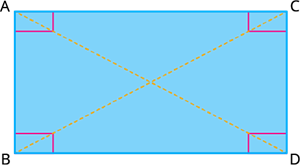
Consider the rectangle \(ABCD\) whose angles are \(90^{\circ}\) and \(AB \parallel CD\) and \(AC \parallel BD\). If \(AB = BD = CD = CA\) then \(ABCD\) is a square.
A square is a quadrilateral in which all four angles are equal to \(90^{\circ}\), and all four sides are of equal length.
Why is a square a special rectangle?
A square satisfies all properties of a rectangle.
- Four right angles (✓)
- Opposite sides are equal and parallel (✓)
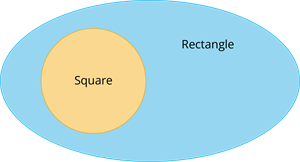
Every square meets the definition of a rectangle. Thus, every square is a rectangle, but not every rectangle is a square.
Carpenter's problem
The Carpenter's Problem helps us understand how to construct a square using its diagonals instead of its sides.
A carpenter has two wooden strips of equal length. A thread is passed through the four endpoints, forming the diagonals of a quadrilateral.
How should the carpenter arrange the diagonals so that the wooden strips form a perfect square?
Recall the rectangle:
From the carpenter's problem for a rectangle, we know that a quadrilateral becomes a rectangle when:
- The diagonals are equal in length.
- The diagonals bisect each other (meet at their midpoints).
What more is needed for a square?
A square has one extra property:
- All \(4\) sides are equal.
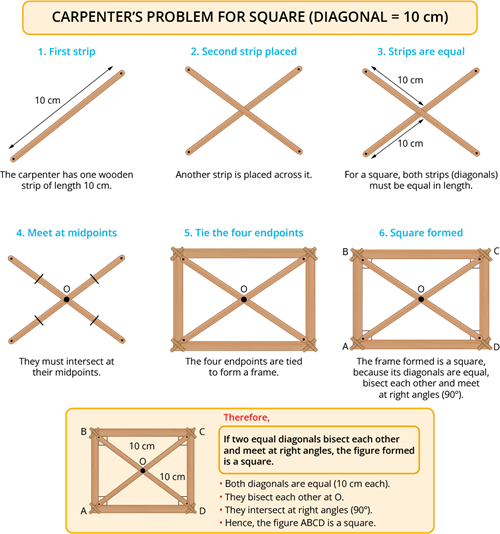
To make the rectangle into a square, the diagonals must also intersect at \(90^{\circ}\).
Deduction: Diagonals of a square intersect at \(90^{\circ}\).
Proof:
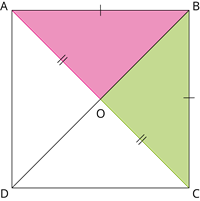
Consider the square \(ABCD\) and draw diagonal \(AC\).
Consider two triangles \(AOB\) and \(BOC\).
\(AO = OC\) [Diagonals bisect each other]
\(AB = BC\) [Sides of a square are equal]
\(BO = BO\) [Common side]
Thus, \(\triangle AOB \cong \triangle BOC\) [By SSS congruence rule]
Therefore, \(\angle AOB = \angle BOC\) ---- (\(1\)) [By CPCT]
We know that \(AOC\) is a straight line.
Then, \(\angle AOB + \angle BOC = 180^{\circ}\)
\(\angle AOB + \angle AOB = 180^{\circ}\)
\(2 \angle AOB = 180^{\circ}\)
\(\angle AOB = 90^{\circ}\)
Thus, \(\angle AOB = \angle BOC = 90^{\circ}\)
Properties of a Square
Property 1: All sides are equal.
Property 2: Opposite sides are parallel.
Property 3: All angles are \(90^{\circ}\).
Property 4: Diagonals are equal and bisect each other at \(90^{\circ}\).
Property 5: Diagonals bisect the angles of the square.
Angles in a Quadrilateral

Consider a quadrilateral \(ABDC\).
Cut the quadrilateral into two triangles by drawing one of its diagonals \(AD\).
From the figure, \(\angle 1 + \angle 2 = \angle A\) and \(\angle 3 + \angle 4 = \angle D\).
Applying angle sum property in \(\triangle ABD\), we have:
\(\angle BAD + \angle ABD + \angle ADB = 180^{\circ}\)
\(\angle 1 + \angle B + \angle 4 = 180^{\circ}\) ---- (\(1\))
Applying angle sum property in \(\triangle ACD\), we have:
\(\angle DAC + \angle ACD + \angle CDA = 180^{\circ}\)
`
\(\angle 2 + \angle C + \angle 3 = 180^{\circ}\) ---- (\(2\))
Adding equations (\(1\)) and (\(2\)), we get:
\(\angle 1 + \angle B + \angle 4 + \angle 2 + \angle C + \angle 3 = 180^{\circ} + 180^{\circ}\)
\((\angle 1 + \angle 2) + \angle B + \angle C + (\angle 3 + \angle 4) = 360^{\circ}\)
\(\angle A + \angle B + \angle C + \angle D = 360^{\circ}\)
Thus, the sum of all angles of a quadrilateral is \(360^{\circ}\).