

1. Quadrilateral
A quadrilateral is a four-sided figure.
-
It has \(4\) sides.
-
It has \(4\) vertices.
-
It has \(4\) angles.
-
The angles of a quadrilateral are the angles between its sides.
2. Rectangle
Definition
A rectangle is a quadrilateral in which all the angles are \(90°\).
Properties of a Rectangle
Remember these four important properties:
-
All angles are \(90°\).
-
Opposite sides are equal.
-
Opposite sides are parallel.
-
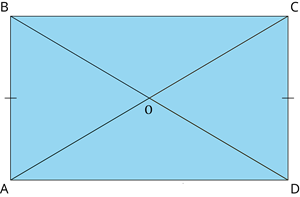
Diagonals are equal in length and bisect each other.
So, if the diagonals of a rectangle intersect at \(O\):
-
\(AC = BD\)
-
\(AO = OC\)
-
\(BO = OD\)
Important Rectangle Idea
A rectangle can also be described as a quadrilateral whose:
-
diagonals are equal, and
-
diagonals bisect each other.
Thus:
Equal diagonals + diagonals bisect each other → Rectangle
Also, if all four angles of a quadrilateral are \(90°\), its opposite sides are automatically equal. Therefore, it is a rectangle.
Construction Idea to Remember
To form a rectangle using its diagonals:
-
Draw two diagonals of equal length.
-
Make them bisect each other.
-
The angle between the diagonals can be different; it need not be \(90°\).
The resulting quadrilateral is a rectangle.
3. Square
Definition
A square is a quadrilateral in which:
-
all four angles are \(90°\), and
-
all four sides are equal.
Square as a Special Rectangle
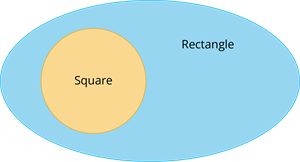
A square is a special type of rectangle.
Therefore:
Every square is a rectangle, but every rectangle is not a square.
Properties of a Square
Remember all five:
-
All four sides are equal.
-
Opposite sides are parallel.
-
All four angles are 90°.
-
Diagonals are equal and bisect each other at \(90°\).
-
Diagonals bisect the angles of the square.
Therefore, each angle of a square is divided into: \(45° + 45°\)
Diagonal Conditions for a Square
A quadrilateral will form a square when its diagonals:
-
are equal in length,
-
bisect each other, and
-
intersect at right angles (\(90°\)).
So remember:
Equal diagonals + bisect each other + perpendicular → Square
4. Rectangle vs Square – Quick Comparison
Remember
Square = Rectangle + all sides equal
But:
Rectangle ≠ necessarily a square
5. Angles in a Quadrilateral
Angle Sum Property
The sum of the four interior angles of any quadrilateral is \(360°\).
Why?
A diagonal divides a quadrilateral into two triangles.
Each triangle has an angle sum of \(180°\).
Therefore:
\(180° + 180° = 360°\)
Hence,
Sum of angles of a quadrilateral \(= 360°\)
Finding a Missing Angle
If three angles of a quadrilateral are known:
Missing angle \(= 360° −\) sum of the three known angles
Important Result
A quadrilateral cannot have three right angles and a fourth angle that is not \(90°\).
If three angles are \(90°\):
\(90° + 90° + 90° = 270°\)
Therefore, the fourth angle must be:
\(360° - 270° = 90°\)
So, a quadrilateral with three right angles automatically has four right angles and is therefore a rectangle.