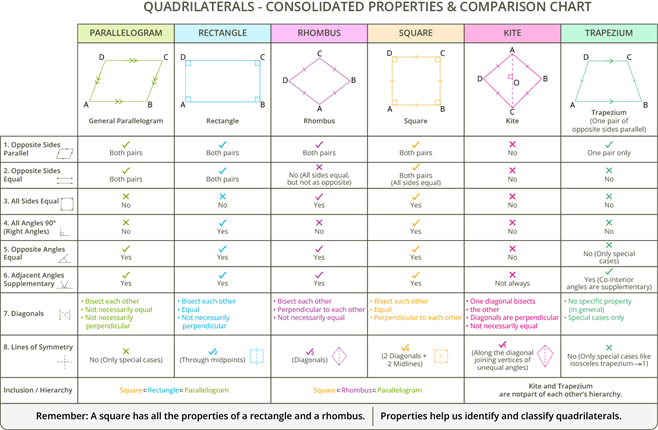
1. Parallelogram
Definition
A parallelogram is a quadrilateral in which opposite sides are parallel.
Properties of a Parallelogram
Remember these important properties:
-
Opposite sides are parallel.
-
Opposite sides are equal.
-
Adjacent angles add up to 180°.
-
Opposite angles are equal.
-
Diagonals bisect each other.
Angle Property
If one angle is known:
-
The opposite angle is equal to it.
-
Each adjacent angle is supplementary to it.
Therefore:
Adjacent angles = 180°
Opposite angles = equal
Diagonal Property
The diagonals of a parallelogram bisect each other.
If diagonals AC and BD intersect at O:
-
AO = OC
-
BO = OD

Important Relationship
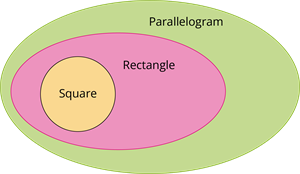
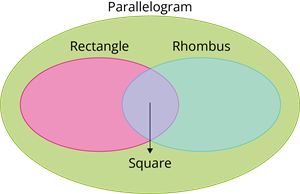
A rectangle is a special type of parallelogram because its opposite sides are parallel.
A square is also a special type of parallelogram.
So:
Square ⟶ Rectangle ⟶ Parallelogram
Every square is a rectangle and every rectangle is a parallelogram.
But the reverse is not necessarily true.
2. Rhombus
Definition
A rhombus is a quadrilateral in which all four sides have the same length.
Properties of a Rhombus
Remember these four properties:
-
All four sides are equal.
-
Opposite sides are parallel.
-
Adjacent angles add up to 180° and opposite angles are equal.
-
Diagonals bisect each other at right angles.
-
Diagonals bisect the angles of the rhombus.
Diagonal Properties
The diagonals of a rhombus:
-
Bisect each other.
-
Intersect at 90°.
-
Bisect the angles of the rhombus.
So, if diagonals intersect at O:
-
Each diagonal divides the other into two equal parts.
-
The angle formed at their intersection is 90°.
Important Relationship
A square is a special type of rhombus because all four sides of a square are equal.
Also:
Square ⟶ Rhombus
But every rhombus is not necessarily a square.
3. Kite
Definition
A kite is a quadrilateral with two non-overlapping adjacent pairs of sides having the same length.
In other words, the equal sides occur in adjacent pairs.
For example:
-
One pair of adjacent sides is equal.
-
The other pair of adjacent sides is also equal.
Important Properties of a Kite
The key diagonal properties are:
-
One diagonal bisects the other diagonal.
-
One diagonal bisects a pair of opposite angles.
-
The diagonals are perpendicular to each other.
Remember
A kite does not have to have all four sides equal.
Therefore:
Every rhombus is a kite, but every kite is not a rhombus.
A rhombus has all four sides equal, whereas a general kite has two pairs of adjacent equal sides.
4. Trapezium
Definition
A trapezium is a quadrilateral having at least one pair of parallel opposite sides.
The parallel sides are called the parallel sides or bases.
The other two sides are the non-parallel sides.
Isosceles Trapezium
An isosceles trapezium is a trapezium in which the non-parallel sides are equal.
Properties of an Isosceles Trapezium
-
The non-parallel sides are equal.
-
The angles at each base are equal.
Therefore:
-
One pair of opposite angles is equal.
-
The other pair of opposite angles is also equal.
Angle Idea
Since the parallel sides are parallel, the interior angles on the same side of a non-parallel side are supplementary.
So the relevant pairs of angles add up to: 180°