

Further applications of Baudhāyana-Pythagoras theorem
The Baudhāyana-Pythagoras theorem is a fundamental result in geometry. It relates the three sides of a right-angled triangle and can solve many practical and geometric problems.
If the shorter sides of a right triangle have lengths \(a\) and \(b\), and the hypotenuse has length \(c\), then \(a^2 + b^2 = c^2\).
This theorem applies to squares, rectangles, rhombuses, distances, and other geometric situations.
Standard uses
- Finding the hypotenuse when both shorter sides are known: \(c = \sqrt{(a² + b²)}\).
- Finding a missing shorter side: \(a² = c² − b²\), so \(a = \sqrt{(c² − b²)}\).
- Diagonal of a square with side \(a\): \(c² = 2a²\), so \(c = a\sqrt{2}\).
- Word problems where the first step is to identify or construct a right triangle.
Problem-solving strategy
- Read the problem and draw a diagram.
- Spot (or make) a right triangle.
- Mark the known lengths and name the unknown one \(x\).
- Write the equation \(a² + b² = c²\).
- Solve for \(x\) and state the answer with units.
A Problem from Bhāskarāchārya’s Līlāvatī
Bhāskarāchārya (Bhāskara II) was an Indian mathematician. His book Līlāvatī contains many problems that can be solved using this theorem.
The problem
A lotus flower grows in a lake. The tip of its stem is \(1\) unit above the water. When a gentle breeze pushes the lotus, the tip of the stem touches the water at a point \(3\) units from its original position. Find the depth of the lake.
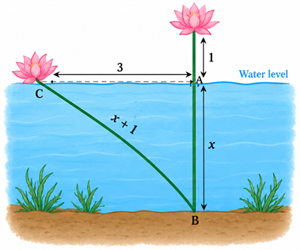
At first, the problem appears to give insufficient information. However, we can represent the situation using a right-angled triangle.
Let \(x\) denote the depth of the lake.
Since the lotus stem extends \(1\) unit above the water, its total length is \(x + 1\).
When the stem bends, the original vertical position, the new position of the tip, and the point where the stem touches the water form a right triangle.
Therefore, the three sides of the triangle are:
One side \(= x\)
Another side \(= 3\)
Hypotenuse \(= x + 1\)
Applying Baudhāyana-Pythagoras theorem, we have:
\(BC^2 = AB^2 + AC^2\)
\((x + 1)^2 = x^2 + 3^2\)
\(x^2 + 2x + 1 = x^2 + 9\)
\(2x + 1 = 9\)
\(2x = 9 - 1\)
\(2x = 8\)
\(x = \frac{8}{2}\)
\(x = 4\) units
Therefore, the depth of the lake is \(4\) units.