

1. A long-standing open problem
We have seen that there are infinitely many Baudhāyana triples - triples of positive integers \((a, b, c)\) satisfying \(a^2 + b^2 = c^2\).
For example, \(3^2 + 4^2 = 5^2\).
Many such triples exist, and new ones can be generated in different ways. This led mathematicians to ask whether similar patterns could occur for higher powers.
Fermat's question
The French mathematician Pierre de Fermat, in the \(17\)th century, wondered whether an equation of the form \(x^n + y^n = z^n\) could have a solution in positive integers when \(n > 2\).
For \(n = 2\), such solutions certainly exist. For example, \(3^2 + 4^2 = 5^2\).
But Fermat claimed that when the power is greater than \(2\), no such positive-integer solutions exist.
Fermat’s Last Theorem
This statement became known as Fermat’s Last Theorem:
The equation \(x^n + y^n = z^n\) has no solution in positive integers when \(n > 2\).
Fermat famously wrote that he had found a remarkable proof, but that the margin of his book was too small to contain it. However, no one ever found the proof.
For more than \(300\) years, mathematicians attempted to prove the theorem. Eventually, Andrew Wiles proved Fermat’s Last Theorem in \(1994\).
Comparing two equations
| Power | Equation | Example |
|---|---|---|
| \(n = 2\) | \(x^2 + y^2 = z^2\) | \(3^2 + 4^2 = 5^2\) |
| \(n > 2\) | \(x^n + y^n = z^n\) | No positive-integer solution |
Thus, the study of right triangles and Baudhāyana triples leads naturally to an important question about powers of numbers.
2. Further Applications of the Baudhāyana-Pythagoras Theorem
The Baudhāyana-Pythagoras theorem is a fundamental result in geometry. It relates the three sides of a right-angled triangle and can solve many practical and geometric problems.
If the shorter sides of a right triangle have lengths \(a\) and \(b\), and the hypotenuse has length \(c\), then \(a^2 + b^2 = c^2\).
This theorem applies to squares, rectangles, rhombuses, distances, and other geometric situations.
Standard uses
- Finding the hypotenuse when both shorter sides are known: \(c = \sqrt{(a² + b²)}\).
- Finding a missing shorter side: \(a² = c² − b²\), so \(a = \sqrt{(c² − b²)}\).
- Diagonal of a square with side \(a\): \(c² = 2a²\), so \(c = a\sqrt{2}\).
- Word problems where the first step is to identify or construct a right triangle.
Problem-solving strategy
- Read the problem and draw a diagram.
- Spot (or make) a right triangle.
- Mark the known lengths and name the unknown one \(x\).
- Write the equation \(a² + b² = c²\).
- Solve for \(x\) and state the answer with units.
A Problem from Bhāskarāchārya’s Līlāvatī
Bhāskarāchārya (Bhāskara II) was an Indian mathematician. His book Līlāvatī contains many problems that can be solved using this theorem.
The problem
A lotus flower grows in a lake. The tip of its stem is \(1\) unit above the water. When a gentle breeze pushes the lotus, the tip of the stem touches the water at a point \(3\) units from its original position. Find the depth of the lake.
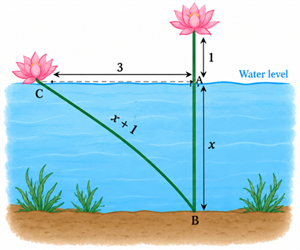
At first, the problem appears to give insufficient information. However, we can represent the situation using a right-angled triangle.
Let \(x\) denote the depth of the lake.
Since the lotus stem extends \(1\) unit above the water, its total length is \(x + 1\).
When the stem bends, the original vertical position, the new position of the tip, and the point where the stem touches the water form a right triangle.
Therefore, the three sides of the triangle are:
One side \(= x\)
Another side \(= 3\)
Hypotenuse \(= x + 1\)
Applying Baudhāyana-Pythagoras theorem, we have:
\(BC^2 = AB^2 + AC^2\)
\((x + 1)^2 = x^2 + 3^2\)
\(x^2 + 2x + 1 = x^2 + 9\)
\(2x + 1 = 9\)
\(2x = 9 - 1\)
\(2x = 8\)
\(x = \frac{8}{2}\)
\(x = 4\) units
Therefore, the depth of the lake is \(4\) units.