

1. Combining two different squares
We have already seen that two identical squares can be combined to form a larger square whose area is equal to the sum of the areas of the two smaller squares.
If each smaller square has side length \(a\), then:
Therefore, Total area \(= a^2 + a^2 = 2a^2\)
The side of the larger square is the diagonal of either smaller square.
What if the two squares are different?
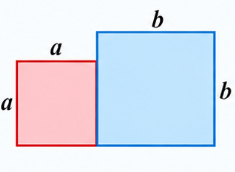
Suppose we have two squares of different sizes:
- Smaller square has side length \(a\).
- The larger square has side length \(b\), where \(b > a\).
Their areas are \(a^2\) and \(b^2\).
We want to construct a square with area \(a^2 + b^2\).
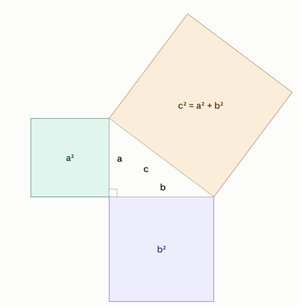
Baudhāyana gave a method for doing exactly this in Verse 1.12 of the Śulba-Sūtra. He wrote as follows:
The area of the square produced by the diagonal is the sum of the areas of the squares produced by the two sides.
In simple words, if two different squares have side lengths \(a\) and \(b\), construct a right-angled triangle whose perpendicular sides are \(a\) and \(b\). The square constructed on its hypotenuse will have an area equal to the sum of the areas of the two given squares.
Construction:
Let the side lengths of the two given squares be \(a\) and \(b\).
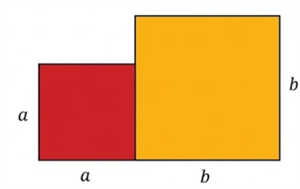
Step 1: Join the two squares.
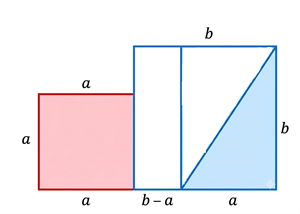
Step 2: Use a side of the smaller square to mark a rectangular portion of the larger square. Draw the diagonal of this rectangle. The diagonal divides the rectangle into a right-angled triangle whose perpendicular sides are \(a\) and \(b\).
Step 3: The diagonal is the hypotenuse of the right triangle. Let the diagonal be \(c\).
Step 4: Construct a square on the hypotenuse by drawing three more such triangles.
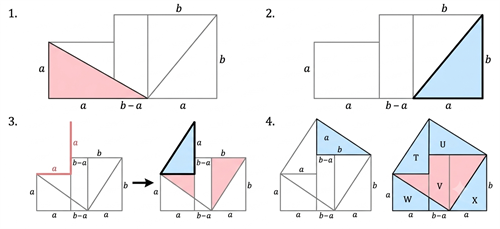
Thus, \((T + U + V)\) is a square with an area equal to the sum of the squares of the two squares of side length \(a\) and \(b\).
Why does the construction work?
A four-sided figure is a square when all its sides are equal, and all its angles are right angles.
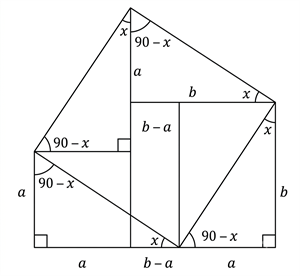
Equal sides:
- \(W\), \(X\), \(T\) and \(U\) are all congruent right triangles, with legs \(a\) and \(b\).
- The sides of the new figure are their hypotenuses.
- So all four sides have the same length \(c\).
Right angles:
- In each right triangle, the two acute angles are \(x\) and \(90° − x\), since angles in a triangle add to \(180°\).
- At each corner of the new figure, three angles lie along a straight line: \(x\), the corner angle, and \(90° − x\).
- A straight line measures \(180°\), so the corner angle \(= 180° − x − (90° − x) = 90°\).
- All four angles are right angles, so the figure is a square with side length \(c\).
Why do the areas add up?
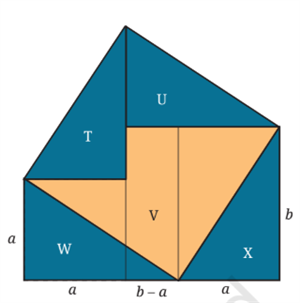
The same pieces make both shapes, so the areas must match:
- Area of the square on the hypotenuse \(= T + U + V\)
- \(T ≅ W\) and \(U ≅ X\) (congruent, so equal areas), so \(T + U + V = W + X + V\)
- \(W + X + V\) is exactly the original two joined squares, which is \(a^2 + b^2\).
Therefore \(c^2 = a^2 + b^2\), which confirms Baudhāyana's assertion.
Sanity check with equal squares \((a = b)\): the formula gives \(c^2 = a^2 + a^2 = 2a^2\). This agrees with the relation between the hypotenuse of the isosceles right triangle and the hypotenuse, where the diagonal square has double the area.
Combining two squares using paper
Step 1: Take two square pieces of paper of different sizes. Small square(side \(a\)) and large square (side \(b\)); sharing a base line.
Step 2: Split the paper into sizes \(a\), \(b - a\), \(a\). Cut the paper into three pieces such that the hypotenuse is \(c\).
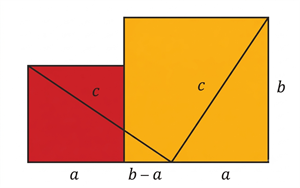
Step 3: Rearrange the pieces to form a larger square.
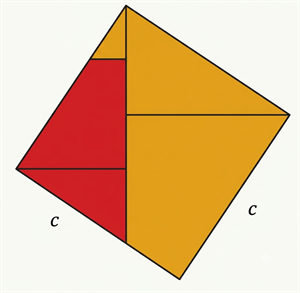
Step 4: Place squares \(a\) and \(b\) at a corner, draw a square on the hypotenuse \(c\).
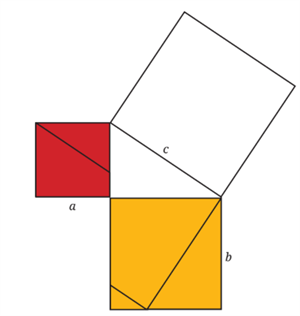
Step 5: Cover the hypotenuse square. The same \(3\) pieces exactly fill the square on \(c\).
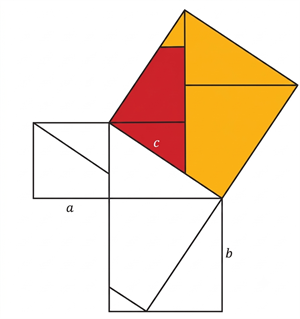
Since the pieces came from the two original squares, their total area has not changed. Thus, \(c^2 = a^2 + b^2\)
So the new square has an area equal to the sum of the areas of the two original squares.
2. Baudhāyana's theorem on right-angled triangles
If a right-angled triangle has side lengths a, b and c, where c is the hypotenuse, then \(a^2 + b^2 = c^2\)
Key facts:
- The hypotenuse is the side opposite the right angle. It is the longest side.
- The theorem applies only to right-angled triangles.
- Baudhāyana stated it in essentially modern form around \(800\) BCE. Pythagoras (c. \(500\) BCE) came a couple of hundred years later, so it is also called the Pythagorean Theorem, or the Baudhāyana-Pythagoras Theorem.
Find the hypotenuse of the right-angled triangle whose shorter side lengths are \(6 \ cm\), and \(8 \ cm\).
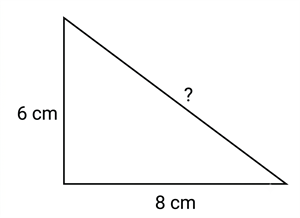
Solution:
Let \(a = 6 \ cm\) and \(b = 8 \ cm\). Let \(c\) be the hypotenuse; then by Baudhāyana - Pythagoras theorem, we have:
\(c^2 = a^2 + b^2\)
\(= 6^2 + 8^2\)
\(= 36 + 64\)
\(= 100\)
\(c = \sqrt{100}\)
\(c = 10 \ cm\)
Therefore, the hypotenuse of the right-angled triangle is \(10 \ cm\).