

1. Hypotenuse of an isosceles right triangle
The side opposite to the right angle of a triangle is called the hypotenuse.
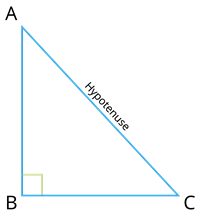
Let us consider an isosceles right triangle with side length \(1 \ \text{unit}\). Let us find the length of the hypotenuse of the isosceles right triangle.
We know that two such isosceles right triangles joined can form a square of side \(1 \ \text{unit}\).
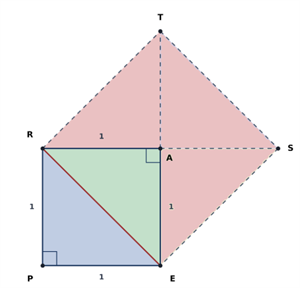
Area of the square \(PEAR = 1 \times 1 = 1 \ \text{sq. units}\)
The diagonal of this square is the hypotenuse of the isosceles right triangle.
When a square is constructed on this diagonal, its area is twice the area of the original square.
Thus, Area of the new square \(REST = 2 \times\) Area of \(PEAR\)
\(= 2 \times 1 = 2 \ \text{sq. units}\) ---- (\(1\))
If the hypotenuse \(ER = c\), then the area of the square constructed on the hypotenuse is given by:
Area of square \(REST = c \times c = c^2\)
\(2 = c^2\) [Using (\(1\))]
\(c = \sqrt{2}\)
Thus, the hypotenuse of the right isosceles triangle is \(\sqrt{2}\).
General relation:
Let the two equal sides of an isosceles right triangle each have length \(a\), and let the hypotenuse have length \(c\).
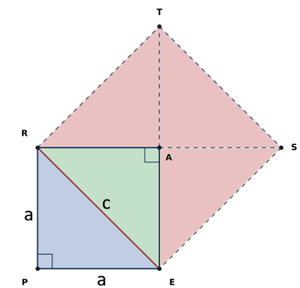
The square on the hypotenuse has an area equal to the sum of the areas of the squares on the two equal sides:
\(c^2 = 2a^2\)
\(c = a \sqrt{2}\)
This relation can be used both to find the hypotenuse when the equal sides are known and to find the equal sides when the hypotenuse is known.
Example:
If the equal sides of an isosceles right triangle are \(8 \ cm\), then find its hypotenuse.
Solution:
If side length, \(a = 8 \ cm\) and hypotenuse \(= c\), then we know the relation:
\(c^2 = 2a^2\)
\(c^2 = 2 \times (8)^2\)
\(c^2 = 2 \times 64\)
\(c^2 = 128\)
\(c = \sqrt{128}\)
We know that \(11^2 = 121\) and \(12^2 = 144\).
Thus, \(\sqrt{128}\) lies between \(11\) and \(12\).
Therefore, the length of the hypotenuse is between \(11 \ cm\) and \(12 \ cm\).
2. Decimal representation of \(\sqrt{2}\)
We know that \(\sqrt{2}\) is the length of the hypotenuse when the equal sides of an isosceles right triangle are \(1 \ \text{unit}\).
We can estimate its value by finding numbers whose squares are close to \(2\).
We know that \(1^2 = 1\) and \(2^2 = 4\).
Thus, \(1 < \sqrt{2} < 2\)
Here, \(1\) is the lower bound and \(2\) is the upper bound.
Similarly, let us consider \(1.4\) and \(1.5\).
\(1.4^2 = 1.96\) and \(1.5^2 = 2.25\)
Thus, \(1.4 < \sqrt{2} < 1.5\)
Now, let us consider \(1.41\) and \(1.42\).
We know that \(1.41^2 = 1.9881\) and \(1.42^2 = 2.0164\)
Thus, \(1.41 < \sqrt{2} < 1.42\)
Going one step further \(1.414^2 = 1.999396\) and \(1.415^2 = 2.002225\)
Thus, \(1.414 < \sqrt{2} < 1.415\)
This process can be continued indefinitely, giving \(\sqrt{2} = 1.414213.....\)
If \(\sqrt{2}\) had a terminating decimal ending in a non-zero digit, then squaring it would produce a decimal number also ending in a specific non-zero digit pattern, never resulting in exactly \(2.000....\). So \(\sqrt{2}\)'s decimal expansion must go on forever. Thus, \(\sqrt{2}\) is a non-terminating decimal.
Why is \(\sqrt{2}\) is not a fraction?
Suppose \(\sqrt{2}\) can be written as a fraction \(\frac{x}{y}\) where \(x\) and \(y\) are counting numbers.
That is, \(\sqrt{2} = \frac{x}{y}\)
Squaring on both sides, we have:
\(2 = \frac{x^2}{y^2}\)
\(2y^2 = x^2\)
In the prime factorisation of a square number, every prime occurs an even number of times. But in \(2y^2\), the prime factor \(2\) occurs an odd number of times, whereas in \(x^2\) every prime occurs an even number of times. This is impossible.
Therefore, \(\sqrt{2}\) cannot be expressed as a fraction \(\frac{x}{y}\).
Hence, \(\sqrt{2}\) cannot be expressed as a terminating decimal or a fraction. Thus, \(\sqrt{2}\) is a non-terminating decimal.