

1. Doubling a square
Given a square, how do you construct a new square whose area is exactly double?
The obvious first attempt is to double the side length. But doubling the side does not double the area. It quadruples it, since area scales with the square of the side length.
Example: Consider a square of side length \(1 \ cm\). Let us try to double the area of the square using its side length.
Solution:
Area of the square \(= 1 \times 1 = 1 \ cm^2\)
Doubling the side length of the square \(= 1 \times 2 = 2 \ cm\)
Area of the new square \(= 2 \times 2 = 4 \ cm^2\)
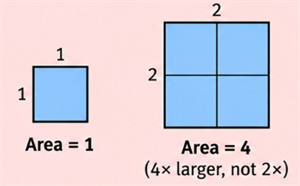
Doubling the side length gives 4 times the area, not double. That is, the square splits into 4 copies of the original.
Baudhāyana's Method (Verse 1.9)
"The diagonal of a square produces a square of double the area of the original square."
Build a new square on the diagonal of the given square. Its area is exactly double; no measuring required.
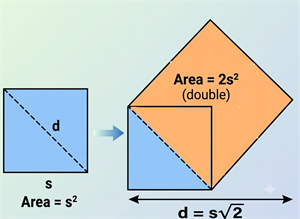
Why does this construction work?
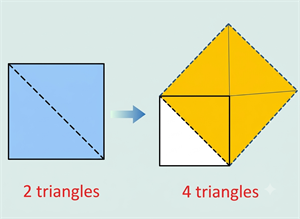
- The original square has \(2\) small triangles.
- The new square(tilted) has \(4\) small triangles, and all of them are congruent.
This implies that the area of the new square \(= 2 \times\) Area of the original square.
Thus, the new square is exactly double the area of the original square.
Important!
Each square in the sequence has double the area of the one before it.
Doubling a square using paper
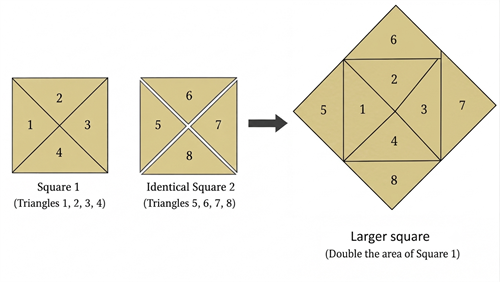
Take \(2\) identical squares. Cut Square \(1\) into \(4\) congruent small triangles and name them as \(1\), \(2\), \(3\) and \(4\). Similarly, cut square \(2\) into \(4\) congruent small triangles and name them as \(5\), \(6\), \(7\) and \(8\). Now, place the triangles \(5\), \(6\), \(7\) and \(8\) around square \(1\) to form a larger square with double the area.
2. Halving the square
Let us construct a square that is half the area of the original square.
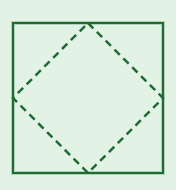
Join the midpoints of the four sides of the given square. The tilted inner square formed has exactly half the area of the outer square.
Important!
A square with half the side length does not have half the area; it has only one-quarter. It would take \(4\) such small squares, not \(2\), to tile the original.
Why the inner square is half?
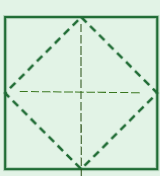
1. The diagonals of the square meet at the centre of the square and split it into \(8\) congruent triangles.
2. Outer square \(=\) All \(8\) triangles.
3. Inner square \(= 4\) of those triangles.
4. \(4\) out of \(8\) triangles is exactly half.
Why can't we simply halve the side?
If the side length of a square is halved, its area is not halved.
For example: If the side of a square is \(2 \ cm\), then
If its side is halved to \(1 \ cm\), then
So the new area is one-fourth of the original area, not one-half.
Thus, Area of new square \(= \frac{1}{4} \times\) Area of the original square.
Halving a square using paper:
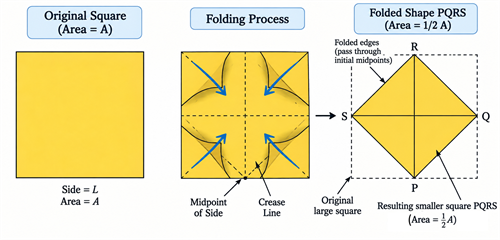
Why \(PQRS\) is a square?
- Join \(QS\) and \(PR\). These are the fold/crease lines.
- At each midpoint, the two half-sides meeting there are equal, and the angle between them is \(90°\) (inherited from the original square's corner).
- This makes the four corner triangles congruent (SAS), so \(PQRS\) has four equal sides. Each triangle in \(PQRS\) is congruent.
- The angles of \(PQRS\) are each \(90°\), since they're formed by two of these congruent right triangles meeting along a straight side.
- Equal sides \(+\) right angles \(\Rightarrow PQRS\) is a square, with area \(=\) half the original.