

Patterns in Mathematics
Patterns are repeated arrangements or regularities or relationships among numbers, shapes, or operations.
Patterns help us to predict, generalize, and understand how numbers and shapes behave.
Patterns can occur in the following:
- Numbers
- Shapes (such as a growing square or triangle design)
- Algebraic expressions
- Everyday situations, such as the arrangement of tiles, bricks, or stair steps,etc.,
By studying patterns, we begin to see connections that allow problem-solving to be both faster and deeper.
Investigating a pattern:
To investigate a pattern means looking for how something changes or grows and trying to find a rule or formula that describes it.
This process involves the following:
This process involves the following:
1: Observing the arrangement or sequence carefully.
2: Recording your observations, the first few terms, differences, or shapes that you see.
2: Recording your observations, the first few terms, differences, or shapes that you see.
3: Predicting what might come next.
4: Formulating a general rule using variables to describe the pattern.
5: Testing the general rule with new terms to see if it always works.
4: Formulating a general rule using variables to describe the pattern.
5: Testing the general rule with new terms to see if it always works.
There are often several ways to observe and interpret a pattern in mathematics. Approaching a problem with different perspective encourages creative and imaginative thinking.
Example:
Consider the following pattern:
\( \begin{matrix}
{\color{Yellow}\Delta } & {\color{Yellow} \Delta \color{Yellow} \Delta \color{Yellow} \Delta} & {\color{Yellow} \Delta \color{Yellow} \Delta \color{Yellow} \Delta \color{Yellow} \Delta \color{Yellow} \Delta \color{Yellow} \Delta} & {\color{Yellow} \Delta \color{Yellow} \Delta \color{Yellow} \Delta \color{Yellow} \Delta \color{Yellow} \Delta \color{Yellow} \Delta \color{Yellow} \Delta \color{Yellow} \Delta \color{Yellow} \Delta \color{Yellow} \Delta} & ... \\ & & & & \\
\text{Step 1} & \text{Step 2 } & \text{Step 3} & \text{Step 4} & ... \\
\end{matrix}\)
{\color{Yellow}\Delta } & {\color{Yellow} \Delta \color{Yellow} \Delta \color{Yellow} \Delta} & {\color{Yellow} \Delta \color{Yellow} \Delta \color{Yellow} \Delta \color{Yellow} \Delta \color{Yellow} \Delta \color{Yellow} \Delta} & {\color{Yellow} \Delta \color{Yellow} \Delta \color{Yellow} \Delta \color{Yellow} \Delta \color{Yellow} \Delta \color{Yellow} \Delta \color{Yellow} \Delta \color{Yellow} \Delta \color{Yellow} \Delta \color{Yellow} \Delta} & ... \\ & & & & \\
\text{Step 1} & \text{Step 2 } & \text{Step 3} & \text{Step 4} & ... \\
\end{matrix}\)
Observe the pattern and describe a general rule for it.
Explanation:
Step - 1: The number of triangles is \(1\).
\(\Rightarrow\) \(\frac{1 \times 2}{2}\) \(=\) \(\frac{2}{2} = 1\)
Step - 2: The number of triangles is \(3\).
That is, \(1 + 2 =3\).
\(\Rightarrow\) \(\frac{2 \times 3}{2}\) \(=\) \(\frac{6}{2} = 3\)
Step - 3: The number of triangles is \(6\).
That is, \(3 + 3 = 6\).
\(\Rightarrow\) \(\frac{3 \times 4}{2}\) \(=\) \(\frac{12}{2} = 6\)
Step - 4: The number of triangles is \(10\).
That is, \(6 + 4 = 10\).
\(\Rightarrow\) \(\frac{4 \times 5}{2}\) \(=\) \(\frac{20}{2} = 10\)
Observe that, the numbers \(2, 3, 4,...\) are consecutively added in order, to the previous step.
This above pattern can be algebarically expresses as \(\frac{n(n+1)}{2}\).
Therefore, the general rule for the given pattern is \(\frac{n(n+1)}{2}\).
Important!
The example pattern given here can be solved using different algebraic expression.
Multiple methods to solve a geometric algebra problem:
In mathematics, diagrams and figures often permit multiple interpretations of the same region or shape. This means that a single problem can be solved through multiple valid methods. Such an approach helps us derive a relation between geometric shapes and algebraic expressions.
Solving geometric problems algebraically enables us to understand algebraic identities rather than just memorizing them. If an expression is visualized as an area or a combination of shapes, the algebra becomes more easier and intuitive.
What does "multiple methods" mean?
The concept of "multiple methods" involves the ability to interpret one diagram in two or more ways, yet arrive at the same area or value using different strategies.For example, when considering a diagram, we might think of the solution in more than one way:
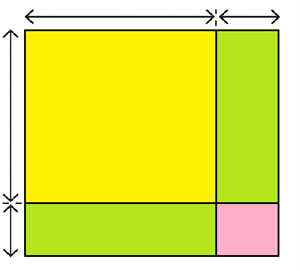
Method 1:
Calculate the required area by taking into consideration the total area of a big square by adding or subtracting its parts.
Calculate the required area by taking into consideration the total area of a big square by adding or subtracting its parts.
Method 2:
Find the area by directly recognizing the shape of the region and calculating it as a single geometric figure.
Find the area by directly recognizing the shape of the region and calculating it as a single geometric figure.
Both approaches must give the same answer, because they represent the same region.
What does this lead to?
Equating the expressions we obtained using the two methods, we naturally come up with well-known algebraic identities like:\((a+b)^2\) \(=\) \(a^2+2ab+b^2\)
\((a−b)^2 = a^2 −2ab + b^2\)
These identities become much easier to understand when they are viewed visually.
Important!
- A single geometric figure can be interpreted in more than one way, and each method produces the same result.
- This approach helps us derive and understand algebraic expressions and identities geometrically.