

1. Some properties of multiplication
Increments in products - How do products change?
When we multiply two numbers and change one or both of them slightly, the product changes in a predictable way. We can work this out using the distributive property.
Distributive Property (basic form):
For any three numbers \(a\), \(b\), \(c\):
\(a(b + c) = ab + ac\)
This can be visualised as the area of a rectangle: a rectangle of length(\(b + c\)) and breadth a has the same total area as two rectangles of breadths \(b\) and \(c\) (both with length \(a\)) placed side by side.
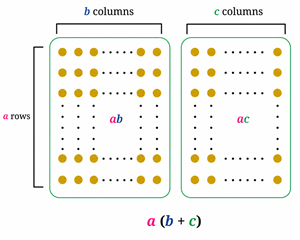
Similarly:
\((a+b)c = ac + bc\)
Case 1: One number increased by 1.
If \(b\) becomes \(b + 1\) (keeping \(a\) fixed):
\(a(b+1) = ab + a\)
So the product increases by \(a\).
Case 2: Both numbers increased by 1.
If \(a\) becomes \(a + 1\) and \(b\) becomes \(b + 1\):
\((a+1)(b+1) = ab + a + b + 1\)
So the product increases by \(a + b + 1\).
Case 3: One increased, one decreased by 1.
If \(a\) becomes \(a + 1\) and \(b\) becomes \(b – 1\):
\((a+1)(b−1) = ab + b − a − 1\)
So the product increases by \(b - a - 1\) (this can be positive, negative, or zero — the product doesn't always increase).
These results also hold when \(a\) and \(b\) are negative integers, since integers also obey the distributive property.
General Rule - Identity 1
Suppose the original numbers are \(a\) and \(b\). If \(a\) is increased by \(m\) and \(b\) is increased by \(n\), the new product is \((a+m)(b+n)\)
Using the distributive property,
\((a + m)(b + n) = ab + mb + an + mn\)
The increase in the product is \(an + bm + mn\).
This single identity covers all the cases above, including decreases. A decrease is simply treated as adding a negative value. For example, \((a + 1)(b – 1)\) is obtained from Identity 1 by putting \(m = 1, n = –1\).
More generally, for the product \(ab\), consider \(m = u\) and \(n = v\):
- \((a + u)(b − v) = ab + ub − av − uv\)
- \((a − u)(b + v) = ab − ub + av − uv\)
- \((a − u)(b − v) = ab − ub − av + uv\)
Key idea: The signs of each term in the expansion follow the usual rules of integer multiplication (positive \(\times\) positive \(=\) positive, positive \(\times\) negative \(=\) negative, etc.)
Identities
Mathematical statements that show two algebraic expressions are equal for all values of the letter-numbers involved (e.g. \(x(y - 2) = xy - 2x\)) are called identities.
Multiplying Two Expressions:
Sometimes both groups have brackets. In such a case, every term in the first bracket must be multiplied by every term in the second bracket.
When two expressions are multiplied, every term in the first bracket must be multiplied by every term in the second bracket. After multiplying all the terms, combine the like terms, if any.
When multiplying variables having the same letter, add the powers using the following product rules.
1. \(a^m×a^n=a^{m+n}\)
2. \((a^m)^n=a^{mn}\)
When multiplying variables having the same letter, add the powers using the following product rules.
1. \(a^m×a^n=a^{m+n}\)
2. \((a^m)^n=a^{mn}\)
Example:
Expand \((x+3)(x+5)\).
\((x+3)(x+5) = (x+3)x + (x+3)5\)
\(= x^2 + 3x + 5x + 15\)
\(= x^2 + 8x + 15\)
Like terms:
Terms with exactly the same letter-numbers (variables raised to the same powers) are called like terms, and only like terms can be combined into a single term.
Example:
\(ab\) and \(2ab\) are like terms.
Thus, \(ab + 2ab = 3ab\)
But, \(a^2\) and \(a\) are not like terms and cannot be combined into one term.
Fast Multiplications Using the Distributive Property
| Multiply by | Think as | Quick Method | Example |
|---|---|---|---|
| \(11\) | \(10 + 1\) | Start from the right. Add each digit to the digit beside it. Write the answer from right to left. If the sum is more than \(9\), carry \(1\) to the next step. |
\(5284 × 11 =\) \(= 58124\)
|
| \(101\) | \(100 + 1\) | Shift the number \(2\) places to the left, then add the original number. | \(4628 × 101 = 467428\) |
| \(1001\) | \(1000 + 1\) | Shift the number \(3\) places to the left, then add the original number. | \(7352 × 1001 = 7359352\) |
| \(10001\) | \(10000 + 1\) | Shift the number \(4\) places to the left, then add the original number. | \(8416 × 10001 = 84168416\) |
| \(10…01\) (General Rule) | \(10ⁿ + 1\) | Move the number \(n\) places left, then add the original number. | Example: \(×100001 →\) shift \(5\) places, then add. |
| \(99\) | \(100 − 1\) | Multiply by \(100\), then subtract the original number. | \(6825 × 99 = 675675\) |
| \(999\) | \(1000 − 1\) | Multiply by \(1000\), then subtract the original number. | \(5248 × 999 = 5242752\) |
| \(9999\) | \(10000 − 1\) | Multiply by \(10000\), then subtract the original number. | \(3145 × 9999 = 31446855\) |
| \(10…0 − 1\) (General Rule) | \(10ⁿ − 1\) | Multiply by \(10ⁿ\), then subtract the original number. | Example: \(×99999 →\) multiply by \(100000\), then subtract. |
2. Special cases of the distributive property
Identity 1A: \((a+b)^{2}\) \(=\) \(a^{2} + 2ab + b^{2}\)
Identity 1B: \((a-b)^{2}\) \(=\) \(a^{2} - 2ab + b^{2}\)