Mind the Mistake, Mend the Mistake
While working with algebraic expressions, it is possible to make mistakes even when the basic idea is understood.
A useful mathematical habit is not just to find the answer, but to check whether each step is correct.
What should we check?
When simplifying an algebraic expression, check:
| Check | Question to ask |
| Distributive property | Has every term inside the bracket been multiplied? |
| Signs | Have the positive and negative signs been handled correctly? |
| Powers | Have the exponents been used correctly? |
| Like terms | Have only like terms been added or subtracted? |
| Multiplication | Has multiplication been performed correctly? |
| Final expression | Can the expression be simplified further? |
Let us see some examples to mend the mistakes:
| Simplification with mistakes | What is the mistake? | Why is it a mistake? |
|---|---|---|
|
1. \(-2p(-4p+3q)\)
\(= -2p+8p-6q\)
|
The factor \(-2p\) has not been multiplied by each term inside the bracket correctly. | By the distributive property, \(-2p\) must be multiplied by both \(-4p\) and \(3q\). The factor \(p\) also has to be included in both products. |
|
2. \(3(x-2)+2(x+5)\)
\(=3x-2+2x+5\)
\(=5x+3\)
|
The numbers outside the brackets have not been distributed to every term inside the brackets. | \(3(x-2)=3x-6\), not \(3x-2\). Similarly, \(2(x+5)=2x+10\). The distributive property must be applied to every term. |
|
3. \((4m+5n)^2\)
\(=16m^2+25n^2\) |
The middle term is missing. | Using the identity \((a+b)^2=a^2+2ab+b^2\), we must include \(2(4m)(5n)\). Squaring each term separately is not enough. |
| 4. \((-r+3)^2\) \(=r^2-6r+9\) |
The student has changed the sign incorrectly while squaring the expression. | Rewrite \((-r+3)\) as \((3-r)\). Then \((3-r)^2=9-6r+r^2\). The correct simplified expression is \(r^2-6r+9\). This example is actually correct, so there is no mistake to mend. |
|
5. \(6w^2+4w\)
\(=10w^2\)
|
Unlike terms have been combined. | \(6w^2\) and \(4w\) are not like terms because their letter-number parts are different. They cannot be added together. |
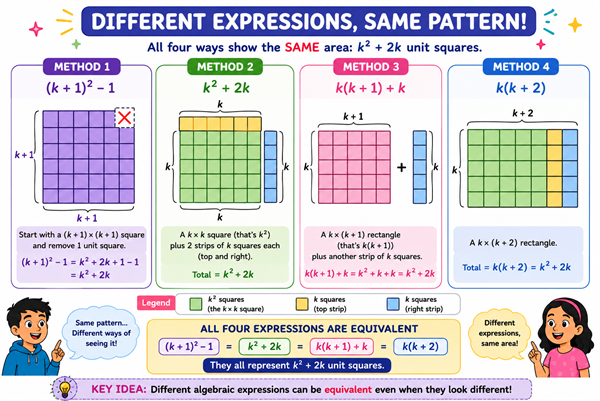
This Way or That Way, All Ways Lead to the Bay:
The same problem can sometimes be solved in more than one way.
Suppose a pattern has the following number of circles:
| Step | Number of circles |
| \(1\) | \(3\) |
| \(2\) | \(8\) |
| \(3\) | \(15\) |
| \(4\) | \(24\) |
We can look for a relationship between the step number and the number of circles.
The numbers can be written as:
\(1 \rightarrow 3 = 1(1+2)\)
\(2 \rightarrow 8 = 2(2+2)\)
\(3 \rightarrow 15 = 3(3+2)\)
\(4 \rightarrow 24 = 4(4+2)\)
So, at Step (\(k\)), the number of circles can be written as \(k(k+2)\).
Using the distributive property, \(k(k+2)=k^2+2k\).
Therefore, the algebraic expression for the number of circles is \(k^2+2k\).