

Pattern 1: Sum of Squares
Let us observe the pattern:
\(2 (2^2 + 1^2) = 3^2 + 1^2\)
Because, \(2(5) = 9+1\)
\(10 =10\)
\(2 (3^2 + 1^2) = 4^2 + 2^2\)
Because, \(2(10) = 16+4\)
\(20 =20\)
\(2 (6^2 + 5^2) = 11^2 + 1^2\)
Because, \(2(61) = 121+1\)
\(122 = 122\)
In general, adding squares of sum and squares of difference, we have:
\((a + b)^2 + (a – b)^2 = (a^2 + 2ab + b^2) + (a^2 – 2ab + b^2)\)
Adding like terms, we have:
\((a + b)^2 + (a – b)^2 = 2a^2 + 2b^2 = 2(a^2+b^2)\)
Thus, \(2(a^2+b^2) = (a + b)^2 + (a – b)^2\)
Pattern 2: Difference of Squares
Let us observe the pattern:
\(9 \times 9 - 2 \times 2 = 11 \times 7\)
Because, \(64-4 = 77\)
\(77= 77\)
\(6 \times 6 - 1 \times 1 = 7 \times 5\)
Because, \(36-1 = 35\)
\(35 =20\)
Product of sum and difference of numbers, we have:
\((a + b)(a – b) = (a^2 - ab +ab - b^2)\)
Adding like terms, we have:
\((a + b)(a – b) = (a^2 - b^2)\)
Thus, \((a + b)(a – b) = (a^2 - b^2)\).
Geometrical proof of identity:
Now, we construct a figure to understand the concept.

Then we construct a rectangle using the above information.
In the given figure, \(AB = AD = a\).
So, the area of square \(ABCD = a^2\).
So, the area of square \(ABCD = a^2\).
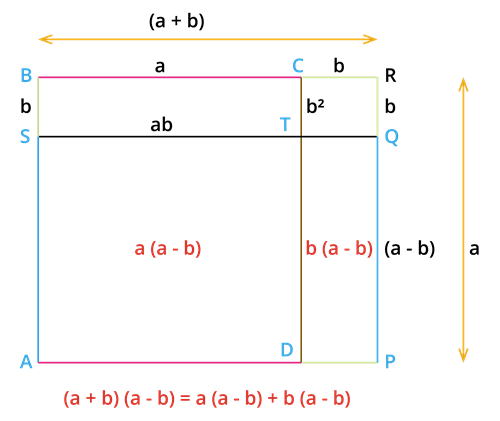
Also, \(SB = DP = b\). Then the area of the rectangle \(SBCT = ab\).
Similarly, the area of the rectangle \(DPRC = ab\). And, the area of the square \(TQRC = b^2\).
Area of the rectangle \(DPQT = ab − b^2\).
Hence, \(\text{the area of the rectangle APQS = The area of square ABCD}\) \(\text{– area of rectangle STCB}\) \(\text{+ area of rectangle DPQT}\).
Therefore, .
Example:
Simplify using the identity.
First, develop the given expression using the identity .
Here, \(a = 3x\); \(b = 12\).
Therefore, \(=\) 9\(x^2 -\)144.