

Distance between any two points in a cartesian plane
Consider any two points \(P(x_1,y_1)\) and \(P(x_2,y_2)\). Draw \(PR\) perpendicular to \(OS\). Draw \(PT\) perpendicular to \(QS\). Then, \(OR = x_1\), \(OS = x_2\), \(RS = OS - OR = x_2 - x_1 = PT\)
\(SQ = y_2\), \(ST = PR = y_1\), \(QT = y_2 - y_1\)
Applying Pythagorean theorem, we have:
\(PQ^2 = PT^2 + TQ^2\)
\(PQ^2 = (x_2 - x_1)^2 + (y_2 - y_1)^2\)
\(PQ = \sqrt{(x_2 - x_1)^2 + (y_2 - y_1)^2}\)
Therefore, the distance between any two points can be determined using the formula \(d = \sqrt{(x_2 - x_1)^2 + (y_2 - y_1)^2}\).
Let us look at the following example.
Find the distance between the points given in the figure below.
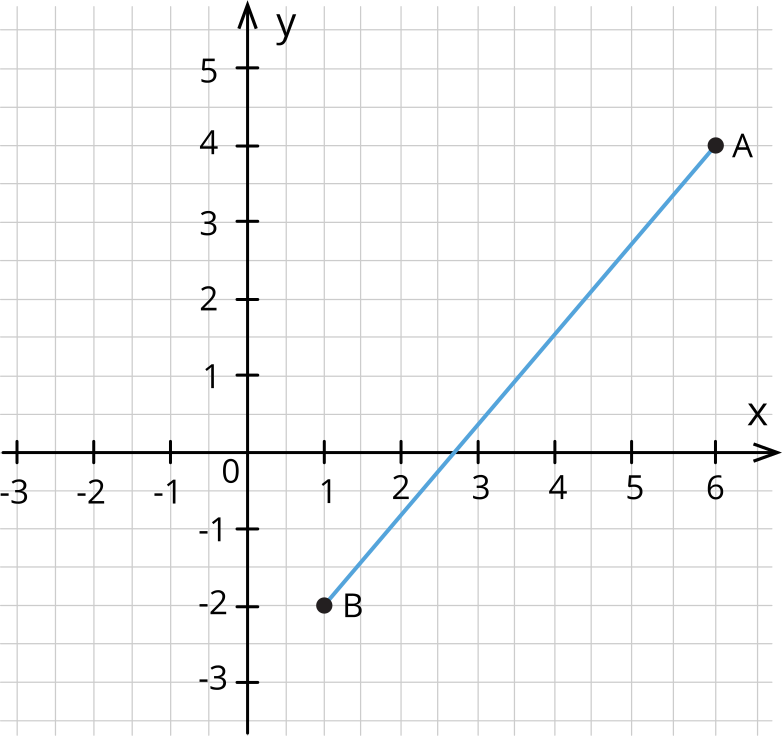
The coordinates of point \(A\)(\(x_1\), \(y_1\)) is (\(6\), \(4\)).
The coordinates of point \(B\)(\(x_2\), \(y_2\)) is (\(1\), \(-2\)).
\(x_1 = 6\)
\(x_2 = 1\)
\(y_1 = 4\)
\(y_2 = -2\)
Distance between the points \(A\) and \(B\) can be obtained using the distance formula.
\(\text{Distance} = \sqrt{(x_2 - x_1)^2 + (y_2 - y_1)^2}\)
\(= \sqrt{(1 - 6)^2 + (-2 - 4)^2}\)
\(= \sqrt{(-5)^2 + (-6)^2}\)
\(= \sqrt{25 + 36}\)
\(= \sqrt{61}\)
Important!
The distance of a point \(P(x,y)\) from the origin can be determined using the formula:
\(OP = \sqrt{x^2 + y^2}\)
Midpoint
Let us look at the following graph:
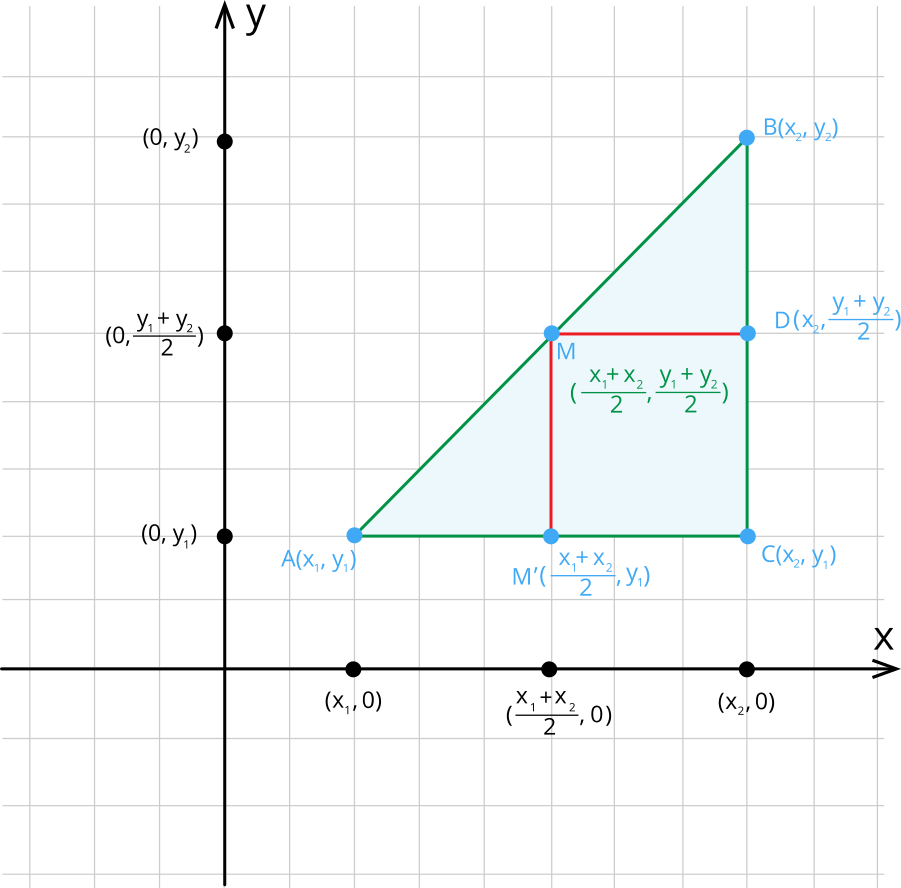
Let the mid-point be \(M\) with the vertex \(M(x\), \(y)\).
From the similarity property, it is understood that \(\triangle{AMM'}\) and \(\triangle{MDB}\) are similar.
This makes the two corresponding sides equal.
Therefore, the ratio between the two corresponding sides are also equal.
\(\frac{AM'}{MD} = \frac{MM'}{BD} = \frac{AM}{MB} = \frac{1}{1}\)
We know that since \(M\) is the mid-point of \(AB\), \(AM = MB\).
So, \(\frac{x - x_1}{x_2 - x} = \frac{y - y_1}{y_2 - y} = \frac{1}{1}\)
Let us only consider \(\frac{x - x_1}{x_2 - x} = \frac{1}{1}\)
\(x - x_1 = x_2 - x\)
\(2x = x_1 + x_2\)
\(x = \frac{x_1 + x_2}{2}\)
Similarly \(y\) becomes \(\frac{y_1 + y_2}{2}\)
\(y = \frac{y_1 + y_2}{2}\)
Hence, the mid-point be \(M\) with the vertex \(M(x\), \(y)\) becomes \(M(\frac{x_1 + x_2}{2}\), \(\frac{y_1 + y_2}{2})\).