

Number line:

In the above number line, the position of point \(P\) in the above line can be represented as \(6\) units with reference to one line (horizontal line).
A similar rule applies to the negative side of the number line as well. It is possible to represent the position of a point with reference to more than one point.
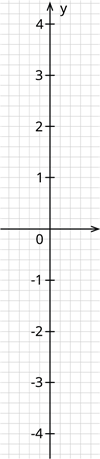
Descartes invented placing two such number lines perpendicular to each other on a plane and locating points on the plane by referring them to these lines. The perpendicular lines may be in any direction. But, when we choose these two lines to locate a point in a plane in this chapter, one line will be horizontal(First image) and the other will be vertical(Second image), as below:
Descartes invented placing two such number lines perpendicular to each other on a plane and locating points on the plane by referring them to these lines. The perpendicular lines may be in any direction. But, when we choose these two lines to locate a point in a plane in this chapter, one line will be horizontal(First image) and the other will be vertical(Second image), as below:

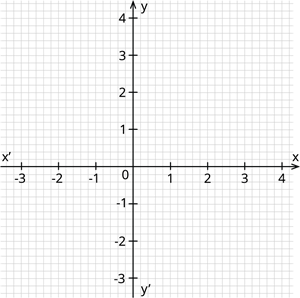
Let us combine these \(2\) lines in such a way they are perpendicular to each other. These two lines intersect each other at the point \((0,0)\).
Cartesian system:
- It is a co-ordinate number system used to describe the position of a point in two dimensions by means of two perpendicular lines (x axis and y axis).
- The line \(X'OX\) is the horizontal line called the \(x\) - axis.
- The line \(Y'OY\) is the vertical line called the \(y\) - axis.
Co-ordinate axes:
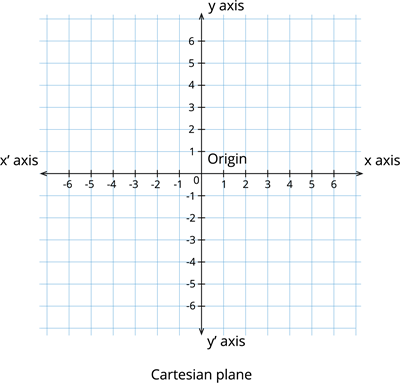
The plural form of the axis is called the axes. A number line represented horizontally is the \(x\) - axis, and a number line represented vertically is the \(y\) - axis. Joining both the lines together at origin is called the \(xy\) plane or cartesian plane or co-ordinate axes.
Quadrants
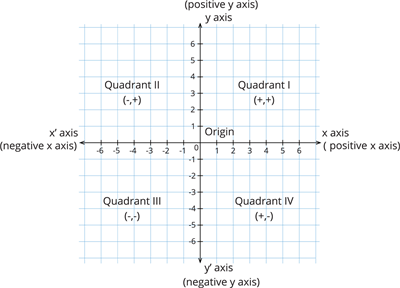
Quadrant I:
- Any point located in quadrant \(I\) will have a positive number in the \(x\) - axis and \(y\) - axis.
- That is, \(x > 0\), \(y > 0\).
- The region is \(XOY\).
Example:\((2,3)\), \((6,10)\), \((9,12)\)
Quadrant II:
- Any point located in quadrant \(II\) will have a negative number in the \(x\) - axis and a positive number in \(y\) - axis.
- That is, \(x < 0\), \(y > 0\).
- The region is \(X'OY\).
Example:\((-3,6)\), \((-2,5)\), \((-15,12)\)
Quadrant III:
- Any point located in quadrant \(III\) will have a negative number in the \(x\) - axis and \(y\) - axis.
- That is, \(x < 0\), \(y < 0\).
- The region is \(X'OY'\).
Example:\((-5,-6)\), \((-2,-1)\), \((-8,-10)\)
Quadrant IV:
- Any point located in quadrant \(IV\) will have a positive number in the \(x\) - axis and a negative number in \(y\) - axis.
- That is, \(x > 0\), \(y < 0\).
- The region is \(XOY'\).
Example:\((1,-3)\), \((3, -4)\), \((7,-1)\)
Coordinate of a point on the axes:
If a point lies on the \(x\) - axis, then the coordinate is \((x,0)\). That is, \(y = 0\).
If a point lies on the \(y\) - axis, then the coordinate is \((0,y)\). That is, \(x = 0\).
Ordered pairs
Let us draw a point in the graph. The point is denoted by \((a,b)\), where \(a\) is the distance along the \(X\) - axis and \(b\) is the distance along the \(Y\) - axis. This pair \((a,b)\) is called as the ordered pair. The ordered pair helps us identify the point correctly.
The \(x\) - coordinate in the ordered pair is called abscissa and the \(y\) - coordinate in the ordered pair is called ordinate.
Here, the ordered pair is \((a,b)\), where \(a\) is the \(x\) - coordinate or the abscissa, and \(b\) is the \(y\) - coordinate or the ordinate.
Example:
Let us draw a point in the graph and name it as \(A\). Here, the ordered pair is \((2,5)\).
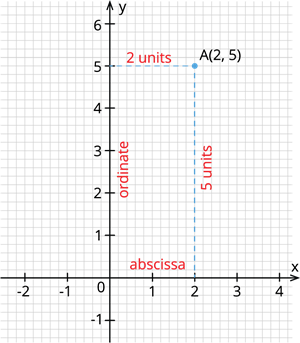
The \(x\) - coordinate or the abscissa of the ordered pair is \(2\) units, and the \(y\) - coordinate or the ordinate is \(5\) units.
Important!
The ordered pair \((a,b)\) and \((b,a)\) is not the same.
Plotting points in a cartesian plane
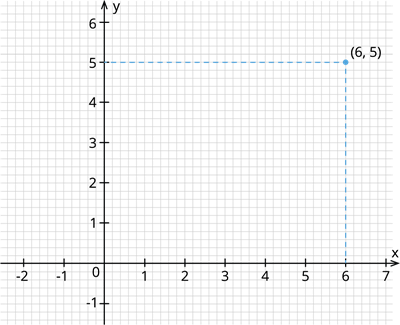
Let us consider an example of how to plot a point \((6,5)\) in the cartesian plane:
1. Let us start from the origin \((0,0)\), move \(6\) units along \(OX\).
2. From the point \(6\) in the \(x\) - axis, move \(5\) units parallel to \(OY\) to reach the point \((6,5)\).
Line parallel to the \(x\) - axis:
Consider drawing a line parallel to the \(x\) - axis. If the distance from the \(x\) - axis and the line is the same, then the line can be represented as \(y = c\) (where \(c\) is a constant).
Line parallel to the \(y\) - axis:
Consider drawing a line parallel to the \(y\) - axis and the distance between the \(y\) - axis and the line is the same, then the line can be represented as \(x = c\) (where \(c\) is a constant).
Distance between any two points in a cartesian plane
Consider any two points \(P(x_1,y_1)\) and \(P(x_2,y_2)\). Draw \(PR\) perpendicular to \(OS\). Draw \(PT\) perpendicular to \(QS\). Then, \(OR = x_1\), \(OS = x_2\), \(RS = OS - OR = x_2 - x_1 = PT\)
\(SQ = y_2\), \(ST = PR = y_1\), \(QT = y_2 - y_1\)
Applying Pythagorean theorem, we have:
\(PQ^2 = PT^2 + TQ^2\)
\(PQ^2 = (x_2 - x_1)^2 + (y_2 - y_1)^2\)
\(PQ = \sqrt{(x_2 - x_1)^2 + (y_2 - y_1)^2}\)
Therefore, the distance between any two points can be determined using the formula \(d = \sqrt{(x_2 - x_1)^2 + (y_2 - y_1)^2}\).
Let us look at the following example.
Find the distance between the points given in the figure below.
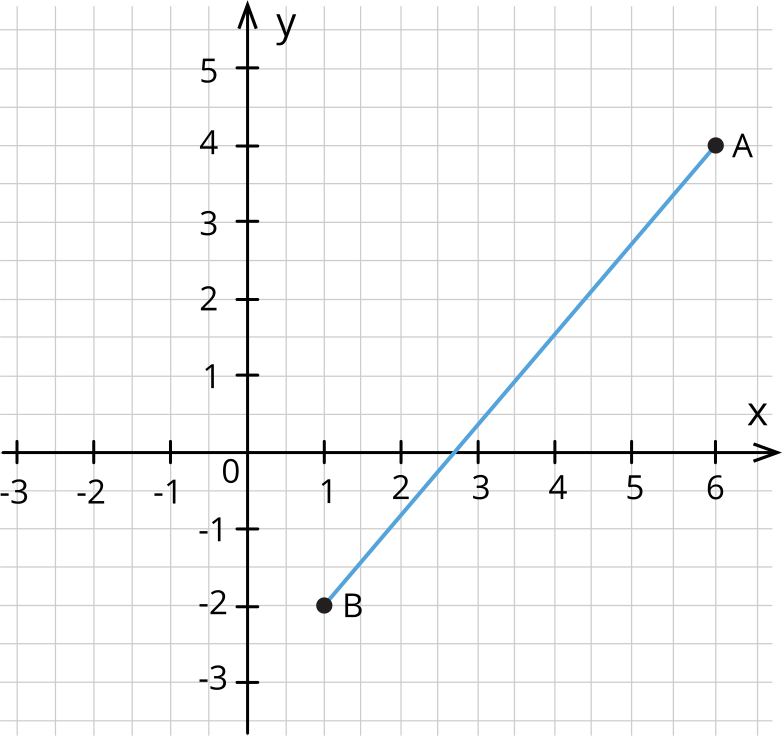
The coordinates of point \(A\)(\(x_1\), \(y_1\)) is (\(6\), \(4\)).
The coordinates of point \(B\)(\(x_2\), \(y_2\)) is (\(1\), \(-2\)).
\(x_1 = 6\)
\(x_2 = 1\)
\(y_1 = 4\)
\(y_2 = -2\)
Distance between the points \(A\) and \(B\) can be obtained using the distance formula.
\(\text{Distance} = \sqrt{(x_2 - x_1)^2 + (y_2 - y_1)^2}\)
\(= \sqrt{(1 - 6)^2 + (-2 - 4)^2}\)
\(= \sqrt{(-5)^2 + (-6)^2}\)
\(= \sqrt{25 + 36}\)
\(= \sqrt{61}\)
Important!
The distance of a point \(P(x,y)\) from the origin can be determined using the formula:
\(OP = \sqrt{x^2 + y^2}\)