

The square of a sum \((a + b)^2\):
Draw a square of side \((a + b)\) units.
Split it into smaller parts as shown in the figure.
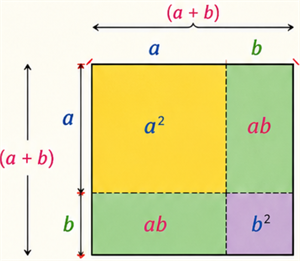
(1) As one big square:
Area \(=\) \((a + b)^2\)
(2) As sum of four smaller parts:
- Square of side \(a\) \(\rightarrow\) area \(= a^2\)
- Square of side \(b\) \(\rightarrow\) area \(= b^2\)
- Two rectangles \(\rightarrow\) area \(= ab\) each
- Total area \(=\) \(a^2 + ab + ab + b^2 = a^2 + 2ab + b^2\)
Since both ways give the area of the same square, they must be equal.
\((a + b)^2 = a^2 + 2ab + b^2\)
Factorisation using Identities:
Let us find the factor of the expression \(x^2 + 6x + 9\).
\(x^2 + 6x + 9 = x^2 + 2(3)(x) + 3^2\)
It looks like the identity \(a^2 + 2ab + b^2 = (a + b)^2\).
Here, \(a = x\) and \(b = 3\).
\(x^2 + 6x + 9 = (x + 3)^2\)
Thus, the factor of \(x^2 + 6x + 9\) is \((x + 3)^2\).
Important!
\((a - b)^2 = a^2 - 2ab + b^2\)