

Distance of Chords from the Centre:
Theorem: Chords of a circle having the same length are all at the same distance from the centre of the circle.
Proof:

Consider a circle with centre \(O\) and two equal chords \(PQ\) and \(RS\).
Join the endpoints of the chords \(PQ\) and \(RS\) with the centre.
Draw a line \(OA\) perpendicular to \(RS\) and \(OB\) perpendicular to \(PQ\).
Method - 1:
Consider the triangles \(POQ\) and \(SOR\).
Here, \(OP\) and \(OR\) are radii of the circle, so \(OP = OR\).
Similarly, \(OQ\) and \(OS\) are radii of the circle, so \(OQ = OS\).
Given that, \(PQ = RS\).
So, by SSS (Side-Side-Side) congruence, the \(\Delta POQ ≅ \Delta SOR\)
Thus, the altitudes \(OA\) and \(OB\) are congruent and \(OA = OB\).
Therefore, the chords \(PQ\) and \(RS\) are at equal distance from the centre \(O\).
Method - 2:
Two right triangles \(OAR\) and \(OBQ\) are obtained where \(\angle OAR = \angle OBQ = 90^{\circ}\) since \(OA \perp RS\) and \(OB \perp PQ\).
Here, \(OR\) and \(OQ\) are radius. So, they are equal.
According to the theorem, the perpendicular from the centre of the circle bisects the chord. So, \(RA = BQ\) since the chords are equal.
Therefore, by the RHS rule(In two right-angled triangles, if the length of the hypotenuse and one side of one triangle is equal to the length of the hypotenuse and corresponding side of the other triangle, then the two triangles are congruent), the triangles are congruent.
This implies that the sides \(OA = OB\).
Therefore, the chords \(PQ\) and \(RS\) are at equal distance from the centre \(O\).
Example:
Given, a circle with two equal and parallel chords. If one of the chords is at a distance of \(5\) \(cm\) from the centre, find the distance between the chords.
Solution:
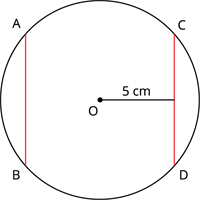
Let \(O\) be the centre of the circle and \(AB\) and \(CD\) be the equal and parallel chords.
Given, one of the chords is at a distance of \(5\) \(cm\) from the centre.
Let the chord \(CD\) be at a distance of \(5\) \(cm\) from the centre.
By the theorem, the equal chords \(AB\) and \(CD\) of a circle are equidistant from the centre.
Thus, the distance between the chord \(AB\) and the centre \(O\) is \(5\) \(cm\).
Therefore, the distance between the two chords is given as follows:
\(=\) \(5\) \(cm\) \(+\) \(5\) \(cm\)
\(=\) \(10\) \(cm\)
Theorem: Chords of a circle that are equidistant from the centre have equal length.
Proof:
Given:
\(CE\) is perpendicular to \(PQ\).
\(CE\) is perpendicular to \(PQ\).
\(CH\) is perpendicular to \(RS\).
\(CE = CH\)
To prove: \(PQ = RS\)
Proof:

Consider the right angled triangles \(CEP\) and \(CHR\).
\(CP = CR\) [Radii of the circle]
\(CE = CH\) [Given]
Also, \(\angle CEP = \angle CHR = 90^{\circ}\)
So, \(\Delta CEP ≅ \Delta CHR\) [By RHS congruence]
Thus, \(PE = HR\) ......(1) [By CPCT]
By the theorem, the perpendicular from the centre to a chord bisects the chord.
We have, \(PE = EQ\) and \(HR = HS\).
Therefore, \(PQ = 2PE\) and \(RS = 2HR\)
From equation (1), we get \(PQ = RS\)
Hence, proved.
Therefore, \(PQ = 2PE\) and \(RS = 2HR\)
From equation (1), we get \(PQ = RS\)
Hence, proved.
Example:
If two chords are connected by a line segment, and the centre of the circle passes through the mid-point of the line segment, then prove that the chords are equal.
Solution:
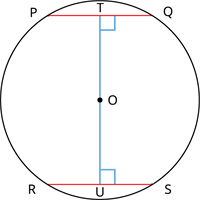
Here, \(PQ\) and \(RS\) be two chords with centre \(O\). Let \(TU\) be the line segment that passes through the centre of the circle. And, the centre of the circle is the midpoint of the line segment.
Join \(PO\) and \(OS\).
To prove: \(PQ = RS\)
Since \(O\) is the midpoint of the line segment. Then, \(OT = OU\).
This implies that the chords are equidistant from the centre.
Therefore by the theorem, the chords are equal.
Hence, proved.