

Circumcircle of the triangle:
The circle passing through the three vertices of the triangle is called its circumcircle.
Circumcentre of the triangle:
The centre of the circle that passes through the vertices of the triangle is called its circumcentre.
Circumradius of the triangle:
The distance between the circumcentre and the vertices of the triangle is called its circumradius.
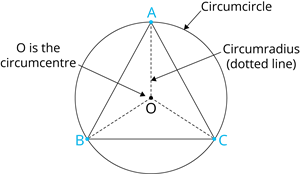
Position of the circumcentre of the triangle:
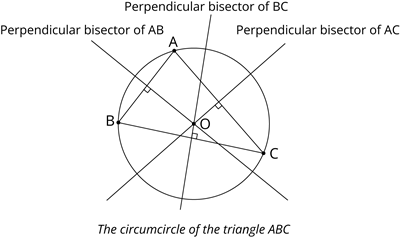
Case - 1: For an acute angled traingle (all the angles \(<90^{\circ}\)), the circumcentre lies inside the triangle.
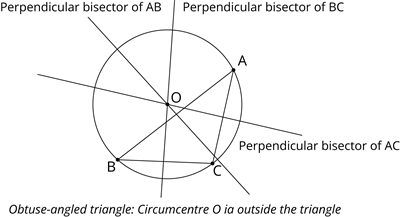
Case - 2: For an obtuse angled traingle (one of the angles \(>90^{\circ}\)), the circumcentre lies outside the triangle.
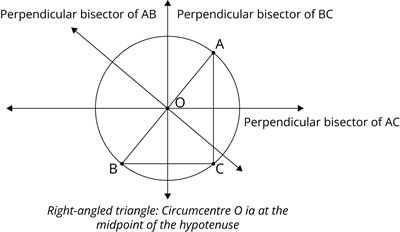
Case - 3: For a right angled traingle (one of the angles \(=90^{\circ}\)), the circumcentre lies on the midpoint of the hypotenuse of the right triangle.
Procedure to construct a triangle:
Case -1: When \(3\) sides of the triangle are known.
Let us constructs a \(\Delta ABC\)(say) with sidelengths \(x \ cm\), \(y \ cm\), and \(z \ cm\).
Step - 1: Construct the base line segment \(AB\) with one of the side lengths. Let us choose \(AB = x \ cm\).
Step - 2: With \(A\) as the centre, construct a sufficiently long arc of radius \(y \ cm\).
Step -3: Now, with \(B\) as the centre, construct a sufficiently long arc of radius \(z \ cm\), such that it intersects the previous arc at \(C\).
Step - 4: Join \(AC\) and \(BC\) to get the required triangle \(\Delta ABC\).
Check this link to recall the construction of triangle when its sides are given.
Case - 2: When \(2\) sides and an angle of the triangle are known.
Let us constructs a \(\Delta ABC\)(say) with \(AB = x \ cm\), \(AC = y \ cm\), and \(\angle A = z^{\circ}\).
Step - 1: Construct the base line segment \(AB\) with one of the side lengths. Let us choose \(AB = x \ cm\).
Step - 2: Using a protractor, construct \(\angle A = z^{\circ}\) by drawing the other arm of the angle.
Step -3: Mark a point \(C\) on the other arm such that \(AC = y \ cm\).
Step - 4: Now, join \(AC\) to get the required triangle \(\Delta ABC\).
Step - 2: Using a protractor, construct \(\angle A = z^{\circ}\) by drawing the other arm of the angle.
Step -3: Mark a point \(C\) on the other arm such that \(AC = y \ cm\).
Step - 4: Now, join \(AC\) to get the required triangle \(\Delta ABC\).
Check this link to recall the construction of a triangle when \(2\) sides and an angle are given.
Case - 3: When \(2\) angles and a side of the triangle are known.
Let us constructs a \(\Delta ABC\)(say) with \(AB = x \ cm\), \(\angle A = y^{\circ}\), and \(\angle B = z^{\circ}\).
Step - 1: Construct the base line segment \(AB = x \ cm\).
Step - 2: Place the protractor at \(A\) and construct \(\angle A = y^{\circ}\) by drawing the other arm of the angle.
Step -3: Place the protractor at \(B\) and construct \(\angle B = z^{\circ}\) by drawing the other arm of the angle.
Step - 4: Mark the intersecting point of the two arms as the vertex \(C\). Thus, \(\Delta ABC\) is the required triangle.
Step - 2: Place the protractor at \(A\) and construct \(\angle A = y^{\circ}\) by drawing the other arm of the angle.
Step -3: Place the protractor at \(B\) and construct \(\angle B = z^{\circ}\) by drawing the other arm of the angle.
Step - 4: Mark the intersecting point of the two arms as the vertex \(C\). Thus, \(\Delta ABC\) is the required triangle.
Check this link to recall the construction of a triangle when \(2\) angles and a side are given.
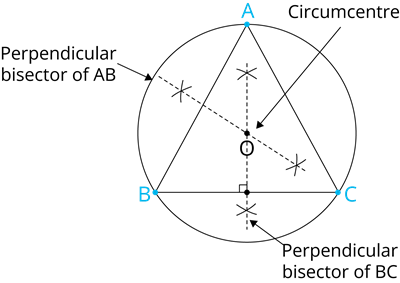
Procedure to construct the circumcircle of the given triangle \(ABC\):
Step - 1: Follow the procedure above to draw the required triangle \(ABC\) using the above cases.
Step - 2: Draw the perpendicular bisectors of any two sides \(AB\) and \(BC\) (say) of the triangle and mark its intersecting point as \(O\). This intersecting point is the circumcentre of the triangle.
Step - 3: With \(O\) as centre and \(OA\) or \(OB\) or \(OC\) as radius, draw a circle.
Important!
In the above constructed triangle \(OA = OB = OC\) as they are radii of the triangle.