

Theorem on unequal chords of the circle:
Let \(AB\) and \(DE\) be two chords of a circle with centre \(C\). Suppose \(AB > DE\). Then the distance from \(C\) to \(AB\) is less than the distance from \(C\) to \(DE\).
Explanation:
The theorem states that the chord nearer to the centre is longer than the chord which is farther from the centre.
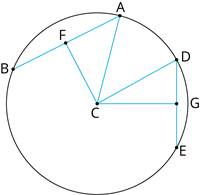
Given, two unequal chords \(AB\) and \(DE\), where \(AB\) \(>\) \(DE\).
Then, the perpendicular distance from \(C\) to \(AB\) is lesser than the perpendicular distance from \(C\) to \(ED\).
That is, \(CF < CG\), where \(F\) and \(G\) are the midpoints of the chords \(AB\) and \(DE\), respectively.
Arc of a circle:
The portion between any two points on the circumference of a circle is called an arc.
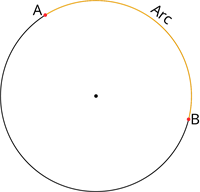
Here, the shorter arc(yellow) is called the minor arc and the longer arc(black) is called the major arc.
Important!
- The arc connecting the two points on the circle along the circle's edge are called end points.
-
If the ends of the arc coincides with the ends of the diameter in such a case each arc is called a semicircle.
-
The area enclosed by a semicircle and the diameter of a circle is called the semicircular region.
Segment of a circle:
The region enclosed by the chord and the arc is called the segment of the circle.
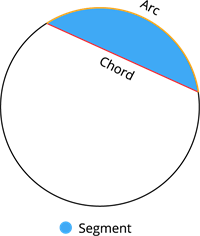
Important!
The region enclosed by the chord and the minor arc is called the minor segment, and the region enclosed by the chord and the major arc is called the major segment.
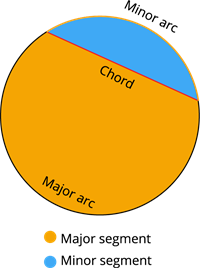
Angles Subtended by an Arc:
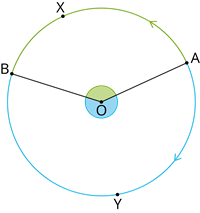
The angle subtended by the arc \(AB\) at the centre is the measure of the \(\angle AOB\), as we sweep along the arc.
- Here the arc through \(X\) subtends an \(\angle AOB\) is the angle subtended by the minor arc.
- And, the arc through \(Y\) subtends an \(\angle AOB\) is the angle subtended by the major arc.
Important!
The angle subtended by the major arc at the centre of the circle is also called a reflex angle and is greater than \(180^{\circ}\).
Theorem on angles subtended by an arc:
The angle subtended by an arc at the centre of the circle is double the angle subtended by the arc at any point on the circle outside the arc.
Explanation:
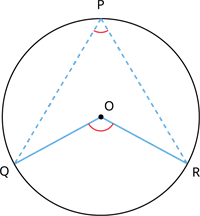
The theorem states that the angle subtended by the arc \(QR\) of the circle at the centre \(O\) is twice the angle subtended by the point \(P\) at any remaining part of the circle. (i.e.) \(\angle QOR = 2 \angle QPR\).
Special cases of angle at the centre and the circumference:
Conjecture \(1\):
The angle subtended by a diameter at any point on the circle is \(90°\).
Explanation:
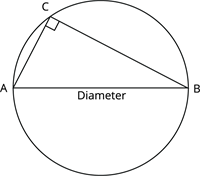
The conjecture is that any angle inscribed in the semi-circle is always \(90^{\circ}\). In other words, the angle subtended by the diameter is always \(90^{\circ}\).
Conjecture \(2\):
Equal arcs of a circle subtend equal angles at the centre.
Explanation:
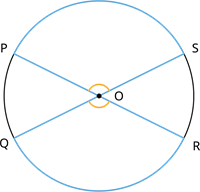
The conjecture is that if the arcs \(PS\) and \(QR\) are equal, then the angles subtended by them at the centre are equal. \(\angle POS = \angle QOR\).
Conjecture \(3\)
Angles in the same segment of a circle are equal.
Explanation:
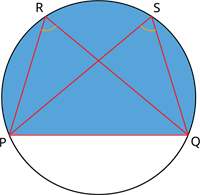
The theorem states that angles in the same segment of the circle are equal. In the given circle, the angles \(\angle PRQ\) and \(\angle PSQ\) are equal as they lie on the same segment (i.e.) \(\angle PRQ = \angle PSQ\).