

Demonstrate that if two chords of a circle are equal in length and intersect each other, the segments of one chord are equal to the corresponding segments of the other.
Explanation:
Now, Draw \(OM⊥ PQ\), \(ON⊥ RS\) and join \(OE\), where \(O\) is the centre of circle.
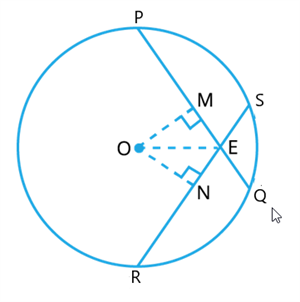
In \(△OME\) and \(△ONE\),
\(OM = \) []
\(OE = \) [common side]
Also, \(∠OME=ONE=\)\(^°\)
Therefore, \(△OME≅△ONE\) []
Now, \(EM=\) [CPCT] .....(1)
Also, \(PQ = RS\).
On dividing both sides by \(2\),
\(\frac{PQ}{2}=\frac{RS}{2}\)
Therefore, \(PM=\) .....(2) [Perpendicular drawn from the centre of a circle to a chord, bisects it]
Now, adding (1) and (2) we get,
\(EM + PM = EN + RN\)
Therefore, \(PE=\) .....(3)
Now, \(PQ =RS \).
On subtracting \(PE\) from both the sides,
\(PQ − PE = RS− PE\)
\(QE = RS − RE\) [from (3)]
That is, \(QE =\)
Hence, proved.