Algebraic expressions:
An algebraic expression is a mathematical term that combines constants and variables using operations like addition, subtraction, multiplication, and division.
Example: \(3x + y + 5\)
- Terms: \(x\), \(y\) and \(5\).
- Variables (letter numbers): \(x\), \(y\)
- Coefficients: \(3\) (of \(x\)), \(1\) (of \(y\))
- Constant: \(5\)
Definition of a polynomial:
- An expression of the form \(p(x) = a_n x^n + a_{n-1} x^{n-1} + ... + a_1 x + a_0 \), where \(n\) is an non negative integer and \(a_0, a_1, a_2, ..., a_n\) are constants and \(a_n \neq 0\) is called a polynomial in \(x\) of degree \(n\).
- An algebraic expression involving one variable and its power are called one - variable polynomials, univariate polynomials or when the context is clear, simply polynomials.
Example:
\(p(x) = x^7 - 3x^6 + x^3 +x + 9\)
The above example is a univariate polynomial.
Univariate polynomials and their degree:
Degree: If \(p(x)\) is a polynomial in \(x\), then the heighest power of \(x\) in \(p(x)\) is called degree of a polynomial \(p(x)\).
| Type of polynomial | Degree | Example |
| Constant polynomial | \(0\) | \(6 = 6x^0\) |
| Linear polynomial | \(1\) | \(2x + 6\) |
| Quadratic polynomial | \(2\) | \(x^2 - 2x + 1\) |
| Cubic polynomial | \(3\) | \(5y^3 + 3y^2 + 3\) |
Linear polynomials and linear patterns:
A polynomial is considered to be a linear polynomial if its degree is \(1\).
When a linear polynomial equals \(0\), it is called a linear equation. The value that satisfies that equation is called its root or zero.
A linear pattern is a pattern in which numbers increase or decrease by the same constant value each time. A linear pattern is of the form \(y = ax + b\).
Example:
Observe the table to find the value of y.
| \(x\) | \(1\) | \(2\) | \(3\) | \(4\) | \(5\) | \(6\) |
| \(y\) | \(5\) | \(8\) | \(11\) | \(14\) | \(17\) | \(?\) |
When \(x = 1\), \(y = 5 = 3 \times 1 + 2\)
When \(x = 2\), \(y = 8 = 3 \times 2 + 2\)
When \(x = 3\), \(y = 11 = 3 \times 3 + 2\)
When \(x = 4\), \(y = 14 = 3 \times 4 + 2\)
When \(x =5\), \(y = 17 = 3 \times 5 + 2\)
In above term each term has a difference of \(3\)
Using the above pattern we get,
When \(x = 6\), \(y = 3 \times 6 + 2 = 20\)
The linear pattern formed using the above table is,
\(y = 3x + 2\)
Linear growth (Growing steadily)
Linear Growth happens when something increases by the exact same amount every single time.
For example, hiring an auto-rickshaw or a taxi,
-
You pay a fixed starting charge of \(₹80\) just to sit in the taxi (even if you travel \(0\) km).
-
For every \(1\) km you travel, the price goes up by a fixed amount of \(₹50\).
This gives us a simple rule (or formula):
\(\text{Total Cost } C(d) = 80 + 50d\)
-
If you travel \(1\) km Cost \(= 80 + 50(1) = \text{₹}130\)
-
If you travel \(2\) km: Cost \(= 80 + 50(2) = \text{₹}180\)
-
Notice how the cost increases by exactly \(₹50\) every time? That steady, fixed increase is Linear Growth.
Linear Decay (Shrinking Steadily)
Linear Decay is just the opposite of linear growth. It happens when something decreases by the exact same amount every single time.
For example, let us consider a water tank drying up during the hot summer months
-
At the start \(t = 0\), the water level is \(2\) meters high.
-
Every month, the hot sun causes the water level to drop by exactly \(0.25\) meters.
The rule for this situation is:
\(\text{Water Height } h(t) = 2 - 0.25t\)
-
After \(1\) month: Height \(= 2 - 0.25(1) = 1.75 \text{ m}\)
-
After \(2\) months: Height \(= 2 - 0.25(2) = 1.50 \text{ m}\)
-
Because the water level drops by the same \(0.25\) meters every month, this steady decrease is linear decay.
Linear relationships:
A linear relationship between two variables \(x\) and \(y\) can be expressed as \(y = ax + b\) where \(a\) is the slope(rate of change) and \(b\) is the fixed or initial value (constant).
For the above taxi charge example, we can represent it as,
\(y = 100 + 15 x\)
Where \(y\) is the total charge for the taxi travelled, and \(x\) is the number of kilometres the taxi travelled.
Visualising Linear Relationship using graphs:
- Plot by finding two points satisfying \(y = ax + b\), then draw a straight line through them.
- \(y = ax (b = 0)\): line passes through the origin \((0,0)\).
- \(a =\) slope:
- \(a > 0\) → line rises (linear growth)
- \(a < 0\) → line falls (linear decay)
- Larger \(|a|\) → steeper line
- \(b = y\)-intercept: point where line cuts \(y\)-axis \(= (0, b)\)
- Same slope (\(a\)), different \(b\) → parallel lines
- Same \(b\), different \(a\) → lines pass through the same \(y\)-intercept but have different steepness.
Example:
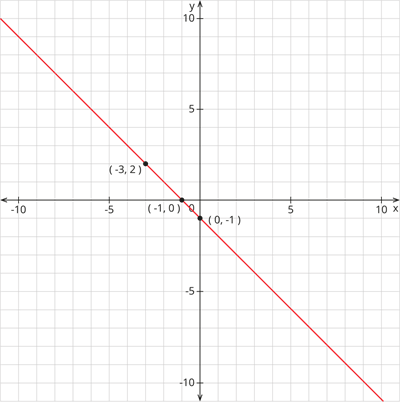
Graph the linear equation \(y = - x- 1\)
Solution:
Given the equation as follows,
\(y = -x - 1\)
Substitute \(x = 0\)
\(y = 0 - 1 = -1\)
Substitute \(x = -1\)
\(y = -(-1) -1 = 1 - 1 = 0\)
Substitute \(x = -3\)
\(y = -(-3) -1 = 3 - 1 = 2\)
Thus, if forms,
| \(x\) | \(-3\) | \(0\) | \(-1\) |
| \(y\) | \(2\) | \(-1\) | \(0\) |
Plotting these points on the graph and connecting them to get a line.