

Area of a Rectangle
Area represents the amount of two-dimensional space occupied by a region, measured relative to a unit square (\(1 \times 1\) square with an area of \(1\text{ unit}^2\)).
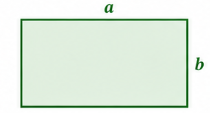
Formula: For a rectangle with sides \(a\) and \(b\), the area (\(A\)) is: \(A = ab\text{ sq. units}\)
Important!
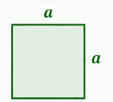 Square: A special case of a rectangle where both sides are equal (\(a = b\)): \(A = a^2\).
Area of a Parallelogram
A parallelogram can be dynamically transformed or dissected into a rectangle sharing the exact same base (\(b\)) and perpendicular height (\(h\)).
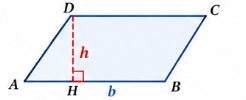
Formula:
\(A = \text{base} \times \text{height} = bh\)
The "Thin Parallelogram" Case: When a parallelogram is so slanted (thin) that the altitude falls outside its base, the area remains \(bh\). This is justified by repeatedly carving off a triangle from one side and translating it to the opposite side (\(\Delta CDD' \cong \Delta BAA'\)) until a standard parallelogram configuration is restored. 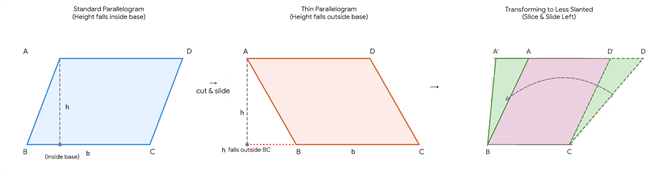
Side Length Limitation: Knowing only the side lengths of a parallelogram is not enough to determine its area, because changing the internal angles changes the height (\(h\)) while the side lengths remain fixed.
Area of a Triangle
The area of a triangle can be proven by enclosing it inside a rectangle or, more elegantly, by joining two congruent copies of any triangle (\(\Delta ABC \cong \Delta A'B'C'\)) along a shared side to construct a perfect parallelogram.
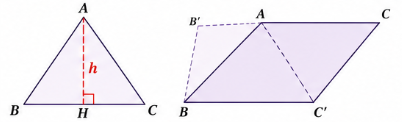
Formula: Since the triangle occupies exactly half the space of the resulting parallelogram, its area is:
\(A = \frac{1}{2} \times \text{base} \times \text{height} = \frac{1}{2}bh\)
Theorem: Property of the Median
A median is a line segment joining a vertex of a triangle to the midpoint of its opposite side.
Theorem: A median of a triangle divides it into two triangles of equal area.
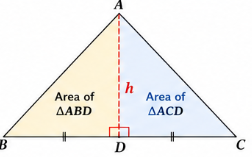
Proof:
In \(\Delta ABC\) with median \(AD\), the two newly formed triangles \(\Delta ABD\) and \(\Delta ACD\)
Since \(AD\) is the median, point \(D\) is the midpoint of \(BC\).
Therefore, \(BD=DC\).
Triangles \(ABD\) and \(ACD\) have equal bases \(BD=DC\) and the same altitude from vertex \(A\) to line \(BC\)
Hence, \(Area(△ABD)= \frac{1}{2} \times BD \times h,\)
\(Area(△ACD)= \frac{1}{2} \times DC \times h\).
Since \(BD=DC\) and the height \(h\) is common, \(Area(△ABD)=Area(△ACD)\).