

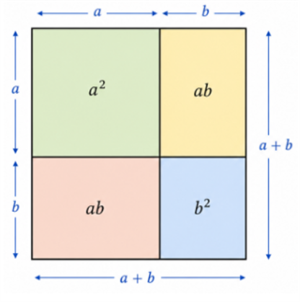
An algebraic identity is modelled using area relationships, showing that a large square of side \((a+b)\) is split into regions with areas \(a^2\), \(b^2\), \(ab\), and \(ab\). Write down the algebraic identity this configuration visually proves.
Proof:
Find the total area geometrically:
A large square has side lengths equal to .
The total area of this whole outer region is:
Sum the interior components: The layout splits the large square into \(4\) distinct regions:
One square with area
A large square has side lengths equal to .
The total area of this whole outer region is:
Sum the interior components: The layout splits the large square into \(4\) distinct regions:
One square with area
Another square with area
Two identical rectangles, each having an area of
Equate both expressions: Since the sum of the interior parts must equal the total boundary area:
\(\text{Total Area} = \text{Square}_1 + \text{Rectangle}_1 + \text{Rectangle}_2 + \text{Square}_2\)
Simplifying this, then we get,