Length of an arc of a circle
An arc is a portion of a circle's circumference. Its length depends directly on the angle (\(\theta^{\circ}\)) it subtends at the circle's center:
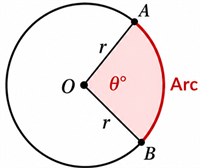
Full circumference: \(C = \pi d = 2 \pi r\)
Arc length formula \(= \frac{\theta}{360^{\circ}} \times 2 \pi r\)
Special cases of arc length
(a) Semicircle
A semicircle is half of a circle. Its central angle is \(180^{\circ}\).
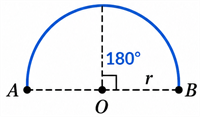
Arc length of a semicircle \(= \frac{180^{\circ}}{360^{\circ}} \times 2 \pi r = \pi r\)
(b) Quarter circle:
A quarter circle is one-fourth of a circle and its central angle is \(90^{\circ}\).
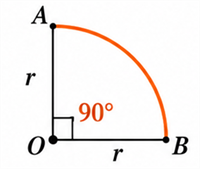
Arc length of a quarter circle \(= \frac{90^{\circ}}{360^{\circ}} \times 2 \pi r = \frac{\pi r}{2}\)
Area of a circle
Derivation of the formula: \(A = \pi r^2\)
Historical reasoning (why \(A\) depends on \(r^2\)): For any shape, if you scale it up, the ratio \((\text{perimeter})² : (\text{area})\) stays constant.
Example: For a square, \(P^2 : A = 16a^2:a^2 = 16:1\) regardless of size. This suggested to ancient mathematicians that \(C^2:A\) should also be a fixed constant for circles, which leads, after centuries of refinement (Babylonians, Egyptians, and finally Archimedes), to the exact result \(A = \pi r^2\).
Archimedes' derivation:
Archimedes showed that for any regular polygon, the enclosed area equals half the perimeter times the radius of the inscribed circle (the circle that touches all its sides):
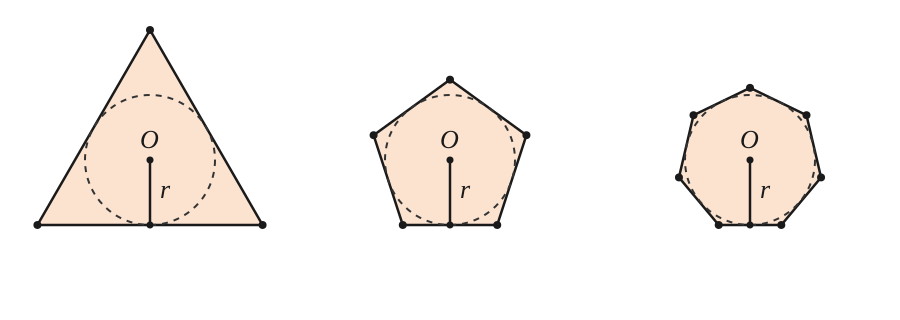
Imagining the number of sides of the polygon increasing indefinitely, the polygon approaches the circle itself, its perimeter approaches the circumference \(2 \pi r\), and its "inradius" approaches \(r\). Hence:
Area of a circle \(= \frac{1}{2} \times 2 \pi r \times r = \pi r^2\)
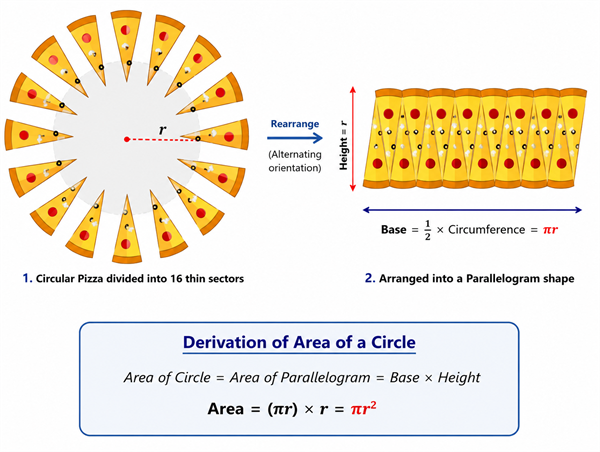
Nīlakaṇṭha's visual derivation:
Cut the circle into many thin, equal triangular slices (like a pizza) from the centre. Rearrange alternate slices, pointing up and down, into a row. As the slices get thinner and thinner, this arrangement approaches a parallelogram with base and height.
Area of a sector of a circle
A sector is the region enclosed by two radii and the arc between them.
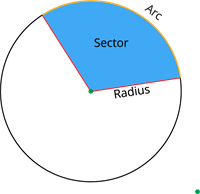
Using the same reasoning as for arc length (symmetry/rotation arguments):
(a) Semicircular disc (half-turn symmetry/reflection symmetry):
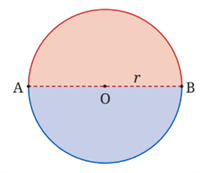
\(\text{area} = \frac{180^{\circ}}{360^{\circ}} \times \pi r^2\) \(= \frac{\pi r^2}{2}\)
(b) Quarter circular disc (quarter-turn symmetry):
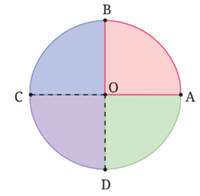
\(\text{area} = \frac{90^{\circ}}{360^{\circ}} \times \pi r^2\) \(= \frac{\pi r^2}{4}\)
General formula: If the sector's arc subtends an \(\theta^{\circ}\) at the centre \(O\), the sector's area is that same fraction of the whole circle's area:
\(\text{Area of the sector} = \pi r^2 \times \frac{\theta}{360^{\circ}}\)
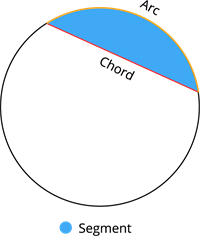
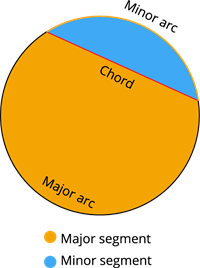
The region enclosed by the chord and the arc is called the segment of the circle.
Important!
The region enclosed by the chord and the minor arc is called the minor segment, and the region enclosed by the chord and the major arc is called the major segment.