

Brahmagupta's formula for the area of the cyclic \(4\)-gon
A cyclic \(4\)-gon(cyclic quadrilateral) is a quadrilateral whose \(4\) vertices lie on the same circle.
For a triangle, if all three sides are known, we can calculate its area using Heron's Formula.But for quadrilaterals, knowing only the four side lengths is not enough to determine the area.
If the quadrilateral is cyclic, then Brahmagupta discovered a remarkable formula that allows us to calculate its area using only the side lengths.
If the sides of the cyclic quadrilateral are \(a\), \(b\), \(c\) and \(d\), then the semi-perimeter is \(s = \frac{a + b + c + d}{2}\).
Then, its area \(= \sqrt{(s - a)(s - b)(s - c)(s - d)}\)
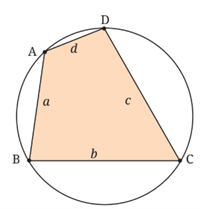
Example:
Verify Brahmagupta’s formula for the case of an isosceles trapezium.
Solution:
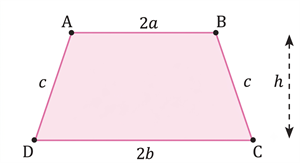
Every isosceles trapezoid is cyclic (its vertices lie on a circle), making Brahmagupta’s formula applicable.
Semi-perimeter \(= \frac{2a + 2b + c + c}{2}\)
\(= \frac{2a + 2b + 2c}{2}\)
\(= a + b + c\)
Area \(= \sqrt{(s - 2a)(s - 2b)(s - c)(s - c)}\)
\(= \sqrt{(a + b + c - 2a)(a + b + c - 2b)(a + b + c - c)(a + b + c - c)}\)
\(= \sqrt{(b + c - a)(a - b + c)(a + b)(a + b)}\)
\(= \sqrt{(b + c - a)(a - b + c)(a + b)^2}\)
\(= (a + b)\sqrt{(b + c - a)(a - b + c)}\)
\(= (a + b)\sqrt{ab - b^2 + bc + ac - bc + c^2 - a^2 + ab - ac}\)
\(= (a + b) \sqrt{2ab - a^2 - b^2 + c^2}\)
\(= (a + b) \sqrt{c^2 - (b - a)^2}\)
Drop a perpendicular from \(B\) down to \(DC\). The horizontal "overhang" on each side works out to \((b - a)\), and the leg has length \(c\). Applying Baudhāyana–Pythagoras theorem, we have:
\(h = \sqrt{c^2 - (b - a)^2}\)
Thus, Brahmagupta's formula gives \(\text{Area} = (a + b)h\).
This matches exactly with the area of a trapezium formula.
Therefore, Brahmagupta's formula, when applied to an isosceles trapezium, correctly reduces to the familiar trapezium area formula, confirming the formula works in this special case.
Special cases and generalisation in Mathematics
A special case arises from a general result when we impose some extra condition. The general result, viewed from the special case, is called a generalisation.
Example 1: A square is a special case of a rectangle.
A square is simply a rectangle in which the two adjacent sides happen to be equal(\(b = a\)).
Area of a rectangle \(= \text{length} \times \text{breadth}\)
\(= a \times b\)
\(= a \times a\) [Since \(b = a\)]
\(= a^2\)
\(=\) Area of a square
Similarly, Perimeter of the rectangle \(= 2(\text{length} + \text{breadth})\)
\(= 2(a + b)\)
\(= 2(a + a)\) [Since \(b = a\)]
\(= 2(2a)\)
\(= 4a\)
\(=\) Perimeter of the square
Therefore, a square is a special case of a rectangle.
Example 2: An isosceles right-angled triangle is a special case of a right-angled triangle.
Let \(ABC\) be a right-angled triangle with \(\angle B = 90^{\circ}\) and the side lengths be \(AB = a\), \(BC = b\) and \(AC = c\).
By Baudhāyana–Pythagoras theorem, we have:
\(c^2 = a^2 + b^2\)
\(c^2 = a^2 + a^2\) [If \(ABC\) is an isosceles triangle with sides \(AB = BC = a\)]
\(c^2 = 2a^2\)
\(c = \sqrt{2}a\)
Thus, an isosceles right-angled triangle is a special case of a right-angled triangle.
Brahmagupta’s Formula Generalises Heron’s Formula
You may already know Heron’s Formula for finding the area of a triangle with sides \(a\), \(b\) and \(c\).
\(\text{Area} = \sqrt{s(s-a)(s-b)(s-c)}\) where \(s = \frac{a + b + c}{2}\)
The similarity between Heron's and Brahmagupta's formulas is not a coincidence!
Brahmagupta’s formula is a generalisation of Heron's formula.
Imagine a cyclic \(4\)-gon, but let one of its sides shrink down until its length is zero (\(d = 0\)). When a side shrinks to zero, two vertices collide, and the \(4\)-gon transforms into a triangle! Since any triangle can have a circle drawn through its three corners, this "\(3\)-sided \(4\)-gon" is automatically cyclic.
Substituting \(d = 0\) into Brahmagupta's formula, we have:
Semi-perimeter \(s = \frac{a + b + c + d}{2}\)
\(s = \frac{a + b + c}{2}\) [Since \(d = 0\)]
Similarly, Area \(= \sqrt{(s - a)(s - b)(s - c)(s - d)}\)
\(= \sqrt{(s - a)(s - b)(s - c)(s - 0)}\)
\(= \sqrt{s(s - a)(s - b)(s - c)}\)
By treating a triangle as a special quadrilateral with one side equal to zero, Brahmagupta’s formula effortlessly turns into Heron’s formula.
Squaring a rectangle
In ancient geometry, squaring a shape means constructing a square having the same area as the given shape. Around 800 BCE, the ancient Indian mathematician Baudhāyana wrote a construction method in his text, the Śhulbasūtra, to change a rectangle of sides \(a\) and \(b\) (where \(a > b\)) into a square with an equal area of \(ab\) \(sq. \ units\).
Construction of a square:
Given a rectangle \(ABCD\) with \(AD = a\) and \(AB = b\) (where \(a > b\)), construct a square with the same area.
Baudhāyana's construction:
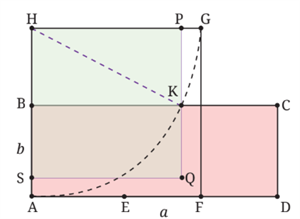
Step 1: Mark a point \(E\) on the side \(AD\) such that \(AE = AB = b\).
Step 2: Mark a point \(F\) such that \(F\) is the midpoint of \(ED\).
Step 3: Construct a square \(AFGH\) using \(AF\) as side, with vertex \(H\) on line \(AB\) extended.
Step 4: Draw an arc \(AG\) with \(H\) as centre which intersects the side \(BC\) at \(K\).
Step 5: Draw a line through \(K\) parallel to \(AH\), meeting \(GH\) at point \(P\).
Step 6: Construct square \(HPQS\) using \(HP\) as a side.
Therefore, square \(HPQS\) has the same area as rectangle \(ABCD\).
Why does this construction work?
We know that \(AE = b\).
\(AF = AE + EF\)
\(= AE + \frac{ED}{2}\) [Since \(F\) is the midpoint of \(ED\)]
\(= AE + \frac{AD - AE}{2}\)
\(= \frac{2AE + AD - AE}{2}\)
\(= \frac{AE + AD}{2}\)
\(= \frac{a + b}{2}\)
Thus, \(HG = \frac{a + b}{2}\).
Since \(HK\) is the radius of the circle, then \(HK = \frac{a + b}{2}\).
Now, \(BH = AH - AB\)
\(= AF - AB\)
\(= \frac{a + b}{2} - b\)
\(= \frac{a + b - 2b}{2}\)
\(= \frac{a - b}{2}\)
Applying Baudhāyana–Pythagoras theorem in \(\triangle HPK\), we get:
\(HP^2 = HK^2 - PK^2\)
\(= HK^2 - BH^2\)
\(= \left(\frac{a + b}{2} \right)^2 - \left(\frac{a - b}{2} \right)^2\)
\(= \frac{a^2 + 2ab +b^2}{4} - \left(\frac{a^2 - 2ab + b^2}{4} \right)\)
\(= \frac{a^2 + 2ab + b^2 - a^2 + 2ab - b^2}{4}\)
\(= \frac{4ab}{4}\)
\(= ab\)
Therefore, square \(HPQS\) has the same area as rectangle \(ABCD\).