

Heron’s formula is a fundamental theorem in geometry discovered by the ancient Greek mathematician and inventor, Heron of Alexandria. 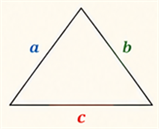
While the traditional area formula for a triangle relies on knowing both a base and its corresponding perpendicular height, Heron's formula allows the calculation of a triangle's area using only the lengths of its three sides.
1. The Core Mathematical Statement
For any triangle with side lengths \(a\), \(b\), and \(c\), the calculation is carried out in two distinct steps:
Step A: Calculate the Semi-Perimeter (\(s\))
The semi-perimeter is exactly half of the total perimeter of the triangle:
\(s = \frac{a + b + c}{2}\)
Step B: Apply Heron's Area Formula
Once \(s\) is determined, the area (\(A\)) of the triangle is given by the square root of the product of the semi-perimeter and its differences with each individual side:
\(\text{Area} = \sqrt{s(s - a)(s - b)(s - c)}\)
2. Theoretical Verifications & Special Cases
The validity of Heron's formula can be examined by cross-referencing it with standard geometric derivations using the classical \(\text{Area} = \frac{1}{2} \times \text{base} \times \text{height}\) method.
Case A: Equilateral Triangle
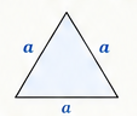
For an equilateral triangle where all three sides are equal (\(a = b = c\)):
Semi-perimeter:\(s = \frac{a + a + a}{2} = \frac{3a}{2}\)
Applying Heron's Formula:
\(\text{Area} = \sqrt{\frac{3a}{2}\left(\frac{3a}{2} - a\right)\left(\frac{3a}{2} - a\right)\left(\frac{3a}{2} - a\right)}\)
\(\text{Area} = \sqrt{\frac{3a}{2}\left(\frac{a}{2}\right)\left(\frac{a}{2}\right)\left(\frac{a}{2}\right)} = \sqrt{\frac{3a^4}{16}} = \frac{\sqrt{3}}{4}a^2\)
(This aligns perfectly with the standard height analysis derived via the Pythagoras theorem, where \(h = \frac{\sqrt{3}}{2}a\) ).
Case B: Isosceles Triangle
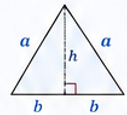
For an isosceles triangle with two equal sides of length \(a\) and a base of length \(2b\):
Semi-perimeter:
\(s = \frac{a + a + 2b}{2} = a + b\)
Applying Heron's Formula:
\(\text{Area} = \sqrt{(a + b)((a + b) - a)((a + b) - a)((a + b) - 2b)}\)
\(\text{Area} = \sqrt{(a + b)(b)(b)(a - b)} = \sqrt{b^2(a+b)(a-b)} = b\sqrt{a^2 - b^2}\)
(This is identical to evaluating a split right-triangle with base \(b\) and height \(h = \sqrt{a^2 - b^2}\) ).
Case C: Right-Angled Triangle (Pythagorean Triplet)
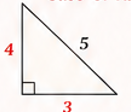
Example:
Consider a triangle with side lengths \(3\), \(4\), and \(5\) units:
Semi-perimeter: \(s = \frac{3 + 4 + 5}{2} = 6\)
Applying Heron's Formula:
\(\text{Area} = \sqrt{6(6 - 3)(6 - 4)(6 - 5)} = \sqrt{6 \times 3 \times 2 \times 1} = \sqrt{36} = 6 \text{ sq. units}\)
(By the converse of the Pythagoras theorem, this is a right-angled triangle with base \(3\) and height \(4\), yielding \(\frac{1}{2} \times 3 \times 4 = 6\) sq. units ).
3. Underlying Proof Strategy
While multiple proofs exist, the primary geometric proof relies on the following components:
Dropping an altitude (height \(h\)) from one vertex to the opposite side to split the triangle into two right-angled triangles.
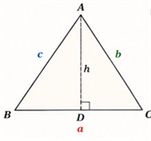
Setting up a system of algebraic equations using the Baudhāyana–Pythagoras theorem to express the unknown height \(h\) solely in terms of sides \(a\), \(b\), and \(c\).
Substituting this expression back into \(\text{Area} = \frac{1}{2}bh\) and expanding via the repeated algebraic application of the difference-of-two-squares identity:
\(x^2 - y^2 = (x - y)(x + y)\)