

Perimeter
The perimeter of any geometric shape is the total length around its continuous boundary. If you imagine walking along the border without backtracking until you return to the starting point, the total distance traveled is the perimeter.

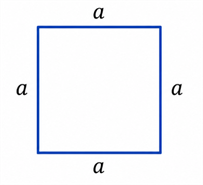
Square: A square with side \(a\) has a perimeter of \(4a\).
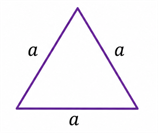
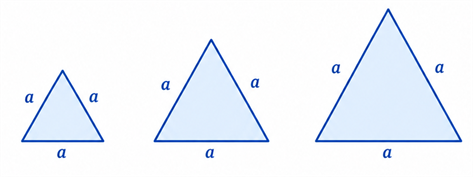
Equilateral Triangle: A triangle with side \(a\) has a perimeter of \(3a\).
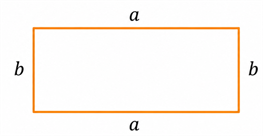
Rectangle: A rectangle with length \(a\) and width \(b\) has a perimeter of \(2(a + b)\). (A square is a "special case" of a rectangle where \(a = b\).)
Proportionality Ratios (The \(C/D\) Ratio)
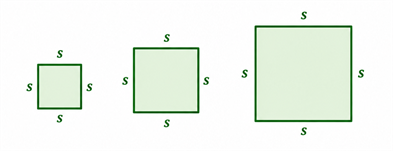
For any regular polygon or circle, the ratio of its perimeter to its fundamental linear dimension remains completely constant, regardless of its size:
\( \text{Ratio} = \frac{\text{Perimeter (Circumference)}} {\text{Fundamental Linear Dimension}} \)
Squares: The ratio of the perimeter to the side is always fixed at \(4:1\).
Equilateral Triangles: The ratio of the perimeter to the side is always fixed at \(3:1\).
Circles: The ratio of a circle's perimeter (called the circumference, \(C\)) to its diameter (\(D\)) is always fixed. This invariant constant is denoted by the Greek letter \(\pi\) (pi).
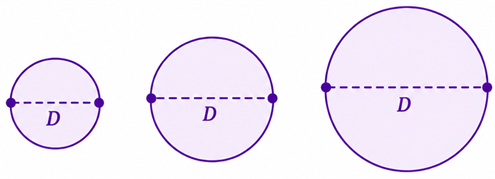
The Properties of \(\pi\) (Pi)
\(\pi = \frac{\text{Circumference (C)}}{\text{Diameter (D)}}\)
That is, \( \frac{\text{C}}{\text{D}}=\pi\)
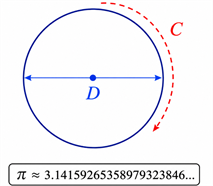
Irrationality: \(\pi\) is an irrational number, meaning it cannot be written as a simple fraction \(\frac{a}{b}\) of two integers. Its decimal expansion goes on forever without repeating a rhythmic pattern.
Important!
Fun Fact:
A simple way to remember the first digits of \(\pi\) is the sentence "How I wish I could recollect pi."
The number of letters in each word gives 3.141592. Since \(\pi \approx 3.14\) (or \(\frac{22}{7}\)), March \(14\) is celebrated as Pi Day.
Key Historical Approximations:
Ancient Mesopotamia: \(\approx 3.125\)
Archimedes (Greece): Archimedes estimated the value of \(\pi \) by bounding (or "trapping") a circle between two geometric shapes
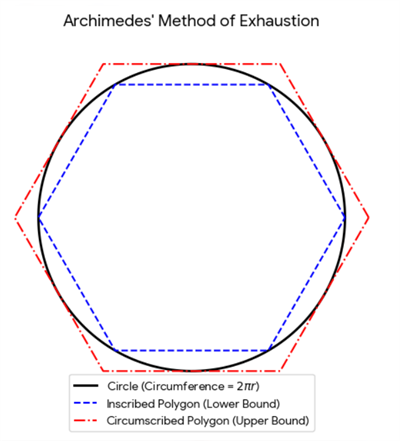
By using a \(96\)-sided polygon, Archimedes determined that the true value of \(\pi \) is securely trapped between these two mixed fractions:
\(3\frac{10}{71} < \pi < 3\frac{1}{7}\)
Lower Bound (\(3\frac{10}{71})\approx3.1408\) (from the inner polygon)
Upper Bound (\(3\frac{1}{7})\approx3.1428\) (from the outer polygon)
Zu Chongzhi (China): \(\frac{355}{113} \approx 3.1415929\) (Extremely accurate fractional approximation)
Modern standard practical approximation: \(\frac{22}{7} \approx 3.14\)
Exact Analytical Discovery: The Indian mathematician Mādhava of Sangamagrāma discovered the first exact analytical formula for \(\pi\) using an infinite series, laying the foundations for early calculus:
\(\frac{\pi}{4} = 1 - \frac{1}{3} + \frac{1}{5} - \frac{1}{7} + \dots\)
Home Experiment to the value of \(\pi\):
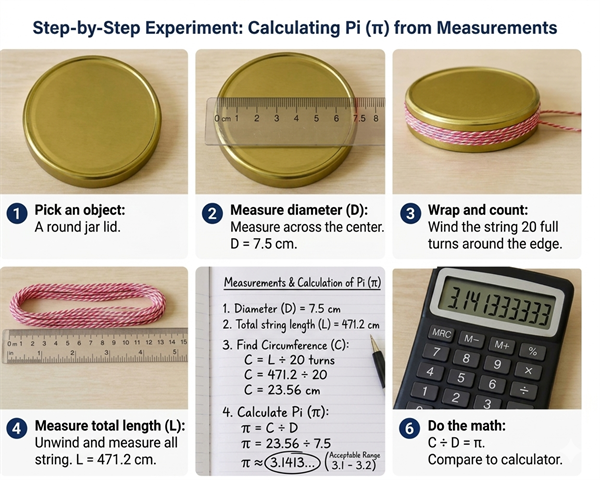
You should get the value between \(3.1\) and \(3.2\)
Length of an Arc of a Circle
An arc is a portion of a circle's circumference. Its length depends directly on the angle (\(\theta^\circ\)) it subtends at the circle's center:
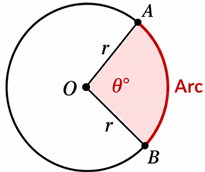
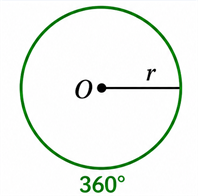
Full Circumference: \(C = \pi d = 2\pi r\) (where \(d\) is diameter and \(r\) is radius)
Semicircle Arc: \(\frac{1}{2}\) of a circle, subtending \(180^\circ\):
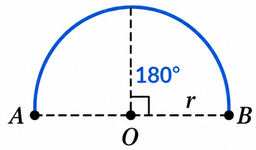
\(\text{Arc Length} = 2\pi r \times \frac{180^\circ}{360^\circ} = \pi r\)
Quarter Circle Arc: \(\frac{1}{4}\) of a circle, subtending \(90^\circ\):
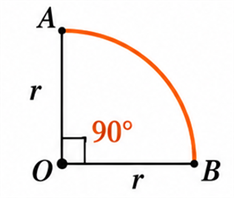
\(\text{Arc Length} = 2\pi r \times \frac{90^\circ}{360^\circ} = \frac{\pi r}{2}\)
General Arc Formula: For any central angle \(\theta^\circ\):
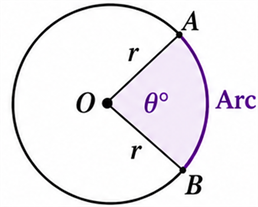
\(\text{Arc Length} = 2\pi r \times \frac{\theta^\circ}{360^\circ}\)
Notable Mathematical Paradoxes on Perimeter
Let's discuss an intersecting problem around the theme of perimeter.
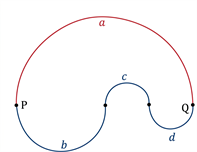
In the following figure, we see points \(P\) and \(Q\) and two paths connecting them. The first path is made up of the semicircle \(a\) The other path is made up of three semicircles \(b\), \(c\) and \(d\). Which path is longer?
Solution:
The Goal: Determine which path is longer.
The length of any semicircle is \(\pi \times \text{radius}\).
Let the radii of the semicircles \(a\), \(b\), \(c\), \(d\) be denoted by \(a'\), \(b'\), \(c'\) and \(d'\).
Path \(1\) length \(= \pi a'\) (where \(a'\) is the large radius).
Path \(2\) length \(= \pi(b' + c' + d')\) (the sum of the smaller radii).
Since the straight line \(PQ\) is the total diameter for both paths, the large diameter equals the sum of the small diameters (\(2a' = 2b' + 2c' + 2d'\)), which simplifies to \(a' = b' + c' + d'\).
Hence Both paths have equal length.
Important!
If you keep making the semicircles smaller, the bumpy line eventually looks perfectly straight. However, the math proves that the total length of these tiny bumps never changes. This creates a fun paradox where a line looks straight to your eyes but still holds both curves' length.
Summary Table of Formulas:
| Geometric Shape / Element |
Perimeter / Boundary Length Formula
|
|
Rectangle
|
\(2 \times (\text{length} + \text{breadth})\)
|
|
Triangle (Base & Height)
|
\(\text{Sum of all three sides}\)
|
|
Triangle (Three Sides \(a, b, c\))
|
\(a + b + c\)
|
|
Circle
|
\(2\pi r\)
|
|
Circular Arc
|
\(\text{Arc Length } (l) = 2\pi r \times \frac{\theta^\circ}{360^\circ}\)
|