1. Perimeter
The perimeter of any geometric shape is the total length around its continuous boundary. If you imagine walking along the border without backtracking until you return to the starting point, the total distance travelled is the perimeter.
| Square | 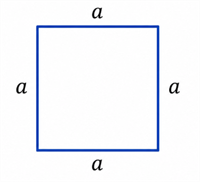 |
Perimeter \(= 4a\) |
| Rectangle | 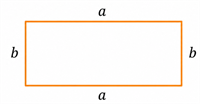 |
Perimeter \(= 2(a + b)\) |
| Equilateral triangle | 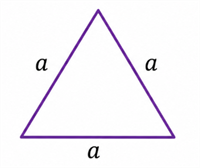 |
Perimeter \(= 3a\) |
2. The \(C/D\) ratio
For any regular polygon or circle, the ratio of its perimeter to its fundamental linear dimension remains completely constant, regardless of its size:
\(\text{Ratio} = \frac{\text{Perimeter (Circumference of the circle)}}{\text{Fundamental linear dimension}}\)
The ratio of a circle's perimeter (called the circumference, \(C\)) to its diameter (\(D\)) is always fixed. This invariant constant is denoted by the Greek letter \(\pi\) (pi).
3. \(\pi\) is irrational
\(\pi = \frac{\text{Circumference} (C)}{\text{Diameter} (D)}\)
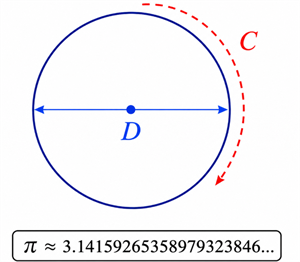
Irrationality: \(\pi\) is an irrational number, meaning it cannot be written as a simple fraction \(\frac{a}{b}\) of two integers. Its decimal expansion goes on forever without repeating a rhythmic pattern.
4. Length of an arc of a circle
An arc is a portion of a circle's circumference. Its length depends directly on the angle (\(\theta^{\circ}\)) it subtends at the circle's center:
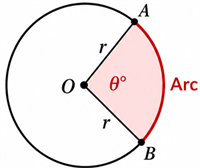
Full circumference: \(C = \pi d = 2 \pi r\) (where \(d\) is the diameter and \(r\) is the radius)
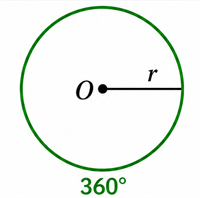
Arc length \(= \frac{\theta}{360^{\circ}} \times 2 \pi r\)
Special cases of arc length:
(a) Semicircle:
A semicircle is half of a circle. Its central angle is \(180^{\circ}\).
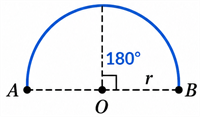
Arc length of a semicircle \(= \frac{180^{\circ}}{360^{\circ}} \times 2 \pi r = \pi r\)
(b) Quarter circle:
A quarter circle is one-fourth of a circle and its central angle is \(90^{\circ}\).
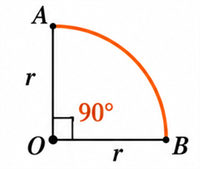
Arc length of a quarter circle \(= \frac{90^{\circ}}{360^{\circ}} \times 2 \pi r = \frac{1}{2} \pi r\)
5. Area of shapes
Area measures the space inside a \(2\)-D shape. The unit is a \(1 \times 1\) square.
- Rectangle: \(ab\)
- Parallelogram: base \(\times\) height. Cut off a triangle and shift it to make a rectangle. For a "thin" parallelogram, shift repeatedly.
- Triangle: \(\frac{1}{2} \times\) base \(\times\) height. Two copies of a triangle make a parallelogram.
- Median theorem: A median divides a triangle into two triangles of equal area, because they have equal bases and the same height.
- A parallelogram's area cannot be found from its side lengths alone. Its area changes as the angle changes.
6. Heron's and Brahmagupta's formula
Heron's formula (Alexandria) gives the area of a triangle from its sides alone.
Semi-perimeter, \(s = \frac{a + b + c}{2}\)
Area of the triangle, \(A = \sqrt{s(s - a)(s - b)(s - c)}\)
Brahmagupta's formula (\(628\) CE) gives the area of a cyclic quadrilateral (a quadrilateral whose vertices lie on a circle)
If the sides of the cyclic quadrilateral are a, b, c and d, then the semi-perimeter is \(s = \frac{a + b + c + d}{2}\).
Then, its area \(= \sqrt{(s−a)(s−b)(s−c)(s−d)}\)
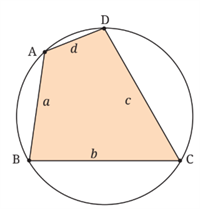
Generalisation: Imagine a cyclic \(4\)-gon, but let one of its sides shrink down until its length is zero (\(d = 0\)). When a side shrinks to zero, two vertices collide, and the \(4\)-gon transforms into a triangle! Since any triangle can have a circle drawn through its three corners, this "\(3\)-sided \(4\)-gon" is automatically cyclic.
Substituting \(d = 0\) into Brahmagupta's formula, we have:
Semi-perimeter \(s = \frac{a + b + c + d}{2}\)
\(s = \frac{a + b + c}{2}\) [Since \(d = 0\)]
Similarly, Area \(= \sqrt{(s - a)(s - b)(s - c)(s - d)}\)
\(= \sqrt{(s - a)(s - b)(s - c)(s - 0)}\)
\(= \sqrt{s(s - a)(s - b)(s - c)}\)
By treating a triangle as a special quadrilateral with one side equal to zero, Brahmagupta’s formula effortlessly turns into Heron’s formula.
7. Squaring a rectangle
"Squaring a shape" means building a square of equal area. Baudhāyana (Śulbasūtra, 800 BCE) squared a rectangle \(a \times b\) using the Pythagorean theorem and the identity \((\frac{(a+b)}{2})² − (\frac{(a−b)}{2})² = ab\). The side of the square is then \(\sqrt{ab}\).
8. Area of a circle
Area of a circle \(= \pi r^2\)
A sector is the region enclosed by two radii and the arc between them.
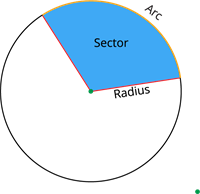
Using the same reasoning as for arc length (symmetry/rotation arguments):
(a) Semicircular disc (half-turn symmetry/reflection symmetry):
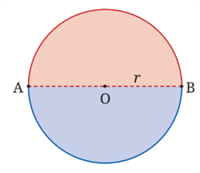
\(\text{area} = \frac{180^{\circ}}{360^{\circ}} \times \pi r^2\) \(= \frac{\pi r^2}{2}\)
(b) Quarter circular disc (quarter-turn symmetry):
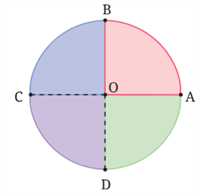
\(\text{area} = \frac{90^{\circ}}{360^{\circ}} \times \pi r^2\) \(= \frac{\pi r^2}{4}\)
General formula: If the sector's arc subtends an \(\theta^{\circ}\) at the centre \(O\), the sector's area is that same fraction of the whole circle's area:
\(\text{Area of the sector} = \pi r^2 \times \frac{\theta}{360^{\circ}}\)
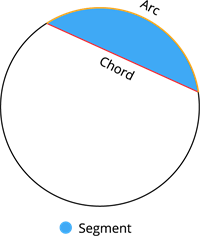
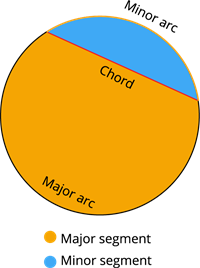
The region enclosed by the chord and the arc is called the segment of the circle.
Important!
The region enclosed by the chord and the minor arc is called the minor segment, and the region enclosed by the chord and the major arc is called the major segment.