

Distance formula
The distance formula is used to compute the distance between two definite points.
Distance formula for a line segment parallel to an axis:
Line segment parallel to \(x\)-axis: Let the points be \(A\) and \(B\), and let the coordinates be (\(x_1\), \(y\)) and (\(x_2\), \(y\)) respectively.
In both coordinates, \(y\) is the same, as both points lie on the same horizontal line (parallel to the \(x\)-axis).
In this case, the points lie either on the \(x\)-axis or parallel to \(x\)-axis.
In such a case, the distance formula will be:
\(\text{Distance}\) \(=\) \(|x_2 - x_1|\)
Line segment parallel to \(y\)-axis: Let the points be \(A\) and \(B\), and let the coordinates be (\(x\), \(y_1\)) and (\(x\), \(y_2\)) respectively.
In both coordinates, \(x\) is the same, as both points lie on the same vertical line (parallel to the \(y\)-axis).
In this case, the points lie either on the \(y\)-axis or parallel to \(y\)-axis.
In such a case, the distance formula will be:
\(\text{Distance} = |y_2 - y_1|\)
Distance formula if the line segment is not parallel to an axis:
Not all line segments are parallel to an axis.
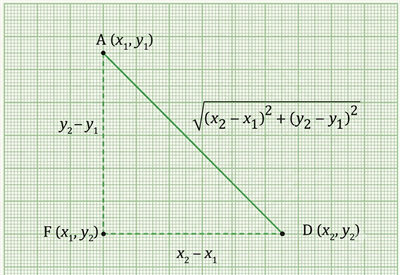
Consider any two points \(A(x_1,y_1)\) and \(D(x_2,y_2)\). Draw \(AF\) perpendicular to \(FD\).
Then \(F = (x_1,y_2)\)
Thus, \(AFD\) is a right-angle triangle at \(F\).
Since \(A\) and \(F\) have the same \(x\)-coordinate, then the length of the vertical side is \(AF = y_2 - y_1\).
Similarly, \(D\) and \(F\) have the same \(y\)-coordinate, then the length of the horizontal side is \(DF = x_2 - x_1\)
Applying Baudhāyana–Pythagoras theorem, we have:
\(AD^2 = AF^2 + FD^2\)
\(AD^2 = (y_2 - y_1)^2 + (x_2 - x_1)^2\)
\(AD = \sqrt{(x_2 - x_1)^2 + (y_2 - y_1)^2}\)
Therefore, the distance between any two points can be determined using the formula \(d = \sqrt{(x_2 - x_1)^2 + (y_2 - y_1)^2}\).
Let us look at the following example.
Find the distance between the points given in the figure below.
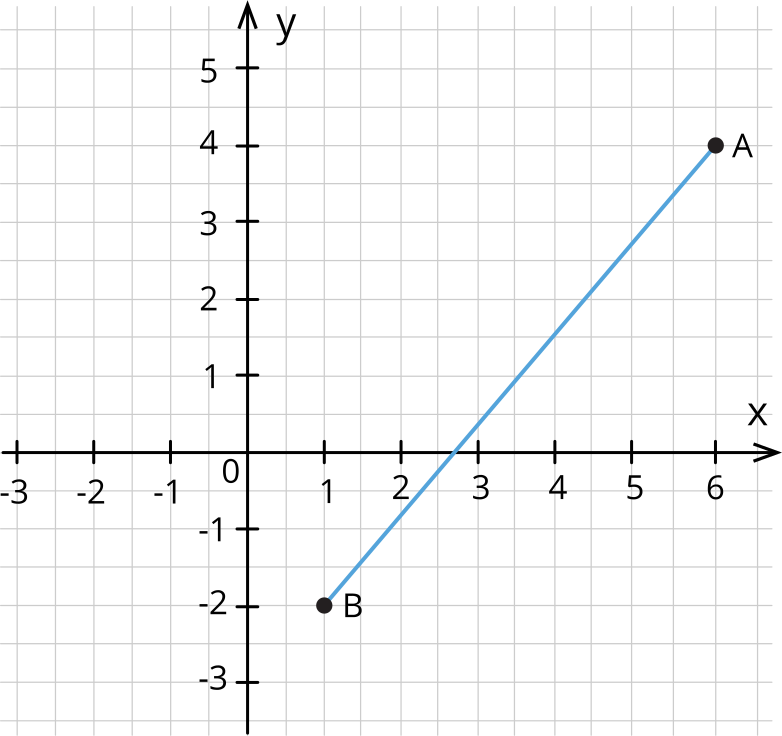
The coordinates of point \(A\)(\(x_1\), \(y_1\)) is (\(6\), \(4\)).
The coordinates of point \(B\)(\(x_2\), \(y_2\)) is (\(1\), \(-2\)).
\(x_1 = 6\)
\(x_2 = 1\)
\(y_1 = 4\)
\(y_2 = -2\)
The distance between the points \(A\) and \(B\) can be obtained using the distance formula.
\(\text{Distance} = \sqrt{(x_2 - x_1)^2 + (y_2 - y_1)^2}\)
\(= \sqrt{(1 - 6)^2 + (-2 - 4)^2}\)
\(= \sqrt{(-5)^2 + (-6)^2}\)
\(= \sqrt{25 + 36}\)
\(= \sqrt{61}\)
Important!
The distance of a point \(P(x,y)\) from the origin can be determined using the formula:
\(d = \sqrt{x^2 + y^2}\)
Geometric shape's pattern recognition using the distance formula
1. A triangle is right-angled if the square of the longest side equals the sum of the squares of the other two sides.
2. If the lengths of two sides of a triangle are equal, then it is an isosceles triangle.
3. If the lengths of three sides of a triangle are equal, then it is an equilateral triangle.
4. A quadrilateral is a rectangle if the lengths of its opposite sides are equal and the lengths of its two diagonals are also equal.
5. A quadrilateral is a parallelogram if the lengths of its opposite sides are equal.
6. A quadrilateral is a rhombus if the lengths of all four sides are equal.
7. A quadrilateral is a square if the lengths of all four sides are equal and the lengths of its two diagonals are also equal.
8. If the lengths of all the points from the centre of the circle are equal, then the obtained length is the radius of the circle.