

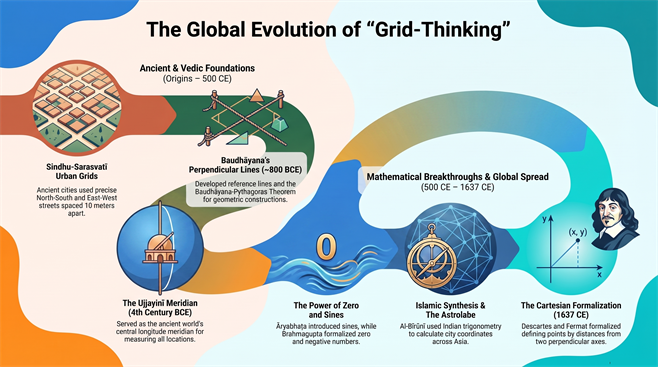
Evolution of coordinate geometry
The \(2\)-D Cartesian Coordinate System

In the above number line, the position of point \(P\) on the line can be represented as \(6\) units with reference to the origin.
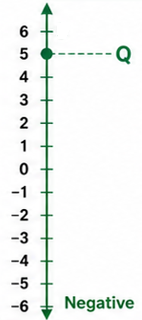
A similar rule applies to the negative side of the number line as well. It is possible to represent the position of a point with reference to more than one point.
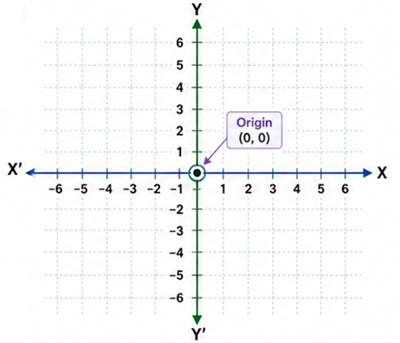
Descartes invented the use of two such number lines, perpendicular to each other, on a plane and locating points on the plane by referring to these lines. Let us combine these \(2\) lines in such a way that they are perpendicular to each other. These two lines intersect each other at the point \((0,0)\).
Cartesian system:
- It is a coordinate number system used to describe the position of a point in two dimensions by means of two perpendicular lines (\(x\)-axis and \(y\)-axis).
- The line \(X'OX\) is the horizontal line called the \(x\) - axis.
- The line \(Y'OY\) is the vertical line called the \(y\) - axis.
Co-ordinate axes:
The plural form of the axis is called the axes. A number line represented horizontally is the \(x\) - axis, and a number line represented vertically is the \(y\) - axis. Joining both lines together at the origin is called the \(xy\) plane, or Cartesian plane, or Co-ordinate axes.
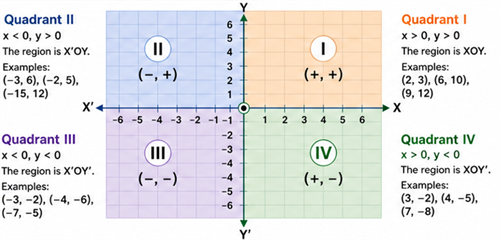
Quadrants:
Coordinate of a point on the axes:
If a point lies on the \(x\) - axis, then the coordinate is \((x,0)\). That is, \(y = 0\).
If a point lies on the \(y\) - axis, then the coordinate is \((0,y)\). That is, \(x = 0\).
Ordered pairs
Let us plot a point on the graph. The point is denoted by \((a,b)\), where \(a\) is the distance along the \(X\) - axis and \(b\) is the distance along the \(Y\) - axis. This pair \((a,b)\) is called an ordered pair. The ordered pair helps us identify the point correctly.
The \(x\) - coordinate in the ordered pair is called the abscissa, and the \(y\) - coordinate in the ordered pair is called the ordinate.
Here, the ordered pair is \((a,b)\), where \(a\) is the \(x\) - coordinate or the abscissa, and \(b\) is the \(y\) - coordinate or the ordinate.
Example:
Let us draw a point on the graph and name it \(A\). Here, the ordered pair is \((2,5)\).
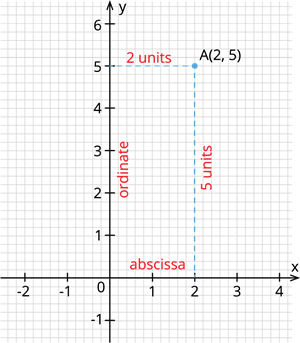
The \(x\) - coordinate or the abscissa of the ordered pair is \(2\) units, and the \(y\) - coordinate or the ordinate is \(5\) units.
Important!
The ordered pair \((a,b)\) and \((b,a)\) is not the same.
Line parallel to the \(x\) - axis:
Consider drawing a line parallel to the \(x\) - axis. If the distance from the \(x\) - axis and the line is the same, then the line can be represented as \(y = c\) (where \(c\) is a constant).
Line parallel to the \(y\) - axis:
Consider drawing a line parallel to the \(y\) - axis and the distance between the \(y\) - axis and the line is the same, then the line can be represented as \(x = c\) (where \(c\) is a constant).