

We see patterns around us everywhere, in nature, art, music, finance and in many other contexts in everyday life. Patterns helps us make a sense of the world and predict what comes next. In mathematics, sequences are special kinds of patterns formed by numbers or other objects arranged in particular order.

| Sequence | Pattern |
| Natural Numbers: \(1,\,2,\,3,\,4,\,5,\,6,\ldots\) |
Each term is one more than the previous term.
|
| Odd Numbers: \(1,\,3,\,5,\,7,\,9,\,11,\ldots\) | Each term is two more than the previous term. |
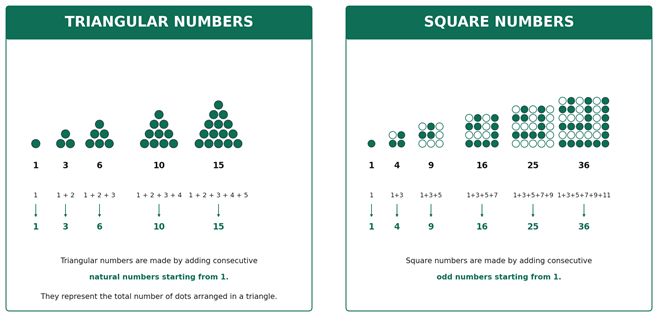
| Triangular Numbers: \(1,\,3,\,6,\,10,\,15,\,21,\ldots\) | Each term is the sum of the natural numbers up to that term. |
| Square Numbers: \(1,\,4,\,9,\,16,\,25,\,36,\ldots\) | Each term is the sum of the odd numbers up to that term. |
Note: The three dots \(\ldots\) indicate that the sequence continues indefinitely.
Sequence and Term
A sequence is an ordered list of numbers where each number is called a \(\text term\) of the sequence
Example:
In the sequence of square numbers \(1, 4, 9, 16, 25, \ldots\)
\(1\) is the first term, \(4\) is the second term, \(25\) is the fifth term, and so on.
Finite and Infinite Sequences
Finite Sequence: A sequence with a fixed number of terms. \(2,\,4,\,6,\,8,\,10.\) \((5\text{ terms})\)
Infinite Sequence: A sequence that continues without end. \(1,\,2,\,3,\,4,\,5,\,\ldots\)
Sequence Notation
we use \(t_1,\, t_2, \, t_3,\, \ldots\)
where \(t_1\) is a first term, \(t_2\) is a second term, \(t_3\) is a third term.
Different letters may also be used.
Different letters may also be used.
\(t_1,t_2,t_3,\ldots\)
\(s_1, \, s_2,\, s_3, \, \ldots\)
\(u_1,\, u_2,\, u_3,\, \ldots\)
Example:
Sequences may contain fractions or negative integers.
\(1,\, \frac{1}{2},\, \frac{1}{3}, \, \frac{1}{4},\, \ldots\)
\(-7,\, -3,\, 1,\, 5, \, 9,\, \ldots\)
\(-7,\, -3,\, 1,\, 5, \, 9,\, \ldots\)
Here, \(n\) is always a non-negative integer, but the term itself can be negative or any real number.
Explicit Rule for a Sequence
An explicit formula uses the term's position number \(n\) to calculate its value.
Example:
\(u_n = 2\,n - 1\)
Substituting,
\(u_1 = (2 \times 1) - 1 = 1\)
\(u_2 = (2\times2) - 1 = 3\)
\(u_3 = (2\times3) - 1 = 5\)
Thus, \(u_n = 2n - 1\) is the explicit rule for the odd number sequence.
Substituting,
\(u_1 = (2 \times 1) - 1 = 1\)
\(u_2 = (2\times2) - 1 = 3\)
\(u_3 = (2\times3) - 1 = 5\)
Thus, \(u_n = 2n - 1\) is the explicit rule for the odd number sequence.
Important!
Note : An explicit formula helps us find any term directly without finding the previous terms.
It can also be used to check whether a number belongs to the sequence and determine its position.
It can also be used to check whether a number belongs to the sequence and determine its position.
Example:
1. Given the explicit rule \(u_n = 2\,n - 1\)
\(53^{\text{rd}}\) term:
\(53^{\text{rd}}\) term:
\(u_ { 53 } = 2 (53) - 1\)
\( = 106 - 1 = 105 \)
Therefore, the \(53^{\text{rd}}\) term is \(105\).
2 (i) Check whether \(308\) is a term of the sequence \(s_n=5\,n-2\)
Substitute \(s_n = 308\).
\(5\,n - 2 = 308\)
\(5\,n = 310\)
\(n = 62\)
Since \(62\) is a natural number, \(308\) is the \(62^{\text{nd}}\) term of the sequence.
(ii) Check whether \(471\) is a term of the sequence.
Substitute \(s_n = 471\).
\(5\,n-2 = 471\)
\(5\,n = 473\)
\(n = 94.6\)
Since \(94.6\) is not a natural number, \(471\) is not a term of the sequence.
Substitute \(s_n = 308\).
\(5\,n - 2 = 308\)
\(5\,n = 310\)
\(n = 62\)
Since \(62\) is a natural number, \(308\) is the \(62^{\text{nd}}\) term of the sequence.
(ii) Check whether \(471\) is a term of the sequence.
Substitute \(s_n = 471\).
\(5\,n-2 = 471\)
\(5\,n = 473\)
\(n = 94.6\)
Since \(94.6\) is not a natural number, \(471\) is not a term of the sequence.
Recursive Rule for a Sequence
A recursive rule describes a sequence by relating each term to previous terms.
Example:
\(u_1 = 1\)
\(u_n = u_{n-1} + 3 ,\quad n\ge2\)
Each term is obtained by adding \(3\) to the previous term.
Finding the successive terms,
\(1,\,1+3,\,4+3,\,7+3,\,10+3,\,13+3,\ldots\)
\(1,\,4,\,7,\,10,\,13,\,16,\ldots\)
\(u_n = u_{n-1} + 3 ,\quad n\ge2\)
Each term is obtained by adding \(3\) to the previous term.
Finding the successive terms,
\(1,\,1+3,\,4+3,\,7+3,\,10+3,\,13+3,\ldots\)
\(1,\,4,\,7,\,10,\,13,\,16,\ldots\)
Important!
The earlier terms must be known to find the next terms.
Virahānka–Fibonacci Sequence
The Virahānka–Fibonacci sequence begins with: \(V_1=1, V_2=2\)
From the third term onwards, each term is found by adding the two previous terms .
\(V_n=V_{n-1}+V_{n-2},\quad n\ge3\)
\(V_3=V_2+V_1=2+1=3\)
\(V_4=V_3+V_2=3+2=5\)
\(V_5=V_4+V_3=5+3=8\)
\(V_4=V_3+V_2=3+2=5\)
\(V_5=V_4+V_3=5+3=8\)
Therefore the Sequence is \(1,\,2,\,3,\,5,\,8,\,13,\,21,\,34,\,\ldots\)
Important!
1. The Fibonacci sequence was first studied by the Indian scholar Virahānka in the \(7^{\text{th}}\) century CE.
2. Later, it was studied by Gopāla, Hemachandra and the Italian mathematician Fibonacci.