

In the Sierpiński square carpet, each side of the square is divided into \(4\) equal parts, forming \(16\) smaller squares and the centre square is removed at every stage.
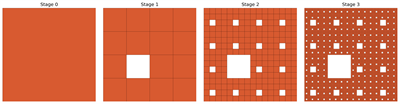
Assertion (A): If the area of the square in Stage \(0\) of the Sierpiński square carpet is \(1\) square unit, then the area of the red region remaining at Stage \(2\) is \(\dfrac{225}{256}\)square units.
Reason (R): At every stage of the Sierpiński square carpet, the red region retains \(\dfrac{14}{16}\) of the red region of the previous stage, so the areas form a \(G.P\) with common ratio \(\dfrac{14}{16}\).
Reason (R): At every stage of the Sierpiński square carpet, the red region retains \(\dfrac{14}{16}\) of the red region of the previous stage, so the areas form a \(G.P\) with common ratio \(\dfrac{14}{16}\).