

Let \(N\) be the midpoint of a line segment \(KL\), let \(P\) be a point not on line \(KL\).
Confirm "If \(P\) lies on the perpendicular bisector of \(KL\), then \(PK\ =\ PL\)". State and Confirm the converse.
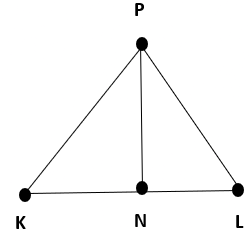
Given: \(N\) be the midpoint of a line segment \(KL\). Join \(PK , PL\) and \(PN\).
Proposition: If \(P\) lies on the perpendicular bisector, i.e \(PN\) is to \(KL\) then \(PK\ =\ PL\)
In \(\triangle PKN\) and \(\triangle PLN\)
\(KN =\) (As \(N\) is midpoint)
= (Common side)
\( \angle PNK\ =\angle\) (it is \(90^ \circ \)
Hence \(\triangle PKN \cong \triangle PLN\) by .
By CPCT \(PK\ =\)
Converse: If \(PK\ =\) then \(P\) lies on the bisector of \(KL\)
In \(\triangle PKN\) and \(\triangle PLN\)
\(PK\ =\) (Given)
= (Common side)
\(KN=\) (\(N\) is midpoint )
Thus \(\triangle PKN \cong \triangle PLN\) by
By CPCT, \(\angle PNK\ =\ \angle\)
These angles form a straight angle so they sum to \(^\circ \)
So, \(\angle PNK\) \(+\) \( \angle\) \(=\)\(^\circ \)
Hence, \(\angle PNK\) \(=\) \(^\circ\) and \( \angle\) \(=\) \(^\circ\)
Therefore, \(P\) lies on the bisector of \(KL\).