Sample space and events
The sample space is the set of all possible outcomes of a random experiment. It is represented by \(S\). Each individual outcome is called an element of the sample space.
Rules for a valid sample space:
- The sample space must contain all possible outcomes.
- No outcome should be repeated.
The number of elements in the sample space is denoted by \(n(S)\).
| Experiment | Sample space | \(n(S)\) |
| Tossing \(1\) coin | \(\{H, T\}\) | \(2\) |
| Tossing \(2\) coins | \(\{HH, HT, TH, TT\}\) | \(4\) |
| Rolling a die | \(\{1, 2, 3, 4, 5, 6\}\) | \(6\) |
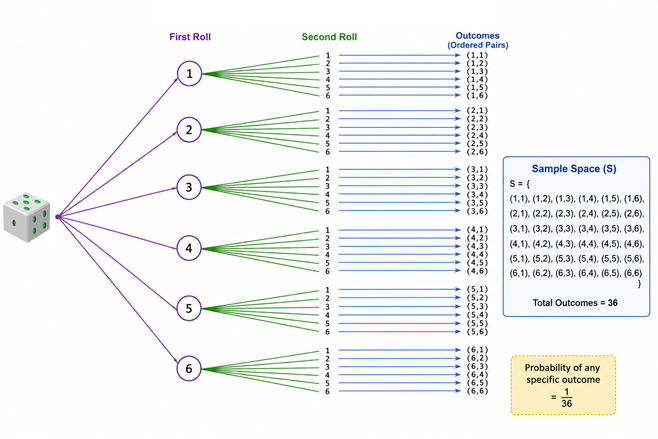
| Rolling \(2\) dice | \(36\) |
Event:
An event is a collection of one or more outcomes from the sample space. Thus, every event is a subset of the sample space.
Example:
Getting an even number from rolling a die.
Solution:
Sample space, \(S = \{1, 2, 3, 4, 5, 6\}\)
Getting an even number, \(E = \{2, 4, 6\}\)
Here,
Tree diagram
A tree diagram is a pictorial method for showing all possible outcomes of a multi-step experiment.
It helps us:
- organise outcomes systematically,
- avoid missing any outcome,
- calculate probabilities easily.
Let's toss a coin and write the possible outcomes(Head or Tail) using a tree diagram.
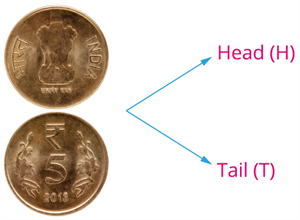
So, the sample space of tossing a coin is \(S = \{H,T\}\).
Let's toss \(2\) coins and write all the possible outcomes of this experiment using a tree diagram.
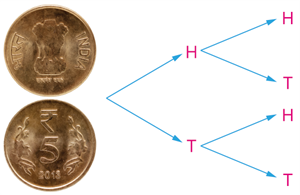
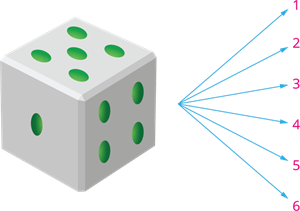
Similarly, when we throw a die, there are \(6\) possible outcomes. We can make a tree diagram for this as well.
Constructing tree diagrams:
Step 1: Draw a starting point.
Step 2: Draw a branch to list all the outcomes after the first toss/roll.
Step 3: Draw a second branch listing all possible outcomes from Step 2.
Step 4: Continue for additional steps if needed.
Step 5: Each complete path from start to the end of the last branch represents one outcome in the sample space.
Example:
Draw a tree diagram of rolling a die twice.