

Irrational numbers:
An irrational number is a number that cannot be expressed as a fraction \(p/q\), \(q \neq 0\) for any integers \(p\) and \(q\).
Example:
\(\sqrt{2}\), \(\sqrt{3}\), \(\sqrt{5}\),...
Some of the famous irrational numbers:
|
Irrational Number
|
Its non-terminating and non-recurring decimal value
|
| \(\pi\) | \(3.141592653589793\)... |
| \(e\) | \(2.718281828459045\)... |
| \(\phi\) | \(1.618033988749894\)... |
Working rule to prove the irrationality of a number:
Let \(x\) be the given irrational number or expression.
Step - 1: Assume the given number \(x\) is rational.
Step - 2: Write in the form \(x = \frac{p}{q}\) where \(p\) and \(q\) are integers and \(q \neq 0\).
Step - 3: Rearrange and simplify the given expression algebraically.
Step - 4: Arrive at a contradiction that an irrational number is a rational number or an impossible condition like \(p\) and \(q\) having a common factor when assumed coprime.
Step - 5: Thus, arrive at a conclusion that the assumption is false and prove the given number or expression \(x\) is irrational.
Operation on irrational numbers:
1. The sum of two irrational numbers is either a rational number or an irrational number.
2. The difference of two irrational numbers is either a rational number or an irrational number.
3. The sum of a rational number and an irrational number is always irrational.
4. The product of a rational number and an irrational number is always irrational.
Representation of irrational number on the number line:
German mathematicians, Cantor and Dedekind, discovered that 'Corresponding to every real number, there is a point on the real number line, and corresponding to every point on the number line, there exists a unique real number'.
Important!
Each real number can be represented by a unique point on the number line. Conversely, each point on the number line represents a unique real number.
Procedure to represent irrational number and on the number line.
We use the concept of Pythagoras Theorem to form square root numbers.
Pythagoras theorem says that 'In a right triangle, the square of the hypotenuse is equal to the sum of the squares of the other two sides'.
Step 1: Draw a number line and label the centre point as zero.
Step 2: Mark the right side of the zero as \(1, 2, 3,...\) and the left side as \(-1, -2, -3,...\).

Step 3: Since we need the principal square root value, we won't consider the negative side for measuring.
Step 4: Measure the length between \(0\) and \(1\) and draw a line perpendicular to point \(1\) such that the perpendicular line measures \(1\) unit.

Step 5: Join \(0\) and the end of the new line segment whose length is unity.
Step 6: Thus, a right-angled triangle is formed.
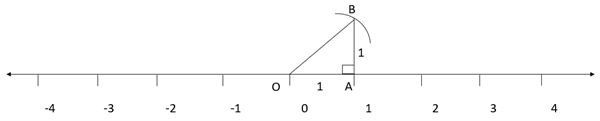
Step 7: Label the base, height and the hypotenuse of the triangle.
Step 8: Length of the hypotenuse can be determined by applying Pythagoras theorem.
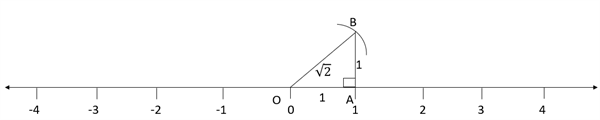
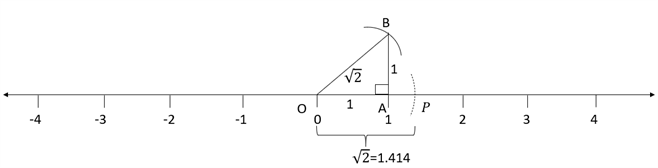
Step 9: Draw an arc on the number line by taking the hypotenuse as the radius and origin as the centre.
Step 10: Thus, the distance between origin and the new arc gives the representation of the square root of \(2\) on the number line. \(OB = OP =\) .
Step 11: Taking the hypotenuse of length as a base and drawing an arc perpendicular to the end of the hypotenuse by taking a unit length, will result in another right triangle with leg lengths
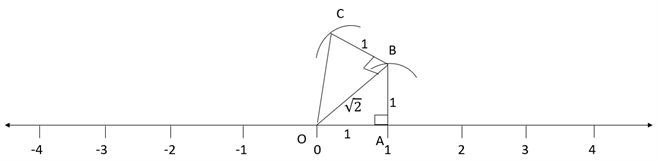
Step 12: Now drawing an arc on the number line by taking the length of the resultant hypotenuse will represent on the number line.
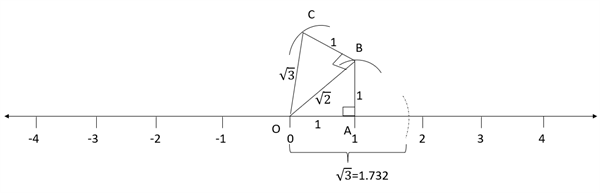
Step 13: By proceeding in the same way, we can locate for any positive integer \(n\), after .