

History of Numbers:
The need to count objects led to the development of numbers. Early humans used fingers, stones, marks, bones, and pebbles for counting. Archaeological discoveries such as the Lebombo Bone and the Ishango Bone show that counting existed over 20,000 – 35,000 years ago.
One to one correspondence:
Before number symbols were invented, people compared quantities by pairing one object with another.
This method laid the foundation for counting numbers, leading to the development of natural numbers.
Example:
\(1\) cow \(→\) \(1\) pebble
\(1\) student \(→\) \(1\) chair
\(1\) student \(→\) \(1\) chair
Types of Numbers:
| Number System | Definition | Examples |
| Natural Numbers \(\mathbb{N}\) | Natural Numbers are the counting numbers. | \({1, 2, 3, ... }\) |
| Whole number \(\mathbb{W}\) | The set of all natural numbers including \(0\) are called whole numbers. | \({0,1,2,3,...}\) |
| Integers \(\mathbb{Z}\) | Integers are the set of positive numbers, negative numbers and zero. | \({...,-3,-2,-1,0,1,2,3,...}\) |
| Rational numbers | A rational number is a number that can be expressed in the form of \(\frac{p}{q}\) where \(p\) and \(q\) are integer and \(q\neq 0\). | \(\frac{-1}{2}\), \(\frac{2}{5}\), \(\frac{7}{11}\), etc., |
| Irrational numbers | An irrational number is a number that cannot be expressed as a fraction \(p/q\), \(q \neq 0\) where for any integers \(p\) and \(q\). | \(\sqrt{2}\), \(\sqrt{3}\), \(\sqrt{5}\),... |
| Real numbers \(\mathbb{R}\) | Real numbers are the numbers which include both rational and irrational numbers. | All numbers on the number line |
Concept of zero:
Zero represents the absence of quantity and also acts as a placeholder in the place value system.
Example:
\(0\) apples means no apples.
\(10\), \(100\), \(5034\),..
Brahmagupta’s Rules for Zero:
• When zero is added to any number \(x\), the number remains unchanged. (i.e.) \(x + 0 = x\).
• When zero is subtracted from any number \(x\), the number remains unchanged. (i.e.) \(x – 0 = x\).
• When any number \(x\) is multiplied by zero, the result is zero. (i.e.) \(x × 0 = 0\).
• When zero is subtracted from any number \(x\), the number remains unchanged. (i.e.) \(x – 0 = x\).
• When any number \(x\) is multiplied by zero, the result is zero. (i.e.) \(x × 0 = 0\).
Arithmetic operation on integers:
Brahmagupta termed the positive numbers as fortunes and negative numbers as debts.| Operation | Result |
| Fortune \(+\) Fortune | Fortune |
| Debt \(+\) Debt | Debt |
| Fortune \(\times\) Debt | Debt |
| Debt \(\times\) Debt | Fortune |
Equivalent rational numbers:
Two rational numbers are said to be equivalent if they represent the same value, even though their forms may differ.Example:
\(\frac{1}{2}\) and \(\frac{2}{4}\) are equivalent.
Operations on Rational Numbers:
Addition and Subtraction:Case - (i): If denominators are the same, add or subtract the numerators.
Case - (ii): If denominators are different:
Step - 1: Find the LCM.
Step - 2: Make the denominators equal.
Step - 3: Add or subtract the numerators.
\(\frac ab\times\frac cd=\frac{ac}{bd}\)
\(\frac ab\div\frac cd=\frac ab\times\frac dc\)
Properties of Rational Numbers:
| Property | Rule |
| Equality | \(a \times d = b \times c\) |
| Closure | Closed under \(+, –, ×\) and \(÷\) (except division by zero) |
| Commutative |
|
| Distributive |
|
Representation of rational number on a number line:
Given a rational number \(\frac{p}{q}\), then the number is represented on the number line using the following procedure.Step -1: Draw a number line and mark the integers with the positive integers to the right of \(0\) and the negative integers to the left of \(0\).
Step - 2: Divide the interval between the two consecutive integers into \(q\) equal parts.
Step - 3: Starting from \(0\), move \(p\) parts to the right of \(0\) if the number is positive or to the left of \(0\) if the number is negative.
Step - 4: Now, locate the number \(\frac{p}{q}\) on the number line.
Step - 2: Divide the interval between the two consecutive integers into \(q\) equal parts.
Step - 3: Starting from \(0\), move \(p\) parts to the right of \(0\) if the number is positive or to the left of \(0\) if the number is negative.
Step - 4: Now, locate the number \(\frac{p}{q}\) on the number line.
Important!
For improper fractions, first convert them into mixed fractions.
Absolute value of a rational number:
The absolute value of a rational number \(a\), written as \(|a|\), represents the distance of \(a\) from \(0\) on the number line.The Density of Rational Numbers:
Between any two distinct rational numbers, there exist infinitely many other rational numbers.
Between any two rational numbers \(a\) and \(b\), there is always a rational number \(\frac{1}{2}(a+b)\), such that \(a < \frac{1}{2}(a+b) < b\).
Methods to find the rational number between any two rational numbers:
Method 1: Average method
1. Let the rational number be \(a\) and \(b\).
2. Add \(a\) and \(b\) and divide the sum by \(2\). That is, \(c = \frac{a+b}{2}\) which might lie in between those two number.
3. To get another rational number, find the average of \(c\) and \(a\), for one more rational number, find the average of \(c\) and \(b\). Proceeding in this way, you can find the infinite number of rational between two rational numbers.
2. Add \(a\) and \(b\) and divide the sum by \(2\). That is, \(c = \frac{a+b}{2}\) which might lie in between those two number.
3. To get another rational number, find the average of \(c\) and \(a\), for one more rational number, find the average of \(c\) and \(b\). Proceeding in this way, you can find the infinite number of rational between two rational numbers.
Method 2: Same denominator method
That is, make it as .
Now you can verify that the numbers between and are all rational numbers between \(a\) and \(b\).
This method gives all the required number of rational numbers between \(a\) and \(b\) in one step.
If we want to find \(n\) rational numbers between the numbers \(a\) and \(b\), we write \(a\) and \(b\) as rational numbers with denominator \(n + 1\).
If we want to find \(n\) rational numbers between the numbers \(a\) and \(b\), we write \(a\) and \(b\) as rational numbers with denominator \(n + 1\).
That is, make it as .
Now you can verify that the numbers between and are all rational numbers between \(a\) and \(b\).
Method 3: Increasing the decimal space
Given any two decimal numbers, rewrite them with more decimal places to create more space so as to obtain the decimal numbers lying between them.
Working rule to prove the irrationality of a number:
Let \(x\) be the given irrational number or expression.
Step - 1: Assume the given number \(x\) is rational.
Step - 2: Write in the form \(x = \frac{p}{q}\) where \(p\) and \(q\) are integers and \(q \neq 0\).
Step - 3: Rearrange and simplify the given expression algebraically.
Step - 4: Arrive at a contradiction that an irrational number is a rational number or an impossible condition like \(p\) and \(q\) having a common factor when assumed coprime.
Step - 5: Thus, arrive at a conclusion that the assumption is false and prove the given number or expression \(x\) is irrational.
Operation on irrational numbers:
| Operation | Result |
| Irrational \(+\) Irrational | Rational or Irrational |
| Irrational \(−\) Irrational | Rational or Irrational |
| Rational \(+\) Irrational | Irrational |
| Rational \(×\) Irrational | Irrational (except when the rational number is 0) |
Represntation of irrational number on the number line:
We use the concept of Pythagoras Theorem to form square root numbers.
Pythagoras theorem says that 'In a right triangle, the square of the hypotenuse is equal to the sum of the squares of its legs'.
Pythagoras theorem says that 'In a right triangle, the square of the hypotenuse is equal to the sum of the squares of its legs'.
Decimal expansion of real numbers:
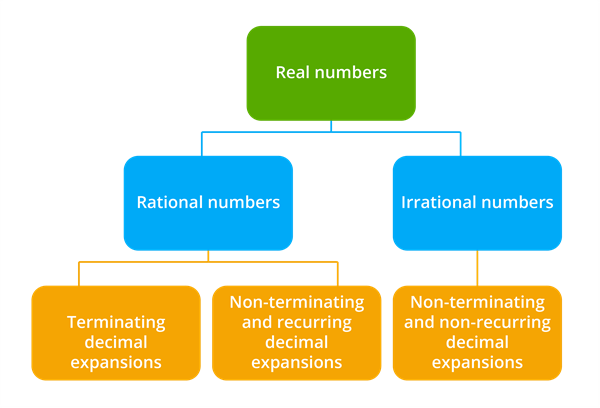
A terminating decimal is a decimal number that has the finite number of digits the decimal point.
A recurring decimal is a decimal number that has repeating number/numbers which continuous infinitely.
Predicting the type of decimal expansion:
The decimal expansion of a rational number \(\frac{p}{q}\), where \(q \neq 0\) will be terminating when the prime factors of \(q\) are only \(2\) or only \(5\) or both \(2\) and \(5\).Converting a decimal number to fractional form:
Case - (I): The decimal expansion is purely repeating (Eg: \(1.\overline{34}\)).Step - 1: Consider the given decimal number as \(x\).
Step - 2: Multiply \(x\) by \(10^{n}\) where \(n\) is the number of repeating digits.
Step - 3: Subtract the original number from the number obtained from step 2, then solve for \(x\).
Step - 2: Multiply \(x\) by \(10^{n}\) where \(n\) is the number of repeating digits.
Step - 3: Subtract the original number from the number obtained from step 2, then solve for \(x\).
Step - 1: Consider the given decimal number as \(x\).
Step - 2: Multiply \(x\) by \(10^{m}\) where \(m\) is the number of non-repeating digits.
Step - 3: Multiply \(10^{m}x\) by \(10^{n}\) where \(n\) is the number of repeating digits.
Step - 4: Subtract the numbers obtained from the previous two steps and solve for \(x\).
Step - 2: Multiply \(x\) by \(10^{m}\) where \(m\) is the number of non-repeating digits.
Step - 3: Multiply \(10^{m}x\) by \(10^{n}\) where \(n\) is the number of repeating digits.
Step - 4: Subtract the numbers obtained from the previous two steps and solve for \(x\).