

1. The need to count
- Mathematics began with a practical need to keep count, long before writing.
- One-to-one correspondence: a herder puts one pebble in a pot for each cow that leaves and removes one for each cow that returns. If pebbles remain, cows are missing. This is the birth of the Natural Numbers \(ℕ = {1, 2, 3, …}\).
- Lebombo Bone (South Africa/Eswatini, about \(35,000\) years old): \(29\) uniform notches, probably a lunar or menstrual calendar.
- Ishango bone (Congo, about \(20,000\) BCE): three columns of notches. One column groups them as \(11, 13, 17, 19\) (the primes between \(10\) and \(20\)). Another seems to show doubling. So the idea of "number" is tens of thousands of years old.
- India:
- Indus Valley cities such as Lothal and Harappa used standardised weights and measures for trade.
- The Vedas named powers of \(10\) up to \(10^{12}\) (parārdha). The Lalitavistara (\(4\)th century BCE) goes up to \(10^{53}\) (tallakṣhaṇa).
- The Ṛigveda used powers of \(10\), which set the stage for our decimal place-value system and for zero.
2. Zero (Śhūnya)
- Babylonians and Mayans used a placeholder for an empty column, but did not treat zero as a number.
- Philosophy to mathematics: in the Upanishads, Buddhist texts and Patanjali's Yoga Sutras, śhūnyatā (emptiness) was the goal of meditation. This gave Indian thinkers the mindset to accept "nothing" as a concept. It then entered architecture, literature and linguistics, and reached mathematics through Āryabhaṭa and Brahmagupta.
- Bakhśhālī Manuscript (early centuries CE): a bold dot (bindu) represents zero.
- Brahmagupta (Brāhmasphuṭasiddhānta, \(628\) CE) defined zero as \(a − a = 0\) and gave rules:
- \(a + 0 = a\)
- \(a − 0 = a\)
- \(a \times 0 = 0\)
3. Integers \(\mathbb{Z}\)
- Brahmagupta asked what \(6 − 9\) should be. His answer was a two-way number line: Dhana (fortune) is positive, and Ṛiṇa (debt) is negative. Together with zero, these form the Integers \(\mathbb{Z}\).
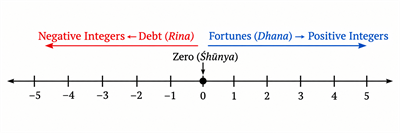
- His rules, based on fortunes and debts:
- fortune \(+\) fortune \(=\) fortune: \(2 + 5 = 7\)
- debt \(+\) debt \(=\) debt: \((-4) + (-2) = -6\)
- debt \(\times\) fortune \(=\) debt: \((−2) × 5 = −10\)
- debt \(\times\) debt \(=\) fortune: \((−2) × (−5) = 10\)
- Why \((−) × (−) = (+)\): removing \(4\) debts of \(₹3\) each leaves you \(₹12\) richer.
4. Rational numbers \(\mathbb{R}\)
A rational number can be written as \(\frac{p}{q}\) with \(p\), \(q\) integers and \(q \neq 0\). Division by zero is undefined.
- Key observations:
- \(\mathbb{N}\), whole numbers and \(\mathbb{Z}\) are all inside \(\mathbb{Q}\), since \(\frac{3}{1} = 3\)
- Representation is not unique: \(\frac{-2}{3} = \frac{-4}{6} = \frac{-6}{9}\). We use the lowest terms form (\(p\) and \(q\) co-prime).
- The negative sign can sit anywhere: \(-\frac{1}{4} = \frac{-1}{4} = \frac{1}{-4}\).
- Laws (Brahmagupta):
- Equality: \(\frac{a}{b} = \frac{c}{d}\) if \(ad = bc\).
- Add/subtract: use a common denominator, then \(\frac{a}{b} \pm \frac{c}{b} = \frac{(a ± c)}{b}\).
- Multiply: \(\frac{a}{b} \times \frac{c}{d} = \frac{ac}{bd}\).
- Divide: \(\frac{a}{b} \div \frac{c}{d} = \frac{a}{b} \times \frac{d}{c} = \frac{ad}{bc}\), with \(c \neq 0\).
- Addition and multiplication are commutative and obey the distributive law: \(p(q + r) = pq + pr\).
- Closure: \(\mathbb{Q}\) is closed under \(+\), \(−\), \(\times\) and \(\div\) (except division by \(0\)). By contrast, \(\mathbb{N}\) is closed under \(+\) but not under \(−\) (for example \(2 − 5 = −3\)).
5. Number line, Absolute value and Density
- Plotting \(\frac{p}{q}\): divide each unit interval into \(q\) equal parts and move \(p\) parts from \(0\), right if positive and left if negative. For example, \(\frac{11}{4} = 2 \frac{3}{4}\) lies three-fourth of the way from \(2\) to \(3\).
- Absolute value: \(|x|\) is the distance of \(x\) from \(0\), so \(|x| \geq 0\). For example, \(|\frac{−2}{3}| = \frac{2}{3}\).
- Distance between \(a\) and \(b\) is \(|a − b|\). For \(−2\) and \(3\) it is \(|-2 - 3| = |-5| = 5\).
- Density: Between any two rational numbers there is another, namely their average \(\frac{(a + b)}{2}\). So there are infinitely many rationals between any two points.
6. Irrational numbers
- History: Baudhāyana's Śhulbasūtra (about \(800\) BCE), used to build fire altars, met lengths that fractions could not describe. The Greeks hit the same crisis later.
- Where it appears: a unit square has diagonal \(d\) with \(1^2 + 1^2 = d^2\), so \(d = \sqrt{2}\) (Baudhāyana–Pythagoras Theorem).
- Definition: Irrational numbers cannot be written as p/q (Eg: \(\sqrt{2}, \pi, \sqrt{10}\)).
- Proof that \(\sqrt{2}\) is irrational (Hippasus, about \(400\) BCE), by contradiction:
- Assume \(\sqrt{2} = \frac{p}{q}\) in lowest terms (\(p\), \(q\) co-prime).
- Squaring gives \(2q^2 = p^2\), so \(p^2\) is even, and therefore \(p\) is even. Write \(p = 2k\).
- Substituting gives \(2q^2 = 4k^2\), so \(q^2 = 2k^2\), which means \(q\) is even.
- Both \(p\) and \(q\) are even, which contradicts "lowest terms." So \(\sqrt{2}\) is irrational.
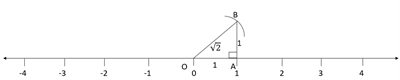
Locating \(\sqrt{2}\): draw \(OA = 1\), then \(AB = 1\) perpendicular to \(OA\).
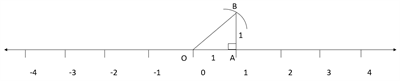
Then \(OB = \sqrt{2}\). With centre \(O\) and radius \(OB\), draw an arc that meets the number line at \(P\). The same idea, repeated, gives \(\sqrt{n}\). This is the square root spiral.
- \(\pi\):
- It is the ratio of a circle's circumference to its diameter.
- Āryabhaṭa (\(499\) CE) gave \(\frac{3927}{1250} = 3.1416\) but called it only an asanna (approximation).
- Lambert proved \(\pi\) irrational in \(1761\).
- Mādhava (\(14\)th century, Kerala School) found an exact infinite series: \(\pi = 4 \times (1 − \frac{1}{3} + \frac{1}{5} − \frac{1}{7} + …)\). An infinite sum means the value the partial sums get closer and closer to.
7. Real numbers and decimals
- \(\mathbb{R} =\) rationals \(+\) irrationals, which together fill the number line with no gaps.
- Decimals as a signature:
- Rational numbers have decimals that terminate (\frac{3}{8} = 0.375\)) or repeat (\frac{5}{11} = 0.4545… = 0.45\) with a bar).
- Irrational numbers have decimals that never end and never repeat (\(\sqrt{2} = 1.41421…\), \(\pi = 3.14159…\)).
- Why rationals repeat: dividing by \(q\) leaves only \(q − 1\) possible non-zero remainders. A remainder must eventually recur, and then the division loops.
- Predicting termination: for \(\frac{p}{q}\) in lowest terms, the decimal terminates exactly when the prime factors of \(q\) are only \(2\), only \(5\), or both. Then we can make the denominator a power of \(10\). For example, \(\frac{3}{20} = \frac{15}{100} = 0.15\).
- Converting decimals to \(\frac{p}{q}\):
| Type | Method | Example |
|---|---|---|
| Terminating | Write over a power of \(10\), then simplify | \(0.25 = 25/100 = \frac{1}{4}\) |
| Pure repeating | Let x = the number. Multiply by \(10^n (n =\) repeating digits) and subtract | \(x = 0.7\), so \(10x − x = 7\), giving \(x = \frac{7}{9}\) |
| General repeating | Multiply by \(10^m\) (\(m =\) non-repeating digits), then by \(10^n\), and subtract | \(x = 0.16̄\), so \(100x − 10x = 15\), giving \(x = \frac{1}{6}\) |