

Decimal expansion of rational numbers:
Rational numbers can be expanded in the form of decimals by doing the usual long division.
A terminating decimal is a decimal number that has the finite number of digits the decimal point.
A recurring decimal is a decimal number that has repeating number/numbers which continues infinitely.
Now we will analyse the decimal expansions of different types of rational numbers.
|
Rational number
|
Value with the help of long division
|
Nature of the decimal expansion
|
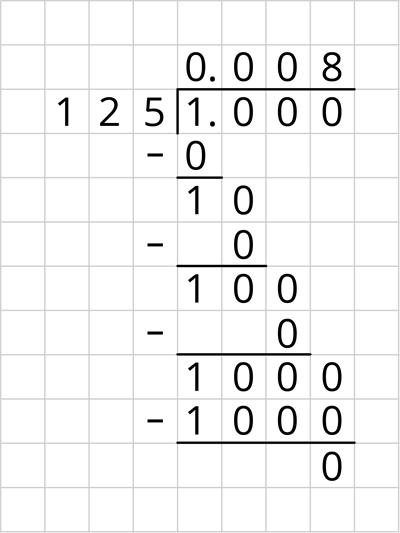 |
Terminating decimals | |
 |
Recurring and non-terminating decimals |
Thus, it can be concluded as follows:
A rational number can have either a terminating decimal expansion or a non-terminating recurring decimal expansion.
Predicting the type of decimal expansion:
The decimal expansion of a rational number \(\frac{p}{q}\), where \(q \neq 0\) in its lowest form will be terminating when the prime factors of \(q\) are only \(2\) or only \(5\) or both \(2\) and \(5\).
Example:
The decimal expansion of \(\frac{2}{5}\) will terminate as the denominator has the prime factor \(5\).
The value of \(\frac{2}{5} = 0.4\)
Converting a decimal number to fractional form:
Case - (I): The decimal expansion is purely repeating.
Step - 1: Consider the given decimal number as \(x\).
Step - 2: Multiply \(x\) by \(10^{n}\) where \(n\) is the number of repeating digits.
Step - 3: Subtract the original number from the number obtained from step 2, then solve for \(x\).
Example:
Convert the decimal number \(0.\overline{41}\) in the form of \(\frac{p}{q}\).
Explanation:
Let us take the provided number as \(x\).
That is, \(x = 0.\overline{41}\)
Note that, in the number \(x\) two digits repeat. So, let us multiply \(x\) by \(10^{2} =100\).
\(100x = 41.\overline{41}\)
Subtract \(x\) from \(100x\),
\(100x - 1x = 41.\overline{41} - 0.\overline{41}\)
\(99x = 41\)
\(x = \frac{41}{99}\)
Thus, it is a rational number as it is in \(\frac{p}{q}\) form where \(p\) and \(q\) are integers and .
Therefore, the fractional form of the rational number \(0.\overline{41}\) is \(\frac{41}{99}\).
Explanation:
Let us take the provided number as \(x\).
That is, \(x = 0.\overline{41}\)
Note that, in the number \(x\) two digits repeat. So, let us multiply \(x\) by \(10^{2} =100\).
\(100x = 41.\overline{41}\)
Subtract \(x\) from \(100x\),
\(100x - 1x = 41.\overline{41} - 0.\overline{41}\)
\(99x = 41\)
\(x = \frac{41}{99}\)
Thus, it is a rational number as it is in \(\frac{p}{q}\) form where \(p\) and \(q\) are integers and .
Therefore, the fractional form of the rational number \(0.\overline{41}\) is \(\frac{41}{99}\).
Case - (II): The decimal expansion is general repeating.
Step - 1: Consider the given decimal number as \(x\).
Step - 2: Multiply \(x\) by \(10^{m}\) where \(m\) is the number of non-repeating digits.
Step - 3: Multiply \(x\) by \(10^{n}\) where \(n\) is the number of repeating digits.
Step - 4: Subtract the numbers obtained from previous two steps and solve for \(x\).
Example:
Convert the decimal number \(1.2\overline{39}\) in the form of \(\frac{p}{q}\)
Explanation:
Let us take the provided number as \(x\).
That is \(x = 1.2\overline{39}\)
Note that, in the number \(x\) only one digit is non-repeating. So, let us multiply \(x\) by \(10^{1} = 10\).
\(10x = 12.\overline{39}\)
Now, the number \(12.\overline{39}\) has two repeating digits. So, let us multiply \(10x\) by \(10^{2} = 100\).
\(1000x = 1239.\overline{39}\)
Subtract \(10x\) from \(1000x\),
\(1000x - 10x = 1239.\overline{39} - 12.\overline{39}\)
\(990x = 1227\)
\(x =\) \(\frac{1227}{990}\)
Therefore, the fractional form of the rational number \(1.2\overline{39}\) is \(\frac{409}{330}\).
Let us take the provided number as \(x\).
That is \(x = 1.2\overline{39}\)
Note that, in the number \(x\) only one digit is non-repeating. So, let us multiply \(x\) by \(10^{1} = 10\).
\(10x = 12.\overline{39}\)
Now, the number \(12.\overline{39}\) has two repeating digits. So, let us multiply \(10x\) by \(10^{2} = 100\).
\(1000x = 1239.\overline{39}\)
Subtract \(10x\) from \(1000x\),
\(1000x - 10x = 1239.\overline{39} - 12.\overline{39}\)
\(990x = 1227\)
\(x =\) \(\frac{1227}{990}\)
Therefore, the fractional form of the rational number \(1.2\overline{39}\) is \(\frac{409}{330}\).