

Fundamental Definitions:
Lines & Parts: A line extends infinitely in both directions; a line segment has two endpoints; a ray has one endpoint.
Points: Collinear points lie on the same line; non-collinear points do not.
Angles: Formed by two rays (arms) meeting at a vertex.
Types:
- Acute \( ( < 90^{\circ})\)
- Right \((90^{\circ})\)
- Obtuse \(( > 90^{\circ}\) and \(< 180^{\circ})\)
- Straight \((180^{\circ})\)
- Reflex \(( > 180^{\circ})\).
Pairs:
- Complementary \((\text{sum to}\) \(90^{\circ})\)
- Supplementary \((\text{sum to}\) \(180^{\circ})\).
Intersections: Parallel lines never meet. Transversal lines intersect two or more lines at unique points.
Linear Pair Axioms:
These axioms define the relationship between adjacent angles on a straight line:
- Axiom 1: If a ray stands on a line, the sum of the two adjacent angles is \(180^{\circ}\).
- Axiom 2 (Converse): If the sum of two adjacent angles is \(180^{\circ}\), then their non-common arms form a straight line.
Theorem : Vertically Opposite Angles
When two lines intersect, the angles opposite each other at the vertex are equal.
Lines Parallel to the Same Line
If two lines are each parallel to a third line, they are parallel to each other (Transitivity of parallel lines).
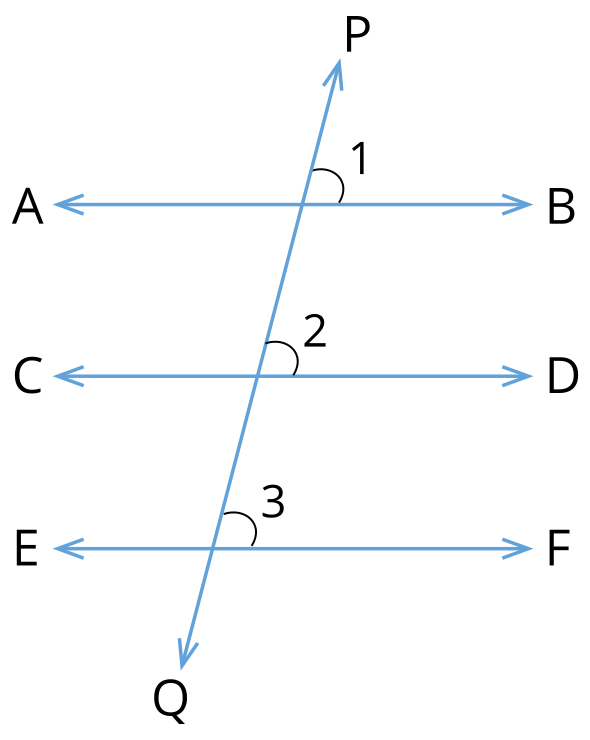
Proof Strategy:
Draw a transversal \(PQ\) across lines \(AB, CD,\) and \(EF\).
- If \(AB \parallel CD\), then corresponding angles \(\angle 1 = \angle 2\).
- If \(AB \parallel EF\), then \(\angle 1 = \angle 3\).
- Therefore, \(\angle 2 = \angle 3\).
- By the Converse of the Corresponding Angles Axiom, since the corresponding angles are equal, \(CD \parallel EF\).