


Prove that the diagonals of a square are equal and bisect each other at right angles.
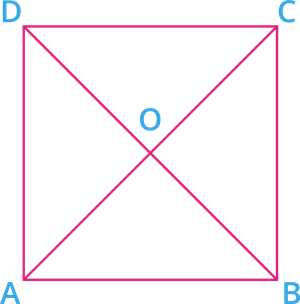
Proof: In \(\Delta ABC\) and \(\Delta DCB\):
\(AB = CD\) [Sides of square are equal]
\(\angle ABC = \angle DCB\) [Angles of square are \(90^\circ\)]
\(BC = BC\) [Common side]
\(AB = CD\) [Sides of square are equal]
\(\angle ABC = \angle DCB\) [Angles of square are \(90^\circ\)]
\(BC = BC\) [Common side]
Thus, by congruence rule, \(\Delta ABC \cong \Delta DCB\)
\(AC =\) [by CPCT] - - - - - (I)
Hence, the diagonals of a square are equal.
We know that, "square is also a parallelogram".
Diagonals of a parallelogram bisect each other.
We know that, "square is also a parallelogram".
Diagonals of a parallelogram bisect each other.
Thus, \(AO = OC\) and \(OB =\) - - - - (II)
Now, in \(\Delta AOD\) and \(\Delta COD\):
\(AD = CD\) [Sides of square are equal]
\(OA = OC\) [Using (II)]
\(OD = OD\) [Common side]
\(AD = CD\) [Sides of square are equal]
\(OA = OC\) [Using (II)]
\(OD = OD\) [Common side]
Thus, by congruence rule, \(\Delta AOD \cong \Delta BOC\)
\(\Rightarrow \angle AOD = \angle COD\) [by CPCT] - - - - - (III)
Sum of the adjacent angles in a straight line is \(180^\circ\).
\(\Rightarrow \angle AOD + \angle COD = 180^\circ\)
Sum of the adjacent angles in a straight line is \(180^\circ\).
\(\Rightarrow \angle AOD + \angle COD = 180^\circ\)
\(\Rightarrow \angle AOD + \angle\) \(= 180^\circ\) [Using equation (III)]
By simplification, we get
\(\Rightarrow \angle AOD = 90^\circ\)
Thus, \(\angle AOD = \angle COD = 90^\circ\)
Vertically opposite angles are equal.
So, \(\angle AOD = \angle COD = \angle BOC = \angle AOB = 90^\circ\)
Hence, the diagonals bisect each other at right angles.
\(\Rightarrow \angle AOD = 90^\circ\)
Thus, \(\angle AOD = \angle COD = 90^\circ\)
Vertically opposite angles are equal.
So, \(\angle AOD = \angle COD = \angle BOC = \angle AOB = 90^\circ\)
Hence, the diagonals bisect each other at right angles.