

For studying a city’s rainfall trend, meteorologists gathered July’s daily rainfall data (in
\(
mm\)) and classified it into the following class intervals.
| Rainfall range (\(mm\)) | Number of days |
| \(0 - 10\) |
\(6\)
|
| \(10 - 20\) | \(9\) |
| \(20 - 30\) | \(10\) |
| \(30 - 40\) | \(3\) |
| \(40 - 50\) | \(2\) |
The frequency polygon is represented by plotting the class marks against the frequencies and connecting the points with straight lines.
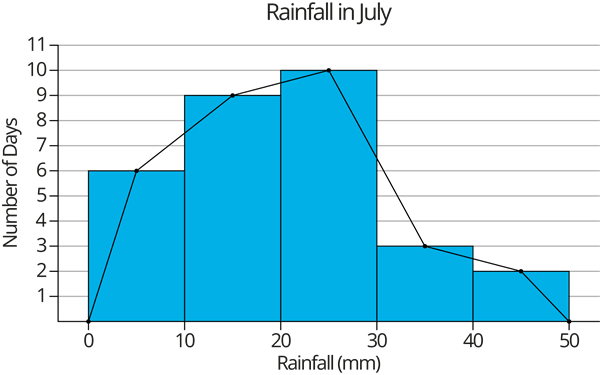
Based on the given data, answer the following.
1. What is the class mark in (\mm\) of the rainfall interval 40 \(-\) 50 \(mm\)?
2. Which rainfall interval has the highest frequency?
3. How many days of rainfall has been recorded totally?
4. From the frequency polygon, what is your interpretation of the pattern of rainfall in July?