

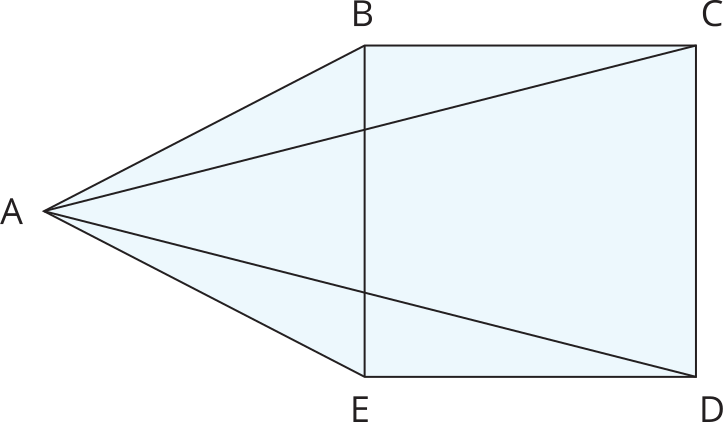
In the figure, \(BCDE\) is a square, and \(ABE\) is an equilateral triangle. Prove that \(AD = AC\).
Proof:
Since \(ABE\) is an triangle, all sides and all angles of \triangle ABE are equal.
That is, \(AB = BE = \) \(\longrightarrow (1)\)
Also, \(\angle AEB = \angle EBA = \angle\) \(\longrightarrow (2)\)
We also know that is a square, and in a square all sides and angles are equal.
That is, \(DE = EB = BC = CD \longrightarrow (3)\)
Similarly, \(\angle DEB = \angle \) \(= \angle BCD = \angle CDE \longrightarrow (4)\)
Now, let us try to prove that \(AD = AC\).
For that matter, we should consider the triangles \(AED\) and \(ABC\).
\(\angle AED = \angle AEB + \angle BED\)
\(= \angle ABE + \angle EBC\) [From \((2)\) and \((4)\)]
\(= \angle ABC\)
That is, \(\angle AED = \angle ABC\)
Also, \(AE = AB\) [From \((1)\)]
Similarly, \(DE = BC\) [From \((3)\)]
Here, two pairs of corresponding sides and one pair of corresponding angles are equal.
Thus by SAS congruence criterion, \(\triangle AED \cong \triangle ABC\).
Since \(\triangle AED \cong \triangle ABC\), and by CPCT, \(AD = AC\).
For that matter, we should consider the triangles \(AED\) and \(ABC\).
\(\angle AED = \angle AEB + \angle BED\)
\(= \angle ABE + \angle EBC\) [From \((2)\) and \((4)\)]
\(= \angle ABC\)
That is, \(\angle AED = \angle ABC\)
Also, \(AE = AB\) [From \((1)\)]
Similarly, \(DE = BC\) [From \((3)\)]
Here, two pairs of corresponding sides and one pair of corresponding angles are equal.
Thus by SAS congruence criterion, \(\triangle AED \cong \triangle ABC\).
Since \(\triangle AED \cong \triangle ABC\), and by CPCT, \(AD = AC\).