

Answer variants:
[Since they are alternate angles]
\(\frac{AO}{BO} = \frac{CO}{DO}\)
\(\angle AOB \sim \triangle COD\)
\(\angle DCO\)
\(\angle ODC\)
\(\frac{CO}{DO}\)
\(\frac{BO}{DO}\)
[Since corresponding sides of similar triangles]
\(\triangle ABC\) and \(\triangle COD\)
\(ABCD\) is a trapezium. Here, the sides \(AB\) and \(CD\) are parallel to each other. Also, the diagonals intersect at \(O\). Prove that \(\frac{AO}{BO} = \frac{CO}{DO}\).
Let us look at the figure given below for a better understanding.
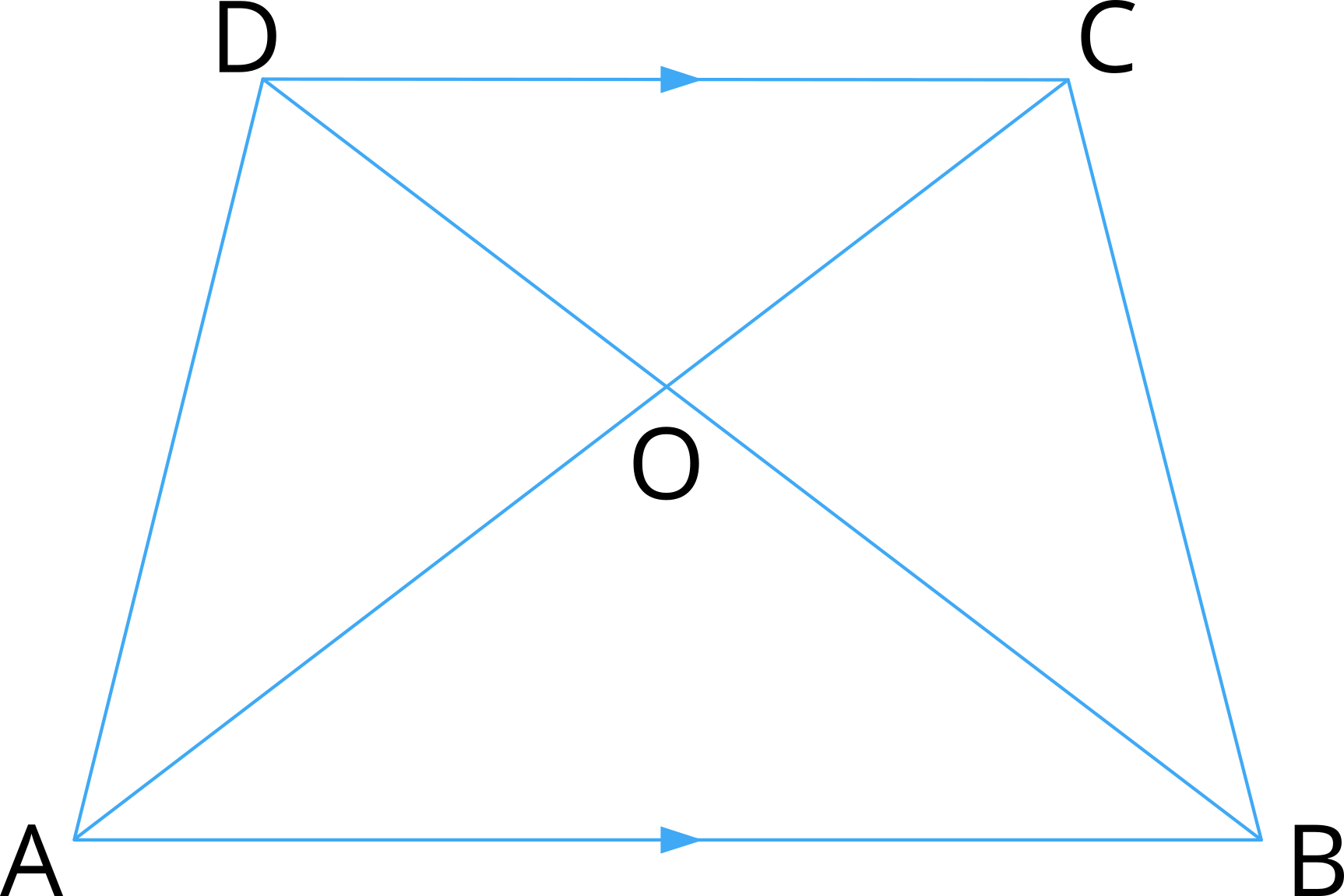
We already know that in , \(AB\) is parallel to \(CD\). [Given]
This makes, \(\angle OAB\) \(=\) , and \(\angle OBA\) \(=\) .
By similarity criterion, we have, "If two angles of one triangle are respectively equal to two angles of another triangle, then the two triangles are similar."
Thus, .
Also, \(\frac{AO}{CO}\) \(=\) which can also be written as \(\frac{AO}{BO}\) \(=\) .
Hence, the required condition is proved.