

Cuboid:
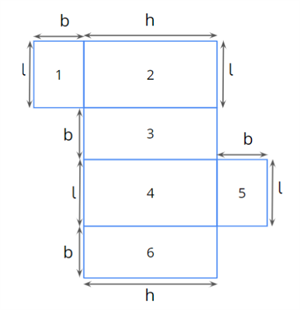
\(\text{The total surface area of the cardboard box}\) \(=\) \(\text{Area}\) \(1\) \(+\) \(\text{Area}\) \(2\) \(+\) \(\text{Area}\) \(3\) \(+\) \(\text{Area}\) \(4\) \(+\) \(\text{Area}\) \(5\) \(+\) \(\text{Area}\) \(6\)
\(= (l \times b) + (l \times h) + (b \times h) + (l \times h) + (l \times h) + (l \times b) + (b \times h)\)
\(= 2 \times [(l \times b) + (l \times h) + (b \times h)]\)
\(= 2 \times (lb + lh + bh)\)
In other words, \(\text{The total surface area of a cuboid} = 2(lb + lh + bh)\)
TOTAL SURFACE AREA OF A CYLINDER:
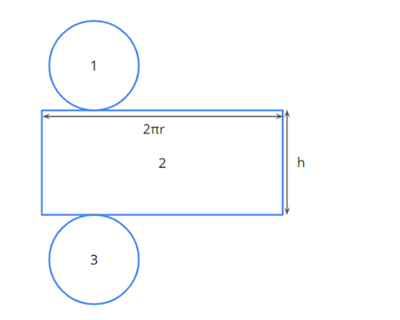
\(\text{The total surface area of a cylinder}\) \(=\) \(\text{Area}\) \(1\) \(+\) \(\text{Area}\) \(2\) \(+\) \(\text{Area}\) \(3\)
\(= \pi r^2 + 2\pi rh + \pi r^2\)
[Since \(\text{Area}\) \(1\) and \(\text{Area}\) \(3\) are circles]
\(= 2\pi r^2 + 2\pi rh\)
\(= 2\pi r(r + h)\)
Let us now look at the lateral surface of the cylinder.
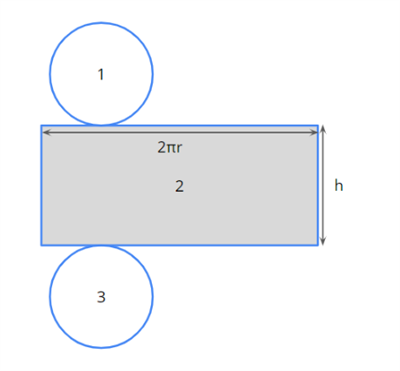
The shaded portion forms the lateral surface of the cylinder.
\(\text{The lateral (or curved) surface area of a cylinder}\) \(=\) \(\text{Area}\) \(2\) \(=\) \(2\pi rh\)
Cone:
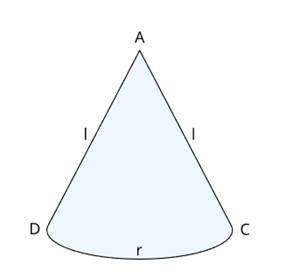
Let \(r\) be the radius and \(l\) be the arc length.
C. S. A. \(=\) \(\frac{\text{Arc length of the sector}}{\text{Circumference of the circle}} \times \text{Area of the circle}\)
\(=\)
\(=\) \(\pi r l\)
Curved surface area of a cone \(=\) \(\pi r l\) sq. units
where \(r\) \(=\) radius of the base of the cone
\(l\) \(=\) slant height of the cone
Right circular cone:
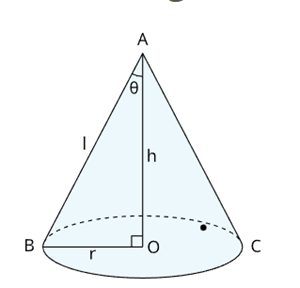
\(AOB\) is a right-angled triangle, right-angled at \(O\).
Using Pythagoras theorem:
\(\text{Hypotenuse}^2 = \text{Base}^2 + \text{Height}^2\)
\(AB^2 = BO^2 + AO^2\)
\(l^2 = r^2 + h^2\)
Slant height \(l = \sqrt{r^2 + h^2}\) units
T. S. A. \(=\) Curved surface area \(+\) Area of the base
\(=\) \(\pi r l\) \(+\) \(\pi r^2\)
\(=\) \(\pi r(l + r)\)
Total surface area of a cone \(=\) \(\pi r(l + r)\) sq. units
Sphere:
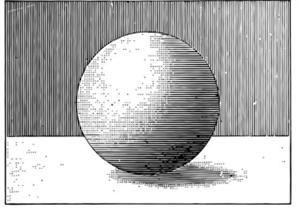
Surface area of a sphere \(=\) \(4 \ \times\) Area of a circle
\(=\) \(4 \times \pi r^2\)
Surface area of a sphere \(=\) \(4 \pi r^2\) sq. units
Important!
Area of the circle \(=\) \(\pi r^2\) sq. units
Hemisphere:
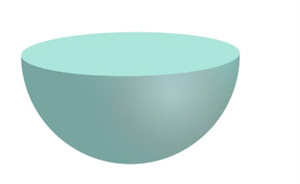
C. S. A. \(=\) \(\frac{\text{Surface area of a sphere}}{2}\)
\(=\)
\(=\) \(2 \pi r^2\) sq. units
Therefore, curved surface area of a hemisphere \(=\) \(2 \pi r^2\) sq. units.
T. S. A. \(=\) Curved surface area of a hemisphere \(+\) Area of the top region
\(=\) \(2 \pi r^2\) \(+\) \(\pi r^2\)
\(=\) \(3 \pi r^2\) sq. units
Therefore, Total surface area of a hemisphere \(=\) \(3 \pi r^2\) sq. units.