

Cuboid:
We know that a cuboid is a rectangular solid with six rectangular faces. It also has three dimensions, namely length, breadth, and height.
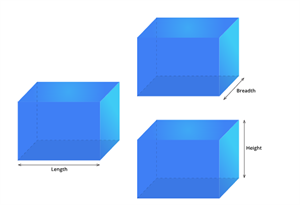
The product of all three dimensions of a cuboid is its volume.
Therefore, \(\text{The volume of a cuboid} = \text{Length} \times \text{Breadth} \times \text{Height}\).
It can also be written as \(\text{The volume of a cuboid} = \text{Area of the base} \times \text{Height}\).
[Since, \(\text{Area of the base} = \text{Length} \times \text{Breadth}\)]
Cylinder:
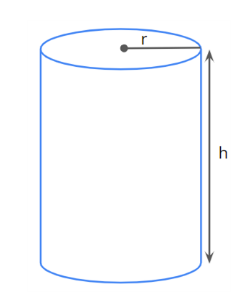
Volume of a right circular cylinder:
Let \('r'\) be the base radius, and \('h'\) be the height of the cylinder.
Volume \(=\) Base area \(\times\) Height cu. units
Volume \(=\) Area of circle\(\times\) Height cu. units
Volume \(=\) \(\pi r^2 \times h\) \(=\) \(\pi r^2 h\) cu. units
Cone:
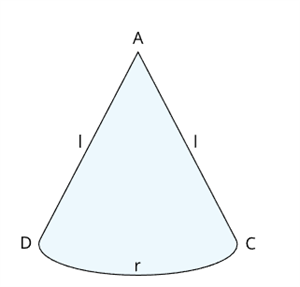
Let \('r'\) be the radius, and \('h'\) be the height of the cone.
Volume of a cone \(=\) \(\frac{1}{3}\) \(\times\) Volume of a cylinder
Volume of a cone \(=\) \(\frac{1}{3}\) \(\pi r^2 h\) cu. units
Sphere:
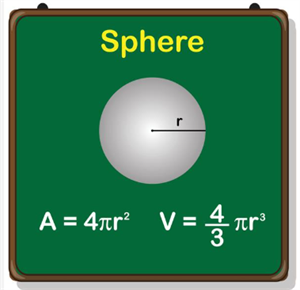
Let \(r\) be the radius of a sphere.
Volume of a sphere \(= \frac{4}{3}πr^3\) cu. units
Hemisphere:
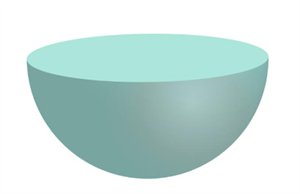
Let \(r\) be the radius of a hemisphere.
Volume of a hemisphere \(=\) \(\frac{2}{3} pi r^3\) cu. units