

Kindly check out the below video to learn about the concept of tangents and circles. Watch the video till the end to complete the task.
Let us discuss some situations when a circle and a line intersect.
Situation 1: The line \(AB\) does not touch the circle.
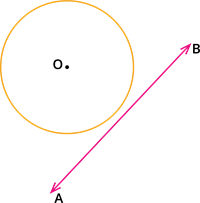 |
Here, there is no common point between the straight line \(AB\) and the circle.
Therefore, the number of points of intersection is zero.
Situation 2: The line \(AB\) touches the circle at one point.
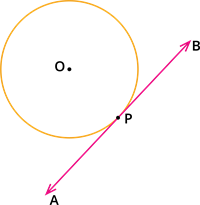 |
Here, there is one common point \(P\) between the straight line \(AB\) and the circle.
The line \(AB\) is called the tangent to the circle at \(P\).
Therefore, the number of points of intersection is one.
Situation 3: The line \(AB\) touches the circle at two points.
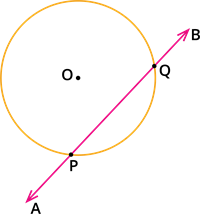 |
Here, there are two common points \(P\) and \(Q\) between the straight line \(AB\) and the circle.
The line \(AB\) is called the secant of the circle.
Therefore, the number of points of intersection is two.
Statement 1:
The tangent at any point of a circle is perpendicular to the radius through the point of contact.
Proof for the theorem:
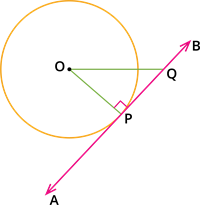
Consider a circle with centre \(O\).
Let \(AB\) be the tangent to the circle at the point \(P\).
To prove:
The line \(OP\) is perpendicular to \(AB\).
Proof:
Take a point \(Q\) other than \(P\) on the tangent \(AB\) and join \(OQ\).
Here, \(Q\) must lie outside the circle.
Thus, \(OQ\) is longer than \(OP\).
That is \(OQ\) \(>\) \(OP\) at every point on \(AB\) except at \(P\).
Therefore, the point \(P\) is at the shortest distance from the centre \(O\).
We know that:
Out of all the line segments, drawn from a point to points of a line not passing through the point, the smallest is the perpendicular to the line.
By the theorem, \(OP\) is perpendicular to \(AB\).
Hence, the proof.
Example:
In the above given figure if \(OP\) \(=\) \(3\) \(cm\) and \(PQ\) \(=\) \(4\) \(cm\), find the length of \(OQ\).
Solution:
By the result, \(\angle OPQ\) \(=\) \(90^{\circ}\).
So, \(OPQ\) is a right angled triangle.
By the Pythagoras theorem, we have:
In a right triangle, the square of the hypotenuse is equal to the sum of the squares of the other two sides.
\(OQ^2\) \(=\) \(OP^2\) \(+\) \(PQ^2\)
\(OQ^2\) \(=\) \(3^2\) \(+\) \(4^2\)
\(OQ^2\) \(=\) \(9 + 16\)
\(OQ^2\) \(=\) \(25\)
\(\Rightarrow\) \(OQ\) \(=\) \(\sqrt{25}\)
\(OQ\) \(=\) \(5\)
Therefore, the measure of \(OQ\) \(=\) \(5\) \(cm\)
Statement 2:
The lengths of tangents drawn from an exterior point to a circle are equal.
Proof for the theorem:
Consider a circle with centre \(O\).
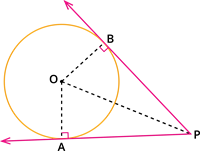
Let \(PA\) and \(PB\) be the two tangents drawn from the external point \(P\) to the circle.
Construction:
Join \(OA\), \(OB\) and \(OP\).
To prove:
The tangent \(PA\) \(=\) The tangent \(PB\)
Proof:
By the theorem \(1\), we have:
The tangent at any point of a circle is perpendicular to the radius through the point of contact.
\(OB\) \(\perp\) \(PB\) and \(OA\) \(\perp\) \(PA\).
Here, \(OA\) and \(OB\) are radius. Hence, they are equal.
The side \(OP\) is a common side to the triangles \(AOP\) and \(BOP\).
Therefore, by the RHS rule (In two right-angled triangles, if the length of the hypotenuse and one side of one triangle is equal to the length of the hypotenuse and corresponding side of the other triangle, then the two triangles are congruent.), the triangles \(AOP\) and \(BOP\) are congruent.
We know that the corresponding parts of the congruent triangles are equal.
Therefore, \(PA = PB\).
Example:
In the above given figure if \(OB\) \(=\) \(3\) \(cm\) and \(OP\) \(=\) \(5\) \(cm\), find the length of \(PA\).
Solution:
By the theorem \(1\), we have:
A tangent at any point on a circle and the radius through the point are perpendicular to each other.
\(\angle OPB\) \(=\) \(90^{\circ}\).
So, \(OPB\) is a right angled triangle.
By the Pythagoras theorem, we have:
In a right triangle, the square of the hypotenuse is equal to the sum of the squares of the other two sides.
\(OP^2\) \(=\) \(OB^2\) \(+\) \(PB^2\)
\(PB^2\) \(=\) \(OP^2\) \(-\)\(OB^2\)
\(PB^2\) \(=\) \(5^2\) \(-\) \(3^2\)
\(PB^2\) \(=\) \(25 - 9\)
\(PB^2\) \(=\) \(16\)
\(\Rightarrow\) \(PB\) \(=\) \(\sqrt{16}\)
\(PB\) \(=\) \(4\)
Thus, the measure of \(PB\) \(=\) \(4\) \(cm\)
By the theorem \(2\), we have:
The lengths of the two tangents drawn from an exterior point to a circle are equal.
Hence, \(PA\) \(=\) \(PB\).
Therefore, the measure of \(PA\) \(=\) \(4\) \(cm\)
Important!
In the above given figure, \(\angle OPA\) \(=\) \(\angle OPB\) where \(OP\) is the angle bisector of \(\angle APB\).