

Kindly check out the below video to learn about applications of trigonometry. Watch the video till the end to complete this task.
In the previous session, we learnt how to find the solution using trigonometric ratios. In this session, let us learn how to find the heights and distances of objects by applying trigonometric ratios. The process of finding heights and distances is the best example of applying trigonometry in real-life situations. Now, let us learn some basic definitions.
Line of sight
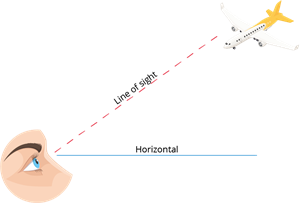
The line of sight is defined as the straight line drawn from the eye of an observer to the object viewed by the observer.
Theodolite

Theodolite is an instrument used to measure the angle between an object and the eye of the observer. It consists of two wheels placed at right angles to each other and a telescope. The angle between the object and the observer's eye is determined by placing the telescope towards the object, thus reading the angle using the telescope scale.
Angle of elevation
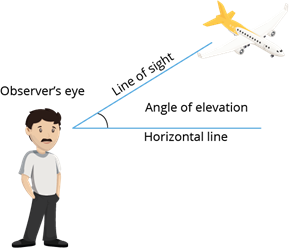
The angle of elevation is defined as the angle formed by the line of sight and the horizontal line when the point being viewed is above the horizontal level.
That is the case when we raise our heads to look at the object.
Angle of depression
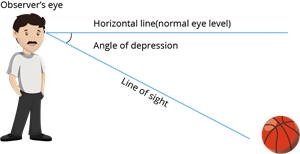
The angle of depression is defined as the angle formed by the line of sight with the horizontal line when the point being viewed is below the horizontal level.
That is the case when we lower our heads to look at the object.
Let us learn real-life situations based on the angle of elevation.
Example:
The altitude of the plane from point \(C\) on the ground is \(1500 \ m\). If the angle of elevation of the person from point \(A\) is \(60^{\circ}\), then find the distance of the person from point \(A\) to \(C\).
Solution:
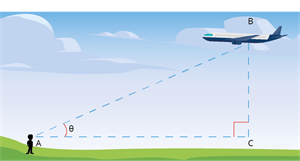
Let \(A\) be the position of the person, \(B\) be the position of the airplane, and \(C\) be the point.
Then, from the given data, we have:
\(\theta = 60^{\circ}\) and \(BC = 1500 \ m\)
In the right triangle \(ACB\), we have:
\(tan \ \theta = \frac{BC}{AC}\)
\(tan \ 60^{\circ} = \frac{1500}{AC}\)
\(AC = \frac{1500}{tan \ 60^{\circ}}\)
\(AC = \frac{1500}{\sqrt{3}}\)
\(AC = 500\sqrt{3}\)
Therefore, the distance between the points \(A\) and \(C\) is \(500\sqrt{3} \ m\).