

Statement:
There is one and only one circle passing through three non-collinear points.
Proof of the theorem:
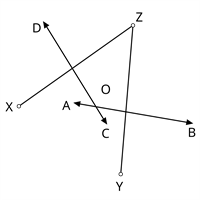
Consider three non-collinear points \(X\), \(Y\) and \(Z\).
Draw two line segments joining the points \(XZ\) and \(YZ\).
Now draw two perpendicular bisectors \(CD\) and \(AB\) of the lines \(XZ\) and \(YZ\) respectively such that they intersect at the point \(O\).
It is known that, every point on the perpendicular bisector of a line segment is equidistant from its end points.
Here the point \(O\) lies on the perpendicular bisector \(CD\) of a line segment \(XZ\). Hence \(O\) is equidistant from \(X\) and \(Z\).
Thus, \(OX\) \(=\) \(OZ\).
Similarly, the point \(O\) lies on the perpendicular bisector \(AB\) of a line segment \(YZ\). Hence \(O\) is equidistant from \(Y\) and \(Z\).
Thus, \(OY\) \(=\) \(OZ\).
\(\Rightarrow\) \(OX\) \(=\) \(OY\) \(=\) \(OZ\).
This implies that the points \(X\), \(Y\) and \(Z\) are at equidistance from the point \(O\).
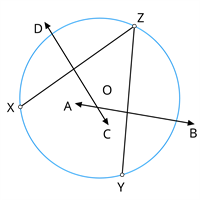
So, any circle drawn with centre \(O\) passing through one of the points \(X\), \(Y\) and \(Z\) passes through other two points also.
Therefore, only one circle is drawn through the three points \(X\), \(Y\) and \(Z\) as shown below.
Important!
By the theorem, the unique circle passing through the three vertices of any triangle is called the circumcircle of that triangle. And its corresponding centre is called the circumcentre and radius is called the circumradius of the triangle.
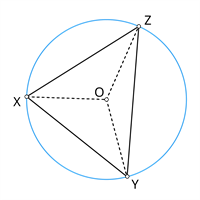
In the figure, \(XYZ\) is a triangle.
The circle through the vertices \(X\), \(Y\) and \(Z\) is the circumcircle of the triangle.
\(O\) is the circumcentre and \(OX = OY = OZ\) is the circumradius.