Discuss the method to find the rational number between any two rational numbers.
Method 1: [Average method]
- Let the rational number be \(a\) and \(b\).
- Add \(a\) and \(b\) and divide the sum by \(2\). That is, \((a+b)/2\) which might lie in between those two number.
- To get another rational number, find the average of \(c\) and \(a\), for one more rational number, find the average of \(c\) and \(b\). In this way, you can find the infinite number of irrational between two rational numbers.
Method 2: [Same denominator method]
This method gives all the required number of rational numbers between \(a\) and \(b\) in one step.
If we want to find \(n\) rational numbers between the numbers \(a\) and \(b\), we write \(a\) and \(b\) as rational numbers with denominator \(n + 1\). That is, make it as . Now you can verify that the numbers between and are all rational numbers between \(a\) and \(b\).
Example:
Let the rational numbers be \(6\) and \(7\). Now follow the steps to find the rational numbers.
Add the rational numbers \(6\) and \(7\) and divide the sum by \(2\).
That is .
Now let's use the second method to find the set of four rational between the numbers \(6\) and \(7\).
Here \(a = 6, b = 7\) and \(n = 4\).
Substituting the known values, we will have
and .
Thus the number between \(30/5\) and \(35/5\) are \(31/5, 32/5, 33/5\) and \(34/5\).
Therefore, the four rational numbers are \(31/5, 32/5, 33/5\) and \(34/5\).
Important!
In the same way, we can find as many rational numbers between two rational numbers. Thus, there are infinitely many rational numbers between any two given rational numbers.
Rational number \(Q\) does not have a unique representation in the form of \(p/q\).
. These are called an equivalent rational number.
Study the following real number line.
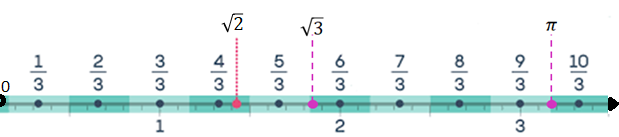
It can be observed from the number line that there are numbers that are not rationals (, , , etc.). Let's discuss such kind of numbers.
And so far, all the numbers you have come across are of the form \(p/q\), where \(p\) and \(q\) are integers and . But there are some numbers which cannot be expressed in \(p/q\) form. We are going to discuss such kind of numbers.
The Pythagoreans in Greece was the first to discover the numbers which were not rational, around \(400 BC\). These numbers are called an irrational number.
An irrational number is a number that cannot be expressed as a fraction \(p/q\), where for any integers \(p\) and \(q\).
Irrational numbers have decimal expansions that neither terminate nor become periodic.
Irrational numbers have decimal expansions that neither terminate nor become periodic.
Important!
As there are infinitely many rationals, so there are infinitely many irrational numbers too.
Some of the irrationals are as follows:
Example:
\(= 1.4142135623730950488…\)
\(= 1.7320508075688772935…\)
\(= 2.23606797749978969…\)
\(= 3.1415926535897932384626433...\)
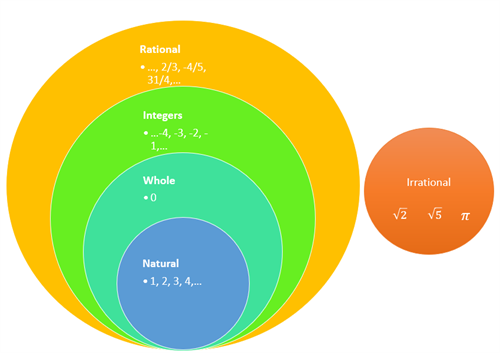
Here come the pictorial forms of the classification of numbers: