

Theorem \(2\)
Angles opposite to equal sides of an isosceles triangle are equal.
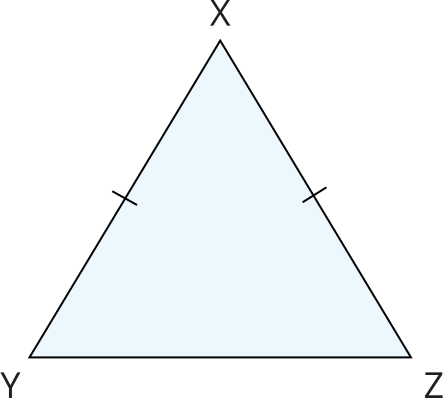
Let us bisect \(\angle YXZ\) such that the bisector meets \(YZ\) at \(O\) as given in the figure below.
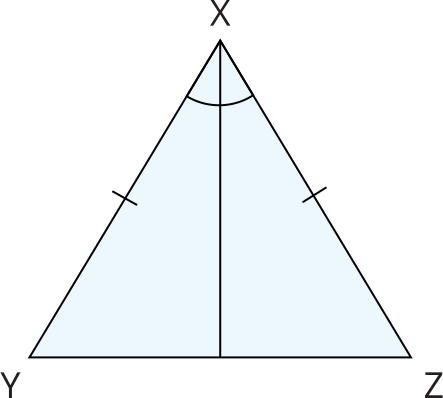
Now, we should prove that \(\angle XYO = \angle XZO\).
We know that, \(XY = XZ\) [Given]
Also considering figure \(2\), \(\angle YXO = \angle ZXO\) [Bisected angle]
\(OX\) is common to both \(\triangle XYO\) and \(\triangle XZO\). [Also, from figure \(2\)]
Thus, by SAS congruence criterion, \(\triangle XYO \cong \triangle XZO\).
Therefore, \(\angle XYO = \angle XZO\).
Hence the theorem is proved.
Theorem \(3\)
The sides opposite to equal angles of a triangle are equal.
Let us consider the figure given below.
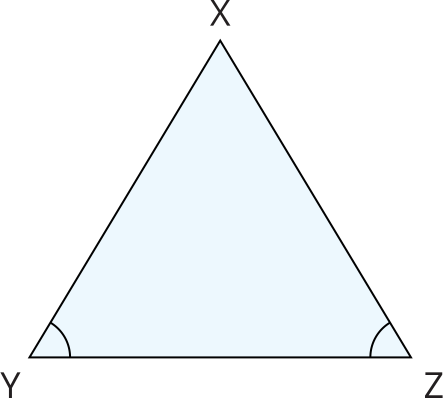
Here, \(\angle XYZ = \angle XZY\).
We should prove that \(XY = XZ\).
Let us bisect \(\angle YXZ\) such that the bisector meets \(YZ\) at \(O\) as given in the figure below.
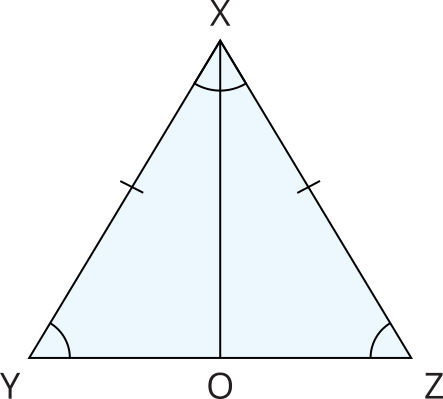
Let us consider the two triangles XYO and XZO.
\(\angle XYO = \angle XZO\) [Given]
\(\angle YXO = \angle ZXO\) [Bisected angle from figure \(2\)]
Also, \angle XOY = \angle XOZ
[By angle sum property of a triangle]
Here, \(\angle XYO = \angle XZO\), \(\angle YXO = \angle ZXO\), and \(OX\) is common to both \(\triangle XYO\) and \(\triangle XZO\).
Thus, by ASA congruence criterion, \(\triangle XYO \cong \triangle XZO\).
Therefore, \(XY = XZ\).
Hence, the theorem is proved.