

Matrix:
A matrix is a rectangular array of elements represented in the form of horizontal rows and vertical columns.
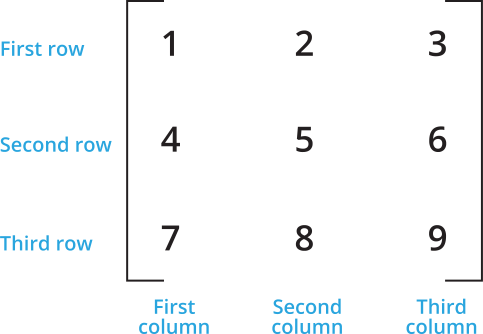
Order of a matrix:
The order of any matrix is given by (Number of rows) × (Number of column).
Types of matrix:
1. Row matrix
A matrix is a row matrix when it is made up of just one row and '\(n\)' number of columns. Row matrices are also called row vectors. The order of the matrix is \(1 \times n\).
2. Column matrix
A matrix is a column matrix comprised of '\(m\)' rows and just one column. Column matrices are also called column vectors. The order of the matrix is \(m × 1\).
3. Square matrix
A matrix is a square matrix when the number of rows equals the number of columns. In other words, \(m = n\). The order of a square matrix is \(m\).
4. Diagonal matrix
In a square matrix, when all the entries except the leading diagonal is zero, then it is called a diagonal matrix. In other words, \(aij = 0 for i ≠ j\).
5. Scalar matrix
In a square matrix, when all the elements of the leading diagonal is the same, then it is a scalar matrix
6. Identity or unit matrix
In a square matrix, when all the leading diagonal elements are \(1\), then it is an identity matrix or a unit matrix.
7. Zero matrix or null matrix
A matrix is a zero matrix or a null matrix when all the matrix elements are zero.
8. Transpose of a matrix
If the order of matrix \(A\) is m×n, then the order of \(A^T\) is \(n×m\).
The transpose of a matrix is obtained by interchanging the elements in the rows and columns. The transpose of a matrix is denoted by \(A^T\), and \(A^T\) is read as 'A transpose'.
If the order of matrix \(A\) is m×n, then the order of \(A^T\) is \(n×m\).
9. Triangular matrix
If all the entries above the leading diagonal are zero in a square matrix, then it is a lower triangular matrix. If all the entries below the leading diagonal are zero, then it is an upper triangular matrix.
Basic concepts:
Equal matrix:
If two matrices \(A\) and \(B\) are equal, they should satisfy the following conditions.
a. Both the matrices should have the same order.
b. Each element of matrix A be equal to the corresponding elements in matrix B. In other words, \(a_ij = b_ij\) for all values of \(i\) and \(j\).
b. Each element of matrix A be equal to the corresponding elements in matrix B. In other words, \(a_ij = b_ij\) for all values of \(i\) and \(j\).
The negative of a matrix:
When we replace every element of \(A\) by its additive inverse, we get the negative of matrix \(A\).
a. Every element of \(–A\) is the negative of the corresponding element of \(A\).
b. The negative of matrix \(A_{m×n}\) is denoted by \(−A_{m×n}\).
Operations on matrices:
1. Addition and subtraction of matrices:
- Two matrices can be added or subtracted if they have the same order.
- To add or subtract two matrices, add or subtract the corresponding elements.
2. Multiplication of Matrix by a Scalar:
We can multiply the elements of the given matrix \(A\) by a non-zero number \(k\) to obtain a new matrix \(kA\) whose elements are multiplied by \(k\).
Properties of Matrix Addition and Scalar multiplication:
Let \(A\), \(B\), \(C\) be \(m×n\) matrices and \(p\) and \(q\) be two non-zero scalars (numbers). Then we have the following properties.
| 1. | Commutative property | \(A+B=B+A\) |
| 2. | Associative property |
|
| 3. | Scalar identity for unit matrix | \(IA=A\) |
| 4. | Distributive property |
|
Additive Identity:
The zero matrices are the identity for matrix addition. When a zero matrix (\(O\)) is added to any matrix, say \(A\), the result is always the same matrix \(A\).
Let \(A\) be any matrix. Then, \(A+O=O+A=A\).
Additive Inverse:
If \(A\) be any given matrix then \(–A\) is the additive inverse of \(A\).
Let \(A\) be any matrix. Then, \(A+(−A)=(−A)+A=O\).
Multiplication of matrices:
Matrices are multiplied by multiplying the elements in a row of the first matrix by the elements in a column of the second matrix, then adding the results.
Properties of matrix multiplication:
Let's learn the various properties of multiplication of matrix as follows:
| 1. | Commutative property |
If \(A\) is of order \(m×n\) and \(B\) of the order \(n×p\) then \(AB\) is defined but \(BA\) is not defined. Even if \(AB\) and \(BA\) are both defined, they don't need to be equal.
(i.e.) \(AB≠BA\).
|
| 2. | Associative property |
\((AB)C=A(BC)\)
|
| 3. | Distributive property |
|
| 4. | Multiplication of a matrix by a unit matrix | Consider \(A\) is a square matrix of order \(n×n\) and \(I\) is the unit matrix of the same order then \(AI=IA=A\). |